

Tracing the origins of the engineers' aspirations.
The developers made repeated decisions and took on challenges.
DataSpider's 25-Year Journey
In the ever-evolving IT environment, DataSpider was born in 2001 to flexibly connect diverse systems. We have gathered its creator, Kazutoshi Ono, and other members who have been deeply involved with DataSpider, to look back on its journey, including the thoughts behind its development, its history of evolution, and turning points in the market—stories that can only be shared now, a quarter of a century after its inception.
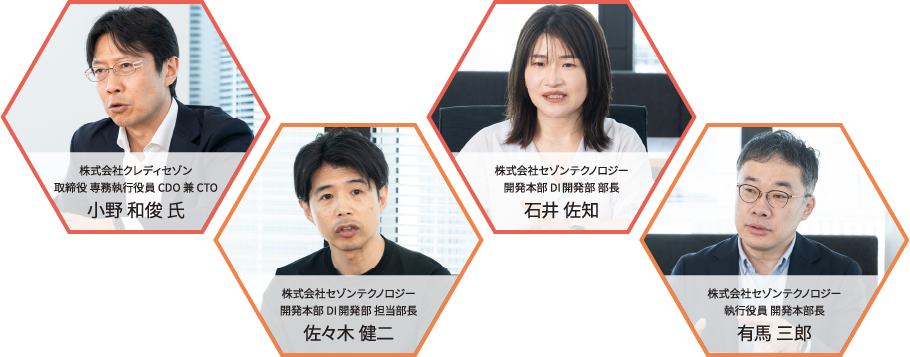
My first experience with DataSpider
First, please tell us about how you got started with DataSpider and how you became involved with it.
- Mr. Ono
-
I started working as CEO at Appresso Co., Ltd. in 2000, developed DataSpider in about six months, and released version 1 in 2001. Despite being the CEO of a venture company, I continued coding until around 2013 when we merged with the former Saison Information Systems. It was a somewhat unusual management style, with the CEO, who was at the top of the organization, working as a lead programmer under the development manager.
I currently work at Credit Saison Co., Ltd., where our generalist staff members use DataSpider Servista in various integrations with Microsoft Power Platform when leveraging self-service BI as citizen developers. As one of the powerful no-code/low-code tools, I am now on the user side within a business company. - Arima
-
I joined the company in 2009 and worked in SI development, but my first encounter with DataSpider was when I applied to join the Technovation Center, which was newly established in April 2016 as an organization directly under the CTO responsible for technology management and quality control. The catalyst was developing an adapter using DataSpider Servista adapter SDK. I remember being impressed when I first encountered it by the elegance of the product's source code and the ingenuity used to achieve high-speed processing.
- Ishii
-
My journey with DataSpider Servista began around 2019 when I was using it for SI development. I was originally a programmer, and I remember being amazed that processes that previously required writing a huge amount of code and repeatedly testing could now be accomplished with drag-and-drop icons. I strongly felt that it was a fantastic piece of software well-suited to the business environment, with its numerous features and extensive operational capabilities. After that, driven by a desire to develop things myself, I moved to the development department through an open recruitment process in 2020, and now I'm the head of the department that handles the development of DataSpider Servista, HULFT Square and other products.
- Sasaki
-
Aside from Mr. Ono, I have the longest history with DataSpider, dating back to 2003. While self-studying Java and XML, I wanted to be involved in software development, and I learned about Appresso Co., Ltd., which was a member company of the XML Consortium that I was active in at the time, and joined the company as a software development engineer. DataSpider was already commercially available, but I was completely unaware of it at the time because I had no prior IT experience. After joining the company, I was consistently involved in the development of DataSpider, but currently I am involved in the development of HULFT Square.
The origin of the DataSpider concept
What are your thoughts on DataSpider now that it's been 25 years since its release?
- Mr. Ono
-
It feels like a very long time has passed, but at the same time, 2001 was a whirlwind of a startup era, and it went by in a flash. However, I think the goals of the product haven't actually changed in 25 years. The world of systems doesn't have simple answers, and even with centralized systems like ERP, subsystems can never be completely eliminated. There are lighter systems like email and Excel, and heavier systems like ERP, and the further apart they are, the more difficult it is to coordinate them, a situation that existed even back then. Also, the emergence of new technologies like generative AI is, of course, unpredictable, and since it's unpredictable, the way IT works is to accept the coexistence of multiple different things in any era. It was from the idea that something was needed to connect them that we started creating DataSpider. The role that DataSpider is required to play and what it aims for haven't changed since its initial development, and I've come to realize once again that what we aimed for back then was not wrong.
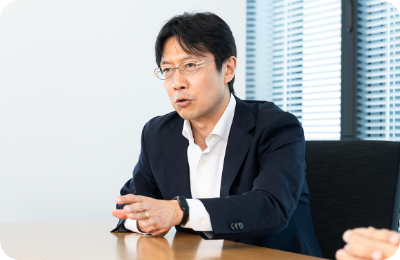
What was the initial impetus for developing DataSpider?
- Mr. Ono
-
Around 1997, when I was a university student, I worked part-time as a researcher at Nomura Research Institute. The analysts there would research topics and client information related to their work every morning using various media, including newspapers and white papers, to grasp the day's topics before starting work. At that time, the internet was just beginning to spread, and what we now call crawling was done manually.
I received a request to create a personalized website that would consolidate topics relevant to analysts into a portal site, and I was in charge of everything from design and development to implementation and operation all by myself. That experience was a major turning point for me.
So, they actually made that request to a student part-timer?
- Mr. Ono
-
I'm a programmer who started writing programs when I was in fourth grade. Actually, I've automated all the manual work I was paid for as a researcher. It's a programmer's instinct to automate anything that can be automated, like a mountain climber who climbs a mountain because "it's there." There were tasks that could be automated, so I did it (laughs).
Then one day, a senior colleague at my company pointed out to me, "You're supposed to be an hourly worker, but you're doing something completely unrelated." I explained that I was having a program do the research, and after seeing the program in action, my senior colleague, impressed that I could do that, introduced me to a team that was trying to systematize a similar mechanism. The members of the development team were surprised, saying, "You made this all by yourself?" From there, even though I was still a student, I switched to being a contract employee and became 100% involved in system development.
Were there no systems back then that could connect multiple systems and consolidate them into a single piece of information?
- Mr. Ono
-
While there were certainly similar systems in the EAI category, they were all, frankly, too expensive and complex. I felt at the time that there was a "vacant space" where something that could connect systems more easily could be created. At the time, the only ways to connect multiple systems were to use an expensive EAI or build one from scratch, and either option required an investment of tens of millions of yen.
That's what sparked the creation of DataSpider.
- Mr. Ono
-
At that time, there wasn't a single product that could be built for a few million yen. There were several XML-related vendors, but they only provided XML parsers or adapters; none of them had a GUI for orchestration. It might sound strange coming from the person who created it, but in a sense, I think it's fair to say that this genre itself started with DataSpider.
That seems like a pretty big request for a part-time worker. Did you have a lot of trouble with it?
- Mr. Ono
-
To access the various white paper databases within the company, we had to use terminal emulators and somehow manage to handle the unique character encodings and layouts of each. When crawling with a web browser, not everything was in Unicode like it is today, and scraping technology didn't exist. Because the white papers published by the government and the company's internal databases each had different conventions, we had to gather them all in one place and consolidate them into the same format. I remember creating an XML parser even before XML was adopted as a W3C standard specification.
In short, it was incredibly difficult to handle differences in format, layout, character encoding, and article structure across different systems. Nomura Research Institute at the time consulted with system integrators, but they said they couldn't do it well. This experience became a formative one for me, making me realize that a system like DataSpider, which simply connects disparate elements, is what the market really needs.
The evolution of DataSpider
What was the reaction like after releasing DataSpider version 1?
- Mr. Ono
-
After issuing a press release, we received inquiries from various companies. One of them was NHK. At the time, they had a system for providing live updates of high school baseball games on the web, where reporters on-site would write handwritten notes and send them via FTP. They wanted to use DataSpider to update the information more promptly.
As a newly established venture company undergoing testing, I received a briefing on the business during my initial visit. While taking notes during the meeting, I simultaneously created a DataSpider script. When asked how long it would take to build this system using DataSpider, I immediately demonstrated a hastily constructed basic framework. Then, as now, I still value providing positive surprises through programming.
That must have been quite a surprise.
- Mr. Ono
-
I'm sure you experienced the high productivity firsthand, but you were probably skeptical at first. The screen looked promising, but you were probably wondering if it would actually work when you input real-world data. In reality, after several months of testing, including handling irregular processes, you decided it was perfectly capable of meeting your specifications and became our first user. In the startup world, you often hear stories of CEOs overcoming hard things, but at that time, both the company and the product were still in their infancy. As it was also our first project, we were working incredibly hard, but we all put our efforts into it.
I understand that after the release of version 1, the name was changed from DataSpider to DataSpider Servista at the version 2 stage. What was the reasoning behind this change?
- Mr. Ono
-
From listening to many customers, we realized there was a significant enterprise need. We strongly felt the need to implement features that could withstand enterprise specifications, such as handling a large volume of transactions. Therefore, we redesigned the system from the ground up to make it usable in enterprises, making major changes without altering the core data integration. While version 1 was positioned as a convenient tool, we have now evolved DataSpider into a platform that can run processes on a regular basis.
With the major changes underway, we solicited ideas for the product name from our employees, and the name Servista was born from the image of a player who, like a fantasista in soccer, connects services with ease and magic.
Did you encounter any difficulties in implementing enterprise features?
- Mr. Ono
-
While there were certainly growing pains, the fact that we couldn't maintain complete compatibility due to significant specification changes between versions is a major point of regret and a valuable lesson learned to ensure that something of the same scale never happens again. To be honest, we caused a lot of trouble for our customers and partners at the time.
Could you tell me about the turning point that led to a significant increase in sales during the subsequent developments?
- Sasaki
-
As a premise, DataSpider is middleware, so it wasn't something that would sell explosively. Nevertheless, its implementation in a certain securities company's system in 2008 was a major turning point. Although there was a trend towards expanding into the enterprise sector, the financial industry has high demands in all aspects, including performance, quality, and operation, and there was a cautious atmosphere within the company. However, this project fostered an atmosphere of wanting to take on the challenge of meeting those high requirements by pooling all our resources. We formed a dedicated system for sales and development, and with the help of our customers, we were able to overcome the challenges and achieve a track record of stable use. This gave us confidence, both internally and within the financial industry, that we could provide a stable data integration platform as a service, and we believe it led to steady sales growth afterward.
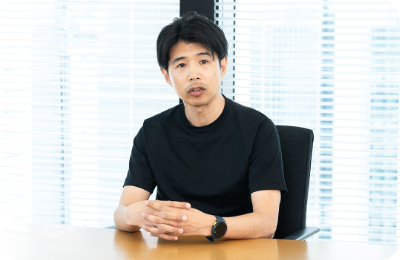
- Arima
-
In February 2026, we had the opportunity to gather our users for a release event for the latest version, DataSpider Servista 5. When I took the stage and asked those using DataSpider to raise their hands, I was surprised to find that quite a few had been using it since version 2. It's amazing that people who have been using it since version 2, the initial stage when enterprise implementation was possible, are still attending events and showing their love for the product. Knowing that they are, in a sense, captivated by it, suggests that the implementation of enterprise-essential features in version 2 significantly contributed to the expansion of sales in the 2000s.
- Mr. Ono
-
The implementation of enterprise-level features in version 2 made it possible for us to introduce the system to securities companies, as Mr. Sasaki mentioned. Mr. Arima's point that "many of our customers have been using the system since version 2" is largely due to the fact that version 2 included all the features that were needed at the time.
These feature enhancements were driven by feature requests from our partners and feedback from users gathered at user group meetings. There's no doubt that our continuous refinement of features based on this on-the-ground feedback has contributed to the growth of DataSpider Servista.
Have there been any breakthroughs related to adapters?
- Mr. Ono
-
One significant factor is the growing recognition that DataSpider is the solution for small-scale connections with peripherals rather than implementing a large-scale ERP EAI for SAP integration. Another major factor was the development of adapters for specific services by partners with expertise in particular integration areas. It started with experts in SaaS and PaaS advising us, and then they created and sold third-party adapters, which benefited not only our business but also our partners'. Within this partner ecosystem, we began to discover golden use cases, which undoubtedly led to further sales expansion.
Do you have any memorable stories about your partner?
- Mr. Ono
-
There are many examples, but one time, when I was speaking with the head of technology at a certain product vendor, the topic of what kind of adapters we could provide came up. Since he had traveled a long distance to attend, I asked him what time his bullet train would take him home after the meeting, and then, in the three hours before he returned to his office, I created an adapter for him as a positive surprise. He was very pleased with it, and that's how our partnership began.
This doesn't seem like an approach that everyone can take.
- Sasaki
-
It's really hard to imitate Mr. Ono's efficiency in designing and implementing software. I believe my strength lies in calmly and thoroughly engaging with the product, and making sure I get the essential points covered. I had mentally agreed that it would be good if Mr. Ono and I could build a complementary relationship.

- Mr. Ono
-
In essence, DataSpider can be said to realize diversity in the systems world, a world of mixed systems. As a company that creates areas where such systemic diversity is required, our organization also needs diversity. In that sense, it is necessary to have a variety of people, such as programmers like myself who build things quickly and efficiently, and people like Sasaki who create things through solid and steady processes, and to leverage each person's strengths in our business. It is important for us to maintain diversity ourselves.
Let's stay connected, now and in the future.


What lies ahead after 25 years of progress is a new evolution that will support our operations going forward.
Please take a look at this information, which will be useful for future data utilization.

