

LOZI Co., Ltd. is a startup company established to solve social issues such as responding to regulations on truck drivers' working hours and promoting joint transportation in the logistics industry.
The company develops and provides "SmartBarcode," a solution that visualizes the movement of goods by scanning barcodes and QR codes with a smartphone, connecting fragmented supply chains. SmartBarcode has been adopted by many companies, including major logistics companies and companies in industries other than logistics, and is becoming a new platform for supply chains. The company uses HULFT Square to streamline data integration within SmartBarcode.
Customer Issues
We want to reduce the time and effort required for data preparation and processing through data integration, thereby accelerating service delivery.
Benefits of implementation

By expediting service delivery
Solving social problems
to promote

Truck driver
Reduce waiting time
Contributes to achievements such as

data integration
Reduces the workload for both shippers and logistics providers.
Background: Tackling logistics challenges with a "passport that connects things"
Supply chains are currently facing numerous challenges, including a shortage of truck drivers, restrictions on working hours, and rising transportation costs. In this context, SmartBarcode, developed and provided by LOZI, is attracting attention as a solution that can transform not only the logistics industry but society as a whole, and its adoption rate is increasing.
Based on the concept of "a passport for goods connecting the supply chain," this service allows users to attach barcodes or QR codes to products or pallets, and simply by scanning them with a smartphone, they can obtain and input information such as product details and transportation routes via a web application. Its key feature is the seamless and global visualization of information from the beginning to the end of the supply chain, even when many businesses are involved, using barcodes and QR codes.
SmartBarcode is a web application that does not require a dedicated scanner or app download, making it easy to implement. It also offers many advantages, such as accessing different datasets depending on the person and location scanning, enabling information input and sharing across companies, automating document creation, and integrating acquired data with companies to eliminate manual data entry into mission-critical system, core system. As of 2025, it is an unparalleled service.
SmartBarcode is a service born from LOZI's strong desire to contribute to solving social issues related to supply chains, which was established in 2020. The company was founded in 2018. Director Masahiro Ban recalls that it started amidst the enforcement of work style-related laws and the focus on regulations on truck drivers' working hours, the so-called "logistics 2024 problem."
"With the increasing number of businesses and personnel involved in a single shipment, such as joint transportation where goods from multiple businesses are transported together, and joint storage where goods are managed in the same warehouse, the supply chain is becoming more complex and cumbersome. The question is how to overcome the 'Logistics 2024 Problem.' That's where we focused on barcodes and QR codes, which are used all over the world. SmartBarcode was born from the idea that information could be transmitted seamlessly between businesses using only barcodes and smartphones, without requiring any special capital investment."
In developing and providing SmartBarcode, the company has adopted a motto that is the complete opposite of that of typical vendors: "We will not fulfill all customer requests." Mr. Ban explains the intention behind this as follows:
"Our core philosophy for this service is to create a versatile system that can be used by everyone, not just for specific companies. When we receive requests from customers, we only add features that we deem necessary, considering whether they can be effectively utilized by other customers as well. We believe this is an important policy, both in our vision of developing a system that is used worldwide and in our business strategy of not relying on specific customers for revenue."
HULFT Square was adopted to resolve issues with data integration during implementation.
As intended, SmartBarcode was praised both within and outside the industry for its ease of implementation and versatility, attracting users primarily from major logistics companies from its initial release. Subsequent functional enhancements have made it a platform used by many companies across various industries and business types, including agriculture, Manufacturing, Construction, distribution, and retail. Furthermore, the company actively participated in projects by the Ministry of Land, Infrastructure, Transport and Tourism and the Ministry of Economy, Trade and Industry, pushing forward with the development of new functions aimed at solving national challenges such as the declining workforce and reducing greenhouse gas emissions. However, Mr. Ban says that with this business expansion, challenges for SmartBarcode as a solution have become apparent.
"As our business with large corporate clients increased, we strongly felt the need to streamline data integration. To achieve centralized information management across companies with SmartBarcode, information sharing is essential. This often required relying on the client's IT department for tasks such as sending data via APIs and selecting which data to share. Furthermore, with large corporate clients, who handle vast amounts of information, manually entering each piece of data or connecting to APIs repeatedly became increasingly difficult."
While searching for a solution to address these challenges, they came across HULFT Square. Initially, DataSpider was also a candidate, but Mr. Ban says that he felt HULFT Square could more precisely meet their requirements.
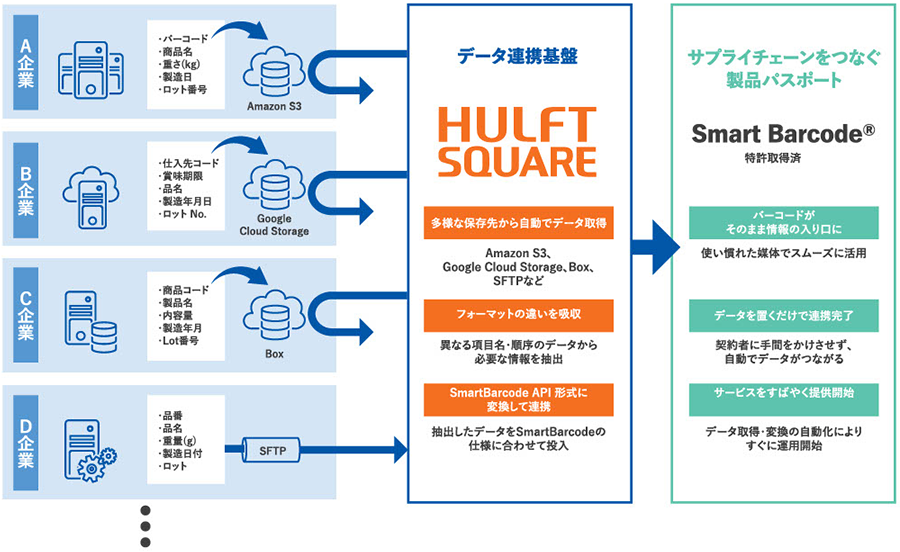
The deciding factor in our selection was the wide variety of systems that can be used to transfer data. Our service is operated on AWS, whereas our clients use different systems such as Google Drive and Kintone. HULFT Square allows us to easily integrate various systems. We thought it would be possible to reduce the workload of both the client and our company by eliminating the need for the client's system department to organize and process the data, and by simply having the data output from the current system sent to us as is, the data organization and processing can be done automatically.
Creating SmartBarcode use cases at an overwhelmingly fast pace.
With the introduction of HULFT Square in 2023, SmartBarcode underwent a significant evolution. Customers can now store data from their mission-critical system, core system in their own cloud storage services or send it via HULFT Square 's SFTP. Unlike before, the data can now be in any format, such as CSV or Excel files. This is because HULFT Square 's ETL function automatically organizes and processes the data before uploading it to SmartBarcode. Mr. Ban explains:
"We can now ask our customers, 'Please send us data in a format that allows for easy output without any hassle, as long as it contains the necessary information, regardless of the type or volume of data,' which has significantly reduced costs for our customers. Furthermore, the automation and acceleration of data integration has enabled us to operate SmartBarcode with a speed that makes a real impact on our customers. For example, we can correct data on the same day we receive a request, or launch a service within about three days, including data integration and demo creation."
Numerous examples of SmartBarcode's use are emerging. For example, consider the case of major consumer electronics retailer A and major consumer electronics logistics company B. Company A receives logistics support from company B, but traditionally used paper slips for store deliveries, which presented challenges such as high paper output and management costs and concerns about information leaks. Meanwhile, company B was troubled by the problem of long waiting times for truck drivers due to the time required for communication at delivery destination stores.
To address these challenges, Company B implemented SmartBarcode. Using smartphones and QR codes, they made it easy to input and share data from shipping to in-store inspection. Initially starting with a few of Company A's stores, this initiative has now expanded to almost all stores based on the results of the pilot program. The enormous amount of paper slips that were previously consumed have been eliminated through digitalization, and at the same time, concerns about information leaks have been completely eradicated.

Masahiro Ban
Meanwhile, at Company B, the process from delivery to inspection at each store has become dramatically more efficient through the transition from paper to tablets, reducing truck driver waiting time by an average of 45 minutes per driver per day. A survey showed that drivers spend an average of 1 hour and 34 minutes waiting for loading and unloading per trip, which is considered a contributing factor to long working hours. As a result, the Ministry of Land, Infrastructure, Transport and Tourism has mandated that this be recorded as working time and is calling for reductions where possible. The significant reduction in waiting time achieved with SmartBarcode can be seen as a realization of LOZI's long-held goal of contributing to solving social issues since its founding.
In addition, Mr. Ban is pleased to report that HULFT Square is also having a positive impact within LOZI.
"Our company works with many customers from pilot projects to full-scale implementation, but as a startup with limited resources, this placed a heavy burden on each employee. After implementing HULFT Square, we were able to reduce the burden on our employees by eliminating the need to review detailed settings during pilot projects and full-scale implementations, allowing them to dedicate their freed-up time to customer support and business expansion."
Our vision is to continue working towards solving social issues with "connecting" as our key word.
Mr. Ban joined LOZI with a strong awareness of logistics issues, stemming from his previous experience in finance and inventory management. He has already achieved significant results using SmartBarcode. Nevertheless, Mr. Ban says he is still determined to achieve much more.
"To use a mountain climbing analogy, we're only about three stations up. There are still many urgent issues to address, such as reducing greenhouse gas emissions, transitioning to a circular economy, and establishing traceability. While our direct involvement is limited, we believe we can continue to contribute by connecting data with solutions like SmartBarcode and visualizing various things and information. For example, individual product management. If the practice of identifying and managing individual products, already implemented in pharmaceuticals and other sectors, spreads to the general consumer goods sector through the use of multiple barcodes, it will drastically change the world of supply chains, including the optimization of inventory based on real-time order and sales data."
Mr. Ban then pointed out that HULFT Square plays a significant role in such developments.
"Even just looking at Japan, there are countless systems used for storing and sharing information. In that context, I believe that HULFT Square 's ability to quickly and easily connect all kinds of systems is a strength that other solutions lack."
Moving forward, LOZI and Saison Technology will continue to work together, using "connecting" as their common keyword, to contribute to solving social issues and creating a better future.
- Download the case study leaflet (Japanese)
- Download "80 Selected HULFT Use Cases" - a collection of use cases for HULFT, DataSpider, etc.
LOZI Inc.
- Head office address: 2-1-36 Marunouchi, Naka-ku, Nagoya City, Aichi Prefecture, 8F
- Established: November 2018
- Capital: 30 million yen
- Number of employees: 6
- Business activities: SmartBarcode business, cross-border e-commerce business
- The content of this case study is current as of the time of the interview. The content of this case study may change without notice.