

BI Tools vs. Generative AI? How to Use Data Together in the AI Era

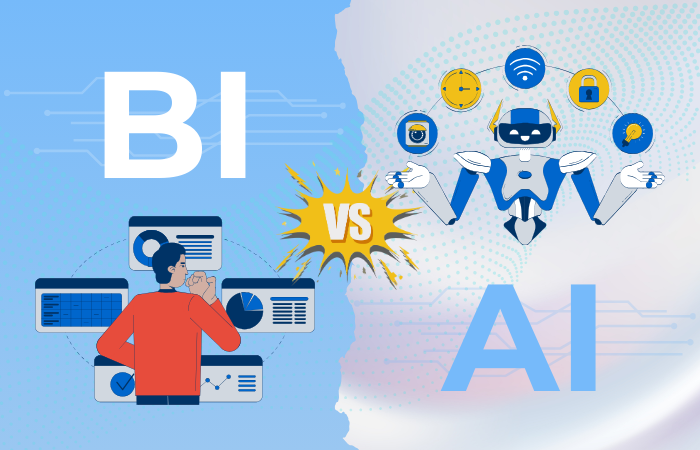
As data utilization in companies advances, BI tools have become established as a means of easily visualizing and analyzing data. Their ability to aggregate a wide range of business data and intuitively grasp it through graphs and dashboards has greatly supported daily business improvement and decision-making. However, in recent years, the remarkable rise of generative AI has presented new possibilities not available with traditional BI tools, and is changing the very nature of data utilization.
In this column, we will organize the characteristics of BI tools and generative AI, which are currently attracting the most attention in the field of data utilization, and how to best use them.
The rise of generative AI in data utilization
In the enterpriseGeneration AIWith the spread of data, the use of data is also increasing.Attention is focused on the possibilitiesGenerative AI addresses issues that have traditionally been difficult to address with BI tools that support the analytical needs of business users.A new breakthroughIt is expected that this will happen.
Issues with data utilization faced by BI tools
Traditional BI tools have proven their value in routine analysis, such as visualizing key business indicators on dashboards and generating reports on sales trends, inventory status, and customer trends. However, when dealing with large and complex data sets, they are always faced with the challenge of requiring a great deal of time and effort for preprocessing and data cleansing. When data formats are inconsistent or contain duplicates or missing data, skilled personnel must spend a great deal of time and effort manually adjusting the data, which can often become a bottleneck before deriving analytical results.
In addition, because BI tools are based on pre-set indicators and graphs, there are limitations to exploring new patterns and unknown insights. Because the design itself, such as how to link related data sources and from what perspective to visualize them to make new discoveries, is important, if implementation proceeds without a clear operational objective or requirement definition, the expected analytical results will not be achieved, and as a result, there are cases where the dashboard becomes a mere formality.
The potential of generative AI for data utilization
The technological advances in generative AI show no signs of slowing down, and data utilization that incorporates AI-generated information in addition to human ideas and knowledge is rapidly expanding. This not only improves efficiency, but also enables data utilization in areas that were previously thought impossible.
In recent years, generative AI has begun to produce concrete use cases in a variety of industries, including corporate marketing, product development, and customer support. This trend has also had a major impact on the world of data analysis, enabling even non-specialist business users to instantly search vast amounts of data assets within their companies and extract the information they need simply by asking questions in natural language. By automatically generating and executing database queries, generative AI has dramatically improved the efficiency of data extraction, enabling hidden patterns and new discoveries to be found even in data that was previously difficult to access.
How to use BI tools and generative AI
Using generative AI for all data analysis is not the optimal solution. In order to maximize the acceleration of a company's data utilization, it is extremely important to have a deep understanding of the strengths of BI tools and generative AI, and to use them appropriately depending on the purpose.
Cases where BI tools are suitable: Regular and routine
BI tools are particularly effective in areas where they quickly and simply visualize indicators that are routinely checked in daily business operations. For example, they are ideal for monitoring KPIs (key performance indicators) that are continuously extracted from stable data sources, such as monthly sales trends, weekly inventory fluctuations, website access status, production line log monitoring and quality control, and departmental cost analysis.
By viewing past data from various angles on the dashboard and checking for anomalies in important KPIs and related indicators, the service supports daily business improvement and rapid decision-making.
Cases where generative AI is suitable: Quick and flexible
Generative AI can quickly verbalize trends and insights that can be derived from data and provide suggestions to users. With traditional analytical methods, it was up to humans to interpret the results of statistical analysis or visualizations made with BI tools. Generative AI uses natural language processing technology to explain the interpretation of data in words. Human users can quickly understand the results of data analysis, regardless of their skill level.
Furthermore, the interests of users who want to use data change from time to time. Generative AI can use language understanding to search for the data users are looking for and extract insights from the data using the desired analytical methods, allowing it to utilize data flexibly and in real time, in contrast to BI tools, which have fixed analysis targets.
Accelerating data utilization with BI tools and generative AI
BI tools and generative AI are not rivals that require you to choose one over the other. Rather, by combining their respective strengths, you can explore the potential value of data more efficiently and deeply than ever before, and return it to your business.

Expressing discoveries made by generative AI in BI tools
As mentioned earlier, it is important to use BI tools and generative AI tools appropriately depending on the usage scenario. On the other hand, there is also the idea of combining BI tools and generative AI.
The deep insights and hidden patterns discovered by generative AI can be difficult to understand in traditional formats. Displaying the results on a visually easy-to-understand dashboard in a BI tool makes it possible to intuitively grasp the overall picture of the data from multiple perspectives. For example, in addition to the graphical representations that BI tools excel at, a written summary of the trends observed and the discoveries made could be presented within the dashboard.
Dashboards incorporating such AI-generated insights provide information in an easy-to-understand format not only to specialized analysts, but also to time-poor management and field personnel unfamiliar with data analysis, leading to company-wide improvements in operations and faster decision-making.
The common need to develop a data infrastructure
To maximize the value of BI tools and generative AI, the most important prerequisite is to have a robust data infrastructure. No matter how excellent the tools you use, if the data flowing through them is of poor quality or contains formatting inconsistencies, it will be extremely difficult to obtain accurate analytical results. This can lead to incorrect decision-making, knowledge dispersion, and even lost business opportunities.
A data infrastructure is essential for consolidating diverse information collected from various internal and external business systems (CRM, ERP, SFA, etc.), websites, IoT devices, external data services, etc., in one consistent location and converting it into a usable format. It is on high-quality, reliable data that the excellent visualization functions of BI tools and the advanced verbalization functions of generative AI come to life.
Finally
By strategically linking the new value brought about by generative AI with BI tools, companies' data utilization will evolve from simply visualizing the past to predicting the future and creating new value.
BI tools are an essential foundation for increasing productivity and accuracy in visualization tasks such as routine reports, daily situation assessments, and KPI management, and for facilitating data sharing and decision-making within an organization. Meanwhile, generative AI goes beyond traditional routine analysis, exploring and analyzing cross-sectional data and uncovering unknown trends and insights. By skillfully using these two tools according to their respective strengths and strategically combining them, companies will be able to discover deep, multifaceted insights that would never have been possible with traditional analytical methods alone.
The person who wrote the article
Related Columns
-

Management speed is determined by structure: Reforming the decision-making process of a regional bank through data integration and AI.
-

How to address the "proliferation" of generative AI in companies: Balancing AI utilization and governance.
-

The Cutting Edge of Generative AI in Manufacturing: How to Derive Insights Beyond Search Through data integration

Recommended Articles
-

Democratizing data analysis with generative AI
We will introduce a method that uses generative AI to enable anyone, including business users, to extract value from data. -
What are the requirements for the data infrastructure required for RAG?
We will focus on "RAG," one approach to generative AI, and introduce the key points for developing a data infrastructure that supports the knowledge base required to utilize RAG in business. -

What is data utilization? Basic knowledge to increase business value
We will explain the key points for increasing business value by organizing the basic concepts, benefits, approaches, and main challenges of data utilization.