

In-house data utilization strategies to strengthen bank fraud detection: The key to shifting to predictive and preventative methods

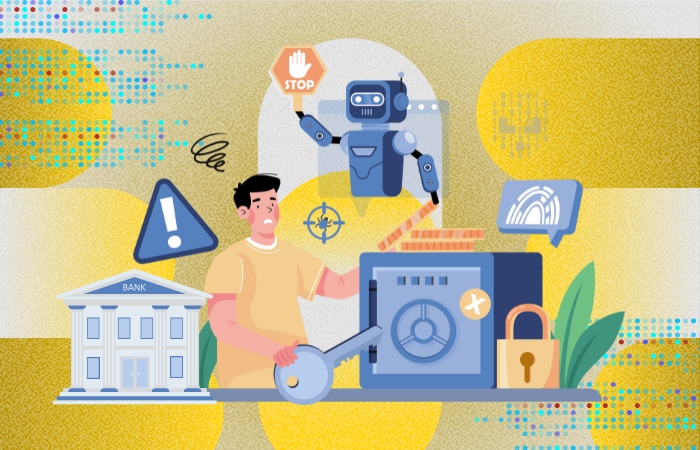
As fraudulent transactions become increasingly sophisticated due to the misuse of AI and deep fakes, banks are reaching the limits of their traditional reactive fraud detection methods. What is important now is to shift to a "predictive and preventative" approach that integrates and utilizes internal data to detect unknown fraud before it occurs.
This article explains the strategy for banks to integrate their in-house data utilization platform with generative AI to improve their fraud detection capabilities.
The current state of increasingly sophisticated fraudulent transactions and challenges facing the banking industry
While the evolution of digital technology has brought us convenience, it has also rapidly increased the risk of financial crime. Fraudulent transaction methods such as phishing scams, identity theft, and anti-money laundering (AML) are becoming more sophisticated and ingenious every year, and the speed of these crimes is accelerating, especially with the malicious use of AI and deepfake technology.
For the banking industry, detecting and preventing fraudulent transactions is a key "defense" essential for protecting customer assets and trust. However, major challenges are emerging on the front lines. Traditional fraud detection systems rely on rules and patterns based on past cases, and tend to always be reactive to new methods. Delays in adding rules also increase the risk of fraud spreading. Such passive, reactive systems are no longer able to keep up with the rapidly increasing sophistication of fraud.
Shift to predictive and preventative fraud prevention
To overcome this limitation and shift from a passive, reactive defense to an active, predictive and preventative defense, simply introducing AI is not enough. To detect fraud in advance and prevent damage before it occurs, the entire banking industry needs to fundamentally change how it thinks about data.
Saison Technology's Data Integration services build a powerful system for detecting signs of fraud using the following three-pronged strategy:
- Establishing a data utilization platform: Establishing a "bank data utilization platform" that integrates internal system data with external data in real time and allows for loosely coupled handling.
- Multifaceted combination of data: From the integrated data, we can uncover signs that cannot be seen in a single transaction, allowing us to detect fraud in advance.
- Generative AI provides insights and automatically builds defense rules: It has the "intelligence" to generate fraud scenarios and automatically build defense rules.
This combination of data integration, data combination, and generative AI is the only solution for gaining customer trust and providing true financial service value.
▼I want to know more about loose coupling
⇒ Loose coupling | Glossary
Data preparation to make AI the "brain"
In the past, when financial institutions used AI, problems with data quality and structure prevented the AI from fully utilizing its capabilities, resulting in an incomplete state in both offensive and defensive aspects.
AI engineers were spending a lot of time on preparatory work such as extracting data, cleansing it, and standardizing formats, and were unable to devote sufficient resources to the areas where AI should be able to demonstrate its true value: detecting signs of fraud and deriving insights.
The "Banking data integration platform" will solve this problem and enable AI to function as a true "brain."
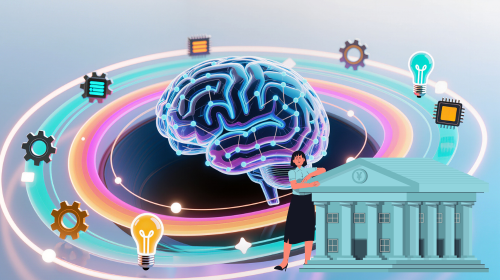
1. The role of the data utilization platform: Creating an environment for "predicting" fraud
Within a bank, there are multiple independent systems, such as accounting systems, information systems, and channel systems, each of which handles data in a different format. In order to provide data to generative AI in the appropriate format, it is essential to establish a data utilization platform that loosely and flexibly connects these data.
This platform aggregates and standardizes data stored in different formats and locations in near real time, providing it in a unified data format that is easy for AI to understand. This completely frees AI from pre-processing such as aligning data locations and formats. With high-quality, multifaceted data readily available, you can focus on your primary tasks, such as generating insights such as risk analysis and predicting customer behavior, and proactively detecting fraud.
2. Combined data for complex insights: Capturing signs of fraud
By allowing AI to focus on insights, it becomes possible to instantly combine multiple data sets for complex analysis, providing robust "defense." Conventional systems could only view individual transaction data. However, with a collaborative platform, AI can instantly analyze complex combinations of data, such as the following, and detect signs of fraud before they occur.
- "High-value remittance instructions" and "Access from an unusual device"
- "Unnatural inquiries made to the call center immediately prior" or "attempts to change address"
- Matching with leaked information (external data) on social media and the dark web
By combining this internal data with external data, we can detect signs of fraud in advance, which would not be possible with simple rules, creating true value that directly contributes to protecting customer assets and gaining their trust.
Generative AI: Automatic generation of fraud scenarios
Once a data utilization infrastructure is in place, generative AI can demonstrate its true value. Generative AI goes beyond simple identification (traditional AI) and has the ability to "generate" new fraud risk scenarios and defense rules on its own. This enables "prevention" to stop fraud from occurring.
1. Automatic construction of fraud scenarios and defense rules
Based on complex data, generative AI can automatically generate a fraudulent "story (scenario)" that explains, "What was the intention behind this transaction and what method was used to make it a fraudulent transaction?"
- Responding to unknown threats: The system detects subtle deviations from large amounts of normal data, analyzes the complex relationships behind them, and proposes hypotheses for fraud. This allows the AI to automatically create and generate defensive rules that detect potential fraudulent transactions in advance, ensuring that even new fraudulent transactions are not overlooked. This enables the system to autonomously put in place a "preventive line" before a human can set up rules.
2. Optimizing detection logic and reducing false positives
Based on the proposed fraud scenario, generative AI can perform virtual simulations within the system to optimize the most effective "detection logic" with the fewest false positives. This improves the accuracy of "defense" while reducing false positives, smoothing legitimate transactions and maintaining the value of customer convenience built through "offense." It achieves a balance between preventing fraud in advance without compromising customer convenience.
Incorporating "human inspection": Defense through collaboration between AI and humans
While automated defenses using data integration and generative AI are robust, the essence of financial services is trust in people and responsibility. By incorporating a process in which the AI's insights into the possibility of fraud are finally judged visually by human experts (such as compliance officers), truly multifaceted judgments and customer trust can be achieved.
1. Responsibility and multifaceted perspectives on AI insights
AI presents risk alerts as "insights" based on multiple factors, but the final decision is made by a human. Experts understand the AI's logic and make the final decision based on the following points:
- Legal and regulatory perspective: Are AI decisions appropriate in light of the latest financial laws and regulations and international AML/CFT regulations?
- Customer context: By taking into account the "circumstances" that only humans can determine, such as the individual circumstances and business context of customers that AI often overlooks, we can avoid causing harm to customers due to false positives and provide sincere service value.
The division of roles, in which AI focuses on identifying and predicting risks and humans focus on making the final decisions and taking responsibility for those risks, maximizes the quality of services.
2. Retraining AI with expert knowledge
The final judgment made by the experts through "visual inspection" is sent back to the AI model as feedback via data integration platform. This allows the AI model to continuously learn from the knowledge of human experts and further refine and evolve its detection logic. This completes an advanced data utilization cycle that combines both offense and defense, where AI and humans work together to infinitely improve the accuracy of fraud prevention.
Conclusion: Achieving an offensive and defensive data strategy with a data utilization platform
The bank data utilization platform combines and integrates vast amounts of data from both inside and outside the bank in real time, and then places an intelligent engine called generative AI on top of it. The insights from this AI are then finally verified by the eyes of experts, allowing for multifaceted decision-making and responsibility. This is the data strategy that the banking industry should aim for, balancing offense and defense.
This system, in which AI detects fraud in advance and automatically builds defense rules (prevention), will enable the banking industry to continue providing true financial service value to its customers by protecting customer assets and trust from fraud risks (protection), while at the same time maximizing revenue opportunities by reducing false positives and ensuring smooth transactions (offense).
The person who wrote the article
Recommended Content
-
![Three business improvement use cases [in the financial industry]](/application/files/9817/5899/2530/img_column_data-utilization_recommended-content_hs-financial-industry-usecase-3.png)
Three business improvement use cases [in the financial industry]
We will introduce specific examples of solutions that can be achieved using iPaaS to address business challenges in the financial industry. -

Optimize banking operations with AI-driven insights
We will introduce how to solve waste in business operations and hidden issues using the power of AI and data. -

Case Study | Seven Bank, Ltd.
We have begun a verification project using HULFT Square to create a system that can analyze data using natural language.