

A Guide to Getting Started with Data Utilization | The Benefits of Accelerating DX and the Secret to Starting Small with Distributed Data


Data utilization is key to promoting digital transformation (DX). However, many people in charge are struggling with questions like, "Where should we start?" and "Should we wait until a perfect data infrastructure is in place?"
This article will clarify the fundamentals of data utilization, its differences from DX and analytics, and explain the business-related benefits such as increased sales and reduced costs. Furthermore, it will reveal practical secrets for achieving results with a small-scale start, even with "dispersed data." Through this article, you will gain a realistic data utilization roadmap for your company that will be useful for internal presentations and budget securing.
Definition of data utilization and its difference from data analysis
First, to correctly understand the overall picture of data utilization, we will review the definition, including the differences between it and data analysis.
Data utilization involves collecting a wide variety of information from inside and outside an organization, analyzing and processing it according to purpose, and reflecting it in actual business measures. It is not just about collecting information, but refers to a wide range of processes, from understanding the current situation to deriving solutions to problems and generating new ideas. In management, this type of information utilization is essential for making speedy and accurate decisions. Recent advances in IT and cloud technology have created an environment in which large amounts of data can be handled relatively easily, furthering this trend.
Definition of Data Utilization
Data utilization refers to the act of transforming information held by a company into valuable insights to improve business results. Specifically, it mainly involves collecting inventory data, sales data, customer information, etc., and analyzing this data to help with decision-making. With the recent advancement of digitalization, the amount of data obtained online has exploded, and there are increasing cases of combining this data and using it for marketing and product development. The ultimate goal is to increase a company's profitability and sustainable competitiveness.
Differences from DX (Digital Transformation)
Terms that are often confused with data utilization include "digitization" and "DX (Digital Transformation)." Digitization is the "means" of replacing paper information with data, while DX refers to the "transformation itself" of changing business models and organizations using digital technology. Data utilization lies somewhere in between, playing the role of the "engine" for realizing DX by analyzing and utilizing accumulated data.
Differences from data analysis
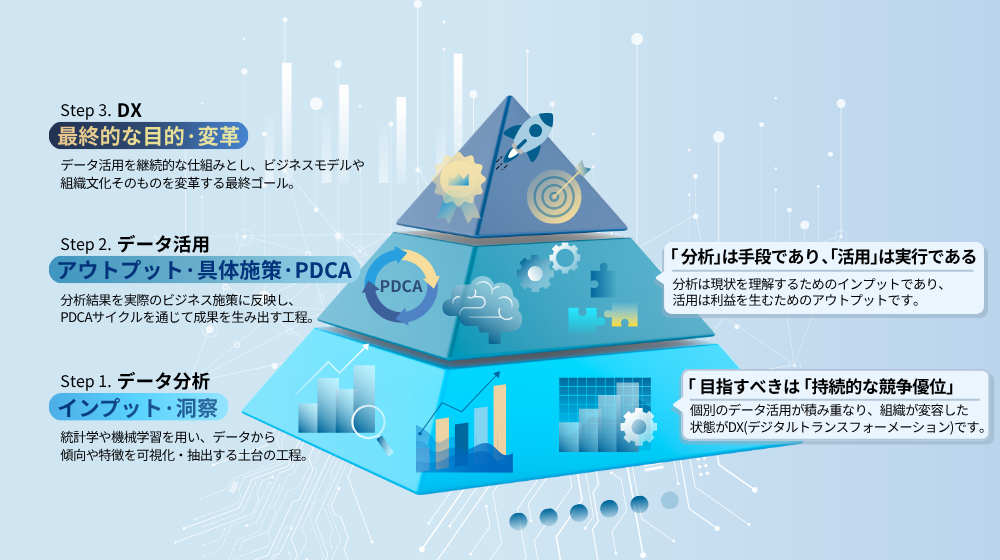
Data analysis is part of the data utilization process. For example, the role of data analysis is for data scientists to use statistical methods and machine learning to derive features, and to use visualization tools to summarize the results in an easy-to-understand format. On the other hand, "data utilization" is the process of turning the analysis results into specific measures and strategies, implementing them, and then repeatedly improving them. In other words, the difference between the two is that while analysis is the input, utilization includes elements of output that lead to business results.
▼I want to know more about machine learning
⇒ Machine Learning | Glossary
The relationship between data utilization, data analysis, and DX.
To summarize the relationship between these three elements, it boils down to a series of steps: "Data collected through digitalization is transformed into insights through data analysis, and these insights are then used in practical operations to ultimately achieve the transformation known as DX (Digital Transformation)." Analysis is merely an input process; it is only when this analysis is translated into concrete measures and decision-making that it can truly be called "data utilization."
The background behind the growing interest in data utilization
In recent years, the spread of cloud computing, advances in IoT, and the sophistication of big data tools have created an environment in which massive amounts of data can be utilized. As competition between companies intensifies, evidence-based strategies are required, and it is becoming increasingly difficult to respond to market changes with qualitative judgment alone. Against this backdrop, decision-making based on objective data has become essential in all aspects of business. Another major reason is that, as consumer behavior and social conditions change rapidly, companies that can effectively use data in a timely manner will have an advantage.
Current Status of Data Utilization in Japanese Companies
While many Japanese companies recognize the importance of data utilization, a culture that relies on "experience and intuition" and data silos across departments remain obstacles. Compared to Western countries, there is also a shortage of specialized personnel such as data scientists, and decision-making not based on objective data is a factor that delays responses to market changes. It is urgent that companies redefine their priorities and transform into data-driven organizations.
The benefits of using data in business
We will introduce the specific benefits of utilizing data from the perspectives of increased sales and business efficiency.
By strategically utilizing data, companies can clarify the direction of their business and implement measures with objective evidence. This is beneficial not only for identifying new business opportunities, but also for minimizing risk and enabling decision-making with a high ROI (return on investment). Furthermore, various benefits can be expected, such as improving loyalty by accurately grasping customer needs and increasing productivity by eliminating duplication in business processes. Recently, there has been a growing focus on creating innovative business models based on data utilization, which can be said to be the key to corporate growth.
Increase sales and create new business opportunities
Analyzing market and purchasing data increases opportunities to discover new product concepts and service ideas. For example, by matching purchase history with reactions on social media, it is possible to optimize offers for each customer segment, leading to increased sales. Another major benefit is that it makes new market needs visible, enabling product development ahead of competitors. Companies that utilize data can more easily identify changing trends and maintain a sustainable competitive edge.
Improved operational efficiency and cost reduction
By referencing precise data in inventory management and production planning, you can achieve less wasteful operations. For example, by introducing a demand forecasting model and creating a system to produce only the required amount at the required time, you can reduce the risk of excess inventory and stockouts. In addition, by conducting simulations based on data analysis, you can find room for optimization of logistics routes and personnel deployment. As a result, you will not only reduce costs, but also reduce the burden on employees and make operations run more smoothly.
Improving strategy formulation and verification accuracy
A company's management strategy is more persuasive when it is backed up not only by information gleaned from the field, but also by objective numerical data. By analyzing past data and understanding success patterns and issues before implementing measures, it is possible to avoid wasteful investment. Furthermore, data functions as an important indicator when running the PDCA cycle at high speed, providing a means of accurately identifying areas for improvement. As a result, strategies are more likely to be effective in a way that is in line with reality.
Faster decision-making
By introducing visualization tools and dashboards, managers and on-site personnel can grasp the situation in real time. For example, if an environment is created where sales data and customer responses can be checked immediately and decisions can be made quickly, it becomes possible to respond flexibly without missing market opportunities. In particular, in businesses with many points of contact with customers, it becomes increasingly important to interpret fluctuations in demand due to seasons and time of day and to quickly change strategies. Utilizing data is also a major key to breaking away from the traditional corporate structure that makes it difficult to make quick decisions.
Benefits from the perspective of human resource development and organizational learning
A secondary, yet extremely important, benefit of data utilization is the transformation into a "learning organization." By having data as an objective common language, everyone from junior employees to veterans can engage in evidence-based discussions, improving the data literacy of the entire organization. Even failed initiatives can be transformed into "valuable learning experiences" by analyzing them with data, enabling sustainable organizational growth that does not rely on individual skills.
A perspective that links the effects of data utilization to KPIs and management indicators.
To maximize the benefits of data utilization, it's necessary to link on-site improvement activities to ultimate financial indicators (KGIs). For example, improving demand forecasting accuracy can be translated into a KPI such as "inventory reduction rate," and how this ultimately contributes to a management indicator like "improved cash flow" can be visualized. By translating data utilization into management "language" in this way, securing budgets and building internal consensus becomes smoother.
\For those who want to move beyond just "looking at numbers."/

Types of data that can be utilized
Organize the various types of data that can be used in business and understand their characteristics.
The data handled by companies comes in a wide variety of formats and sources, and each has slightly different key points for utilizing it. Internally, records of sales, inventory, customers, and more are accumulated, while externally, there are abundant sources of information, such as open data from public institutions and social media. IoT data obtained from machine operation logs and sensors also provides important insights. Understanding the characteristics of each type of data and changing how it is handled as needed is essential to achieving results.
Corporate data (customers, inventory, sales, etc.)
Customer information, sales data, inventory levels, and other data accumulated by a company are some of the most fundamental and important assets in management. For example, analyzing the timing and frequency of purchases based on a customer's purchasing history can help identify the next segment to approach. Furthermore, by comparing recent sales trends with inventory levels, it is possible to develop optimal purchasing quantities and production plans. The insights gained from examining past performance are the first step in utilizing data, and are the most important data when considering how to use data for business.
Organizing business process data
In addition to customer and sales data, on-site "business process data" is also a treasure trove. This includes sensor logs from manufacturing sites, delivery route history in logistics, and call center interaction records. By analyzing this data, it becomes possible to identify bottleneck processes and visualize the work patterns of skilled workers, making it a powerful tool in on-site-driven digital transformation (DX) in manufacturing and logistics.
Tacit knowledge data (digitalization of knowledge)
The know-how and experience of employees working on the front lines are often accumulated within individuals without being put into words. By digitizing this information and making it shareable across the entire organization, it becomes easier to prevent work from becoming dependent on specific individuals and to pass on knowledge more effectively. For example, digitization can be done in various ways, such as creating manuals or video training materials for customer service and troubleshooting tips. Sharing knowledge and experience in a tangible form on social media or within communities is also a promising approach.
Open Data
Open data refers to data that is made available to the public by governments and public institutions in an easy-to-use format. For example, weather information and demographics can be applied to many businesses and are useful for reviewing consumption trends and logistics plans. Because it is made available by public institutions, it is highly reliable and is updated relatively frequently. However, as the content and format may be limited, it is important to identify the information you need.
▼I want to know more about open data
⇒ Open Data | Glossary
Big data (IoT, SNS, etc.)
The vast and diverse data obtained from IoT and social media can sometimes be difficult to analyze using traditional methods alone. However, advancements in sophisticated cloud infrastructure and machine learning technologies have made it easier to extract useful insights from large-scale data. In particular, it is proving useful in a variety Manufacturing, or capturing trends from social media posts and using them in product planning in retail. Gathering large amounts of data into a meaningful form directly leads to expanded business results.
Personal Data and Privacy
When handling data that includes personal information, it is necessary to comply with laws, regulations, and guidelines from the perspective of privacy protection. In Japan, there is the Personal Information Protection Act, and even stricter regulations exist depending on the industry, so improper handling could result in serious risks. When using data, it is also important to clarify the purpose of use and thoroughly manage safe storage and access rights. By establishing such an appropriate operational system, data can be used safely and securely in corporate activities.
Necessary efforts and key points for utilizing data
We will explain the preparations and approaches that are essential for successful data utilization.
To fully utilize data, it is necessary to understand internal and external data sources and secure analytical tools and specialized personnel. It is also important to build a foundation for an organizational culture that accepts data-based decision-making. Furthermore, by establishing governance measures such as permission management and security and creating a thorough system, the value of data can be maximized.
Understand what data you can use
The first step is to identify what data has accumulated within the company. Many companies tend to have information fragmented between departments, but a comprehensive review increases the likelihood of gaining new insights. Looking externally, there are also a variety of information sources, such as open data and social media. Clarifying which data will be used and for what purpose will make analysis design go more smoothly.
Secure data analysis resources and tools
You don't need to implement an expensive and complex data warehousing (DWH) from the start. Begin by considering inexpensive BI tools that can visualize existing Excel data, or no-code analytics tools that can be used without specialized knowledge. The key is "scalability." Choosing tools that can smoothly transition to a larger data volume in the future and that can flexibly integrate with other systems is the key to avoiding wasted investment.
If specialized analysis is required, you will need to decide whether to hire in-house data scientists or personnel with statistical knowledge, or to use an external consulting service. It is also important to introduce a platform that supports machine learning and visualization, creating an environment where even practitioners can easily perform analysis. If a project proceeds with insufficient resources, the effectiveness of data utilization will likely be limited, so appropriate investment based on budget and objectives is required.
Cross-organizational collaboration and data governance
To prevent data utilization from becoming a mere formality, appropriate division of roles is essential. Instead of leaving all analysis to a specialized department (Center of Excellence), an ideal division of labor would involve the IT department handling "data preparation and tool provision," while business units conduct "analysis and implement measures based on on-site challenges." If there are few specialized personnel within the company, we recommend creating a hybrid system that utilizes external consultants as "partners" while simultaneously Education internal members.
Data utilization is not something that can be completed by one department; it is most effective when the entire organization cooperates across the organization. It is important to establish a system that makes it easy for departments to share information and to create rules to standardize data formats and usage etiquette. Establishing governance to maintain data quality and consistency will also increase the reliability of analysis results. Furthermore, strengthening authority management and auditing systems is essential to prevent data leaks in the unlikely event of one.
Thorough security and personal information protection
As data utilization advances, the risk of information leaks and unauthorized access also increases. Particularly when handling personal information, obtaining a privacy mark or various security certifications will make it easier to secure trust both inside and outside the company. As a company, you have a responsibility to practice safe data utilization while complying with laws and regulations. In addition to thoroughly implementing basic measures such as encryption and access management, you should also take ongoing measures such as applying frequently updated security patches.
Basic steps for utilizing data
We will review the general steps to concretely advance data utilization.
To utilize data efficiently, it is important to organize the process in advance. Typically, business objectives and issues are set, the necessary data is collected, processed, analyzed, and put into action. The results are then verified and reflected in the next measures, creating a continuous improvement cycle. Below are the basic steps to understand the general flow.

1. Setting goals and challenges
First, clearly define the specific business issues and goals. For example, it is advisable to set quantitative indicators, such as how much you want to increase sales or how much you want to improve customer satisfaction. Organizing the priority and scope of the issues will clarify the direction of data selection and analysis methods, reducing unnecessary work.
2. Data collection and processing
Next, data that matches the defined goals and challenges is collected. This includes sales and customer information from internal systems, but also external data such as open data and posts on social media, as needed. The data is then processed into a form suitable for analysis, correcting for duplication and missing data, and in some cases, data from different sources is combined. It is also important to carefully check the quality of the data to prevent the use of incorrect data.
3. Data analysis and visualization
We use statistical analysis and machine learning techniques to explore features, patterns, and correlations in the collected data. Visualizing the analysis results in the form of graphs and charts makes them easier to understand intuitively, even for non-experts. Appropriate visualization not only accelerates decision-making but also facilitates information sharing among stakeholders and makes consensus building easier.
4. Formulation of action plans and implementation of measures
Based on the insights gained from the analysis, a specific action plan is developed. For example, possible measures include reviewing the product lineup, changing the timing of e-commerce site promotions, and restructuring the customer support manual. The developed plan is put into action in collaboration with the relevant departments and stakeholders, and progress is regularly monitored. It is important to monitor the results and make adjustments as necessary.
5. Verification of effectiveness and continuous improvement
Objective indicators are used to verify whether the implemented measures are producing the expected results. If the results are different from what was expected, it is important to identify the cause and keep a feedback loop that will be used to improve the next measures. Data utilization is not a one-time thing; continuous improvement increases the maturity of the organization and ultimately produces great business results.
Main challenges in data utilization
There are various barriers to utilizing data. We will consider some typical challenges and how to address each.
Regardless of company size or industry, companies can face a variety of challenges when implementing data utilization projects. These include a lack of internal talent, resistance from organizational culture, and issues with the quality of the data itself. Companies also need to carefully assess investment costs and expected returns, as well as manage legal risks. Below we will look at the main challenges and consider how to address each one.
Organizational culture and lack of human resources
Organizations that are not accustomed to using data to make decisions often have a deeply rooted culture of relying on traditional experience and intuition. Another issue is that there are no in-house personnel capable of data analysis, or the skills have not been sufficiently developed. In such cases, it is necessary to first conduct training and awareness-raising activities to improve data literacy and to communicate the importance of using data from the top down. Organizational investments, such as inviting external experts as necessary, should also be considered.
Data quality and accuracy
If the collected data contains many errors or inaccurate records, the reliability of the analysis results will decrease. For example, if input errors or duplicate data are left unaddressed, it can lead to incorrect decision-making. Therefore, it is essential to establish a quality control system, such as clarifying data input rules and conducting regular data cleansing. Improving quality requires not only tools and systems, but also a change in the mindset of the personnel in charge.
Legal Risk and Compliance
When handling personal information, it is essential to comply with the Personal Information Protection Act and industry-specific regulations. In particular, overseas regulations such as the EU'sGDPRhave been attracting attention in recent years, forcing companies with global operations to respond with even greater caution. If a violation is discovered, it could lead to a major loss of social credibility and penalties. It is important to work with the compliance department, prepare contracts and privacy policies, and strive to use data safely.
Determining costs and ROI
Promoting data utilization requires a certain amount of investment, including system implementation costs and labor costs. However, from a management perspective, it is important to carefully assess whether the benefits justify the investment. Risk can be reduced by verifying results with small-scale projects before rolling them out company-wide, or by introducing metrics that can calculate ROI. It is best to clarify the scale and purpose of investment and gradually expand data utilization.
Furthermore, the creation of regular reports and dashboards can become routine, and often the act of analysis itself becomes the goal rather than the reason for the analysis. In the face of limited resources, this can actually cloud important decision-making.
The important thing here is to assume that "not all data is meaningful" and "not everything needs to be analyzed." Specifically, it's a good idea to identify "analysis not to do" from the following three perspectives.
- Low ROI: The impact of the output on business operations is small compared to the cost and time required for analysis.
- Low feasibility: Insights that do not lead to action or results in the field not being able to take action in the first place
- High level of difficulty: Analysis that requires specialized knowledge and a large amount of preprocessing, but is not very practical
For example, one company that analyzed engagement on social media posts by breaking it down into detailed categories on a weekly basis realized that similar trends were emerging each time and that the improvement measures were largely unchanged. By simplifying the review to once a month, the company was able to redirect its analytical resources to developing new initiatives.
The important thing is not to decide not to do something, but to determine what analysis needs to be done. With limited time and resources, choosing not to do something strategically can ultimately increase the value of data utilization.
"Start using decentralized data" without worrying about master data preparation
Aren't we bound by the ideal of "integrating data before starting to use it"?
Many companies have begun to organize and integrate master data, but there are many cases where it takes years or the process ends halfway through. It is true that if all the data is organized, there is a greater degree of freedom in how it can be used. However, in reality, the idea that "it cannot be used because it is not organized" is often a bottleneck.
In recent years, the approach of "using distributed systems" has been gaining attention. For example, a sales team does not integrate data from mission-critical system, core system and CRM, Each dataLoose couplingReferred to "as is" by By not assuming a perfect match of the master data, Output was obtained early, enabling an improvement cycle to be implemented. That's why.
\For those who want to move beyond just "looking at numbers."/
summary
While data utilization can bring great benefits to business, it is essential to have an understanding across the entire organization and create an appropriate system. Keep in mind the points introduced in this article and use data strategically.
Data utilization is not a one-time initiative, but a process that requires continuous verification and improvement. Setting clear objectives, securing resources, and cross-organizational collaboration are the keys to success. Furthermore, by repeatedly implementing the PDCA cycle while overcoming challenges such as maintaining data quality and addressing legal risks, companies can achieve growth and strengthen their competitiveness. Building a corporate culture that uses data strategically and creates value is arguably one of the most important management challenges of the future.
Technologies such as data virtualization and iPaaS (Integration Platform as a Service) also support this approach. The environment for "getting started without waiting for the infrastructure to be developed" is already in place.
Rather than being bound by the ideal of "getting everything in order" the most realistic first step may actually be to adopt a flexible attitude of "starting with what you can do with the data you have now."

Saison Technology Online Consultation
If you would like to hear more about our data utilization platform, we also offer online consultations.
The person who wrote the article
Related Columns
-

"Data exists, but it can't be used": Challenges and approaches to data utilization in the real estate industry.
-

How to visualize cost management in Construction? We explain the challenges, methods, and system utilization.
-

Make Box even more convenient! Improve file management efficiency by utilizing metadata
Recommended Articles
-

What is a data infrastructure? Integrating internal and external data and driving its utilization
We will provide a comprehensive explanation of the basic overview of data infrastructure, the need to build it, and its main components. -

Evolve with iPaaS! Increase the value of internal data with multi-RAG
We will introduce how "Multi-RAG" utilizing iPaaS (Integration Platform as a Service) can help you extract value from your internal data assets, including structured data. -

How can we turn the "tacit knowledge" lying dormant within our company into "AI knowledge" and utilize it?
We will explain the specific process for turning unstructured data scattered throughout your company into an asset and maximizing the potential of AI.