

Behind the Scenes: Japanese Judo Athletes Win the Most Gold Medals at the Olympics - Leveraging Data to Lead the Way to Victory
HULFT DAYS2021 was an online event held for two days on Wednesday, November 17th and Thursday, November 18th, 2021, with the theme "Information evolves into knowledge - towards the future."
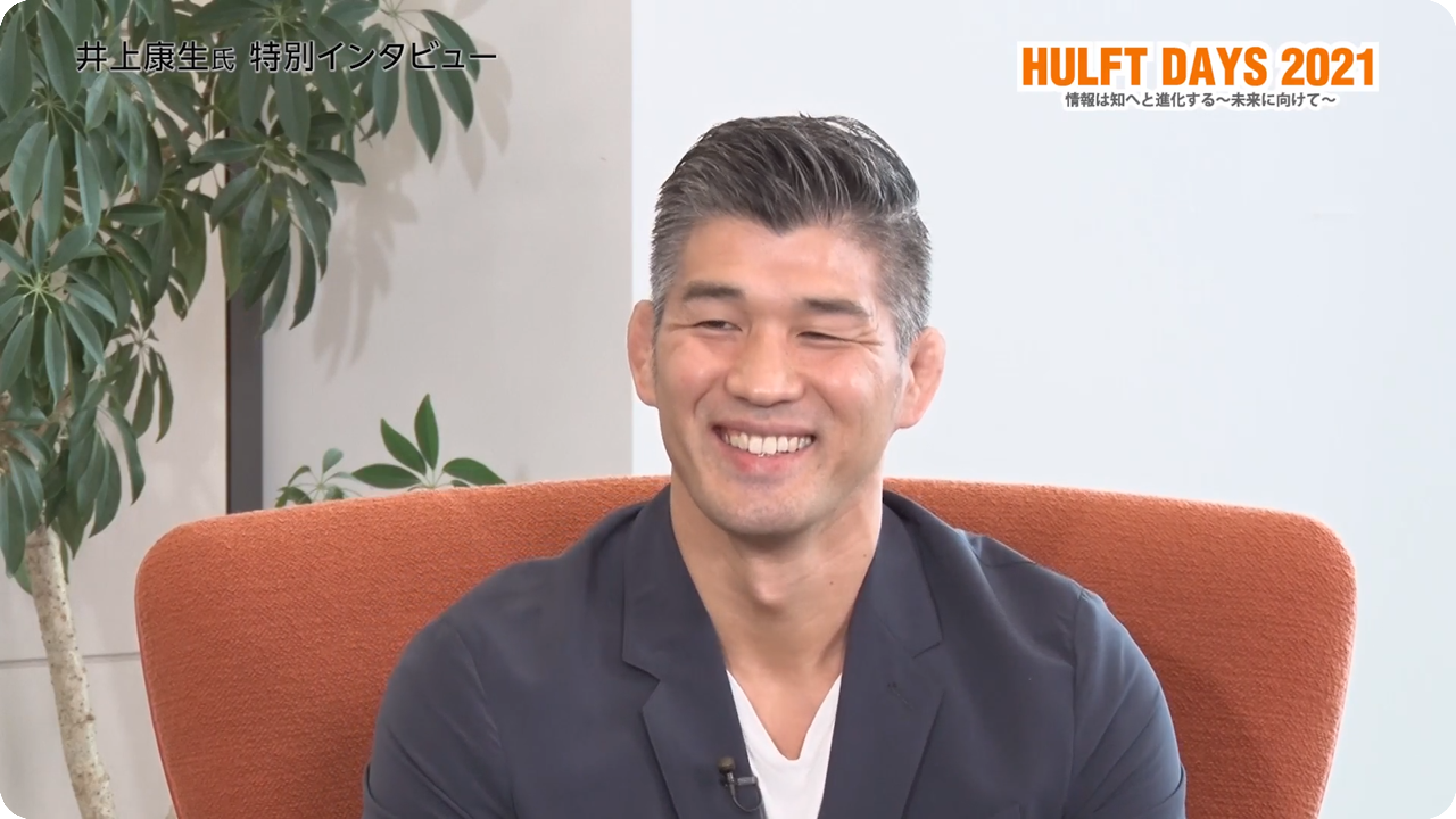
On the first day, November 17th, judoka Kosei Inoue (hereafter referred to as Inoue) took the stage. The Japanese judo team won a record nine individual gold medals at the 2021 Tokyo Olympics. Behind this success was the effective use of data.
How on earth has data been utilized in a sport that is thought to have a strong sensory element? Inoue talked about how to utilize personal data to make the most of team members' abilities and team management.
▼Profile of Yasuo Inoue
judoka
Kosei Inoue, Professor, Department of Martial Arts, Faculty of Physical Education, Tokai University
Born in May 1978 in Miyazaki Prefecture. After attending Tokai University Sagami High School, he graduated from the Department of Martial Arts, Faculty of Physical Education, Tokai University, and completed a Master's program at the Graduate School of Physical Education at the same university. Armed with his sharp inner thigh throw, he excelled in offensive judo, specializing in techniques such as ouchigari, oosotogari, and seoi-nage, achieving numerous successes. He won the 100kg World Championships in 1999, 2001, and 2003. He won the gold medal in the 100kg class at the 2000 Sydney Olympics. He won the All-Japan Championships from 2001 to 2003. He retired from the front line in 2008 and studied in the UK for two years from 2009. After returning to Japan, he served as the All-Japan training coach from 2011 and as the All-Japan men's coach from November 2012. He won medals in every weight class at the 2016 Rio Olympics and a record five gold medals at the 2021 Tokyo Olympics.
*Titles and affiliations are those at the time of interview.
The importance of data that I have felt during my nine years as a manager
I served as the head coach of the All Japan Men's Judo team for nine years, from 2012 to 2021. During that time, when I was thinking about how to develop a strategy for the Tokyo Olympics, the use of data was a major help. As society becomes increasingly digitalized, I believe that by utilizing data in the sports and judo worlds, we have been able to improve the capabilities of the entire organization.
An essential element in utilizing the data was the existence of a special unit called the All Japan Judo Federation Scientific Research Department (hereinafter referred to as "Science Research"). In particular, Takanori Ishii (hereinafter referred to as "Ishii-san") of Science Research was extremely helpful, sharing a variety of information such as personal data on the Japanese national team athletes, as well as match and video analysis.
Personal data was mainly useful for "understanding the athlete's own strengths from both physical and mental perspectives" and "developing strengths and improving weaknesses." Analyzing the opponent's matches allowed me to understand the tendencies of their techniques and how they would match up during a match. Based on that, I was able to make predictions for the next match and devise strategies.
In the world of competition, it's simple: win or lose, that's all. That's why the more you win, the more you shouldn't become complacent, but rather strive for ever higher levels of growth. If you lose, I think it's extremely important to reflect on it and turn it into the energy to win next time. There's a saying that goes, "The battle is always on the battlefield (= the battle is unfolding everywhere)," and the same can be said not only in sports but in many other aspects of the world.
Data is the basis for making the most of players' abilities
Our ideal team building vision was to develop the players' abilities and allow them to demonstrate their individuality. To achieve this, two things were important: a strong sense of self-esteem and risk management skills.
The first point, "strong self-esteem," is what separates the best from the second-rate. Athletes who reach the top all have a strong sense of "I can do it. I'm sure I'll become a world champion." This tendency was also seen in how athletes use their own personal data. Specifically, they look at the data and compare differences in training methods and muscle mass with other athletes, and use it to make up for their own shortcomings.
In this way, data allows you to visualize your current state in numerical terms, helping you to organize your future path. Understanding your current situation and using data to pursue your ideals is an important element in fostering self-esteem.
The second point, "risk management ability," is also extremely important. By assuming the worst-case scenario and making thorough preparations, you can eliminate any gaps and grow to a higher level. Data is also essential for thorough risk management. For example, visualizing the data numerically reveals the tendencies of each player, such as "fouls committed early in the game," "endurance decreases after three minutes," and "losses occur when the game goes to the golden score (overtime)."
This has made it easier to develop strategies to overcome players' weaknesses in advance, avoid risks, and ensure victory in matches. Judo is a sport that requires instantaneous responses, relying on split-second inspiration. It is important to hone your intuition, and it is true that you cannot win without it. However, we have been conscious of taking into account both the "intuition" and the "logical" aspects of our approach. The vast amount of data has played a major role in supporting this.
Strengthening team management through thorough and detailed information sharing
To develop the world's best athletes, we needed to strengthen our organizational capabilities. To achieve this, we first assigned coaches to each athlete's rank, ensuring close communication between the athletes and their coaches.
Next, we divided the support staff into roles such as "physical conditioning, information analysis, mental management, and general affairs." Furthermore, we changed the culture to one where on-site instruction is not top-down, but is left to the coaches and support staff who are professionals in their respective fields.
Having clear division of roles has the advantage that it's easy for players to know who to rely on for what. In fact, the players confided in the coaches and support staff about a variety of things. This has helped to build an open organization, and I think it has become a great team where players can frankly share their opinions as needed.
I'm often asked, "Why isn't there a coach in the box when it's such an important game?" The reason I'm not in the box is because the coaches and support staff in charge know the situation best. I think it's because we thoroughly shared information within the team that we were able to create an organization that could continue to move forward without falling apart even when I, the coach, was gone.
The secret story behind the strategy for the Tokyo Olympics
The judo world did not originally have a culture of working with data, so at first the athletes were confused. However, if it could improve the athletes' abilities by even 1%, it would be better to use data. With this in mind, we started using data, and with the cooperation of Ishii-san and the analysis staff at the Institute of Scientific Research, the athletes gradually began to understand its importance.
During the COVID-19 pandemic, we were extremely helped by footage of past matches. In a situation where we were unable to train properly, Kaken created a system that allowed us to view a huge amount of match footage online. This was revolutionary, as as long as you have an internet connection and a password, you can view the video data at home or at the training ground. Even in the midst of an unprecedented situation like COVID-19, I think it was because we were constantly learning visually that we were able to take part in matches without losing much of our sensory abilities.
Furthermore, data on "refereeing tendencies" and "winning rates of seeded athletes" were key to strategy at the Tokyo Olympics. Regarding refereeing tendencies, data showed that "the speed at which referees issue warnings and penalties is several to several tens of seconds slower at the Olympics than at other international competitions." The reason for this slowness is that the appeal of judo lies in its "techniques."
With the Olympics attracting worldwide attention, referees will be more keen to ensure that the match is decided by skill. Of course, this is just data, so we won't know what will actually happen until the day of the match. Even so, we simulated the refereeing tendencies of previous years and prepared strategically. This time, we decided to fight carefully and patiently without panicking, and aim for one chance even if it went into overtime. That was the strategy we came up with.
At the Tokyo Olympics, four of the five finalists fought to overtime. They were able to win according to their strategy, no doubt because of the data.
The other "win rate for seeded athletes" was based on data from the Rio Olympics. Approximately 84% of athletes who won medals in Rio were seeded. So, one strategy we adopted to win a medal was to "earn the top eight seeds." Not only that, but I think being able to analyze and predict the matches to gain seeded status was also a big step towards victory.
However, simply continuing this way won't make us stronger in the long term. In fact, the International Judo Federation (IJF), like us, is now putting a lot of effort into the field of data utilization. Similar to the Kaken system, anyone can access a huge stock of match footage on the IJF's website. As a result, athletes from all over the world will increasingly use footage of past matches, catching up to us on the same level. I fear that this will also lead to even more opportunities for our movements and strategies to be studied.
I want to use data to its full potential and give back to society, not just the judo world.
Once data utilization becomes widespread among athletes around the world, the next big difference in ability will likely be in how it is utilized. We believe it is important to continue to work on further developing methods for utilizing data while digging into the finer details.
Even if it takes time to climb, it can happen in an instant when you fall. If you compromise or let your guard down even for a moment, you will be swallowed up by the world's strongest athletes. I will keep pushing forward, always remembering my sense of crisis and my willingness to learn.
Finally, our greatest goal is to give back to society the methods of utilizing data that we have cultivated through judo. Winning matches is important, but that is only a small part of our goal. Furthermore, the fact that our athletes were able to perform well at the Tokyo Olympics was not a coincidence, but the result of a series of inevitable events. We would be happy if people could learn at least a little about the existence of the research institute and the tremendous support of the coaches and staff, as well as the athletes' own hard work.
We will continue to work hard to develop the judo world so that we can continue to receive your support.
Related Content
-
Survival Strategy in an AI-driven Society: How will humans live in an artificial super-intelligence society?
-
Applicable AI that can quantitatively judge and evaluate core credit operations of banks - Tips for developing credit screening AI -
-
Grasp insights that cannot be grasped through numbers from text and qualitative information! ~ Characteristics of text classification AI ~