

Starting Data Organization with the KonMari® Method Lesson 1: "When starting data organization, where should you start?"
Lecturer: Takanori Sunako
▼Profile
KonMari Media Japan Co., Ltd. / KonMari Method Business School Founder
He is an active business owner and professional coach who has used the KonMari® Method more than anyone in Japan in corporate management, business management, and communication, both within his own company and other companies. He has been friends with Marie Kondo, creator of the KonMari® Method, for over 12 years, and was a great understander and practitioner of the method until he joined the management of "Team KonMari." He gave up his career as the youngest branch manager of a foreign financial institution, despite opposition from those around him, and reset everything despite being a father of three children. While unemployed, he traveled around the world with his family. He has a long track record of corporate training, online training, lectures, and discussions with celebrities on the business application of the KonMari® Method. (Waseda University, Recruit, Facebook, etc.)
*Titles and affiliations are those at the time of interview.
KonMari Media Japan
KonMari Method Business School
When starting to organize data, where should you start?
Organizing data is essential for business people. However, many people have numerous files scattered across their desktops, and data from years ago stored in the cloud. Before utilizing data, it is important to first create an environment where the data is organized.
This time, we spoke with Takanori Sunako, CEO of KonMari Media Japan, who has introduced many companies to how to apply the KonMari® method in business, about data organization and its benefits.
1. Why the KonMari® Method is Effective for Organizing Data in Business
The KonMari® Method is a tidying method created by tidying consultant Marie Kondo, and is characterized by the idea of tidying up from the perspective of "selecting things that bring joy." The important thing about this method is that "tidying up" is merely the beginning. As a result of tidying up, you can become aware of the things you truly value and discover your ideal self. The process of tidying up using the KonMari® Method leads to a rediscovery of your values.
Now recognized internationally, this method has been proven to be useful in the business world in "Joy at Work: Tidying Up and Creating a Happy Workplace," co-authored by Marie Kondo and Scott Sonnenschein, drawing attention from businesspeople and executives. Living in an information-saturated society, modern people are constantly exposed to vast amounts of data, making daily information organization essential. According to data released by the Ministry of Internal Affairs and Communications in 2020, the amount of information flowing through Japan every second is equivalent to 8 million newspaper pages*. It's now impossible to end a day without coming into contact with information, and we must instantly determine whether the information we receive is valuable to us and our organization. Furthermore, for businesspeople who create new businesses or services, organization is crucial. I, who say this, never had a tidy PC until I left my job after working for a chemical manufacturer and a financial institution. When I was deciding what to do with my work after going independent, I discovered the KonMari® method, and...
"Draw your ideal, present it, select it, and return it"
I empathized with this value and experienced its effectiveness, which is why I've continued to do what I do today. After that, I provided training to various companies, and I witnessed firsthand how even world-renowned IT companies were failing to organize their cloud data. This made me keenly aware of the importance of instilling data organization into business settings. In addition, in 2019, our company also used the KonMari® method to thoroughly organize its data, which resulted in increased efficiency even when working remotely, and doubled sales. Of course, this was before the COVID-19 pandemic.
At first glance, data organization may seem unrelated to improving a company's profits, but in fact it is closely linked. That's why we highly recommend organizing your data to managers who are trying to grow their company and business people who want to expand their scope of activity.
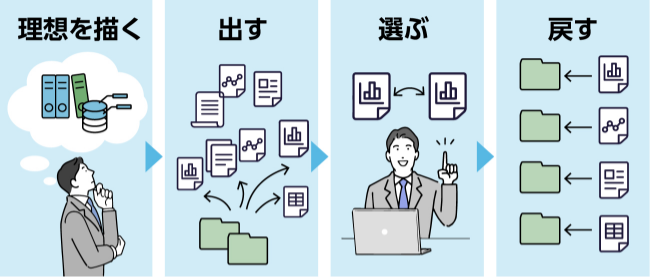
2. The first step in organizing data is to visualize your ideal
The first process in the KonMari® method, and the most important point, is to "envision your ideal." This is also true when it comes to organizing data. There are many cases where the team's ideals are imposed on individuals, or vice versa, but "envisioning your ideal" in organizing data means:
First of all, what kind of data do individuals/companies handle?
It is important to think about the definition. I think that in business situations, multiple teams are working together, and within each team, it is important to first clarify whether the data being used is in documents, Excel, a system, or the cloud.
- Individuals can visualize the ideal state of the data.
- The team draws a picture of the ideal state of the data
Let's try to outline our ideal in this order. When sharing with the team, it's very important to first discuss it with each other, saying, "You have these ideals," rather than trying to impose your own ideals on others. Some people say, "Ideally, about 10 files directly under the shared cloud," while others say, "I think about four is best." Listening to each person's reasons will solidify the team's ideal. Some may wonder what the point is in discussing an ideal state, but in many companies, teams start with ideals established in the past, and the reality is that in many cases, teams "have never even thought about ideals." To ensure that current members are fully aware of what they truly value and what they're aiming for, it's important to first think about and share your ideal. This is the role of the "idealization" process.

3. The next step is to "give it your all"
After envisioning your ideal, the next step is to "put it out," or more specifically, "get it all out." I feel like many people struggle with this "get it all out" process. They only release a certain amount of data, making excuses like, "I don't really need to put this data out," or "There's too much, so I'll save this for another time." However, that defeats the purpose of organizing data. As I mentioned earlier, for better or worse, in this day and age, unlike a bookshelf, data can be stored almost infinitely. Many of us have probably experienced files last updated in 2007 still in the cloud. The longer a file goes unopened, the more likely it is to become buried and difficult to discard. The most common reasons for this are, "Maybe it's actually valuable" or "I might use it someday." However, once it's gone, no one even notices. The reason why leaving unnecessary data around is undesirable is because it can distract you from your thoughts. Just as unfinished tasks can affect your work the next day, leaving unnecessary data behind can lead to poor performance. The reason people can't decide whether they need data or not is because they're either attached to the past or anxious about the future. Either of these factors prevents them from letting go of disorganized data, affecting their thinking. Data is meant to be utilized, not to dominate their thinking.
So, in order to start using data for future use, let's get rid of all the data that hasn't been organized. Properly "getting rid of" this data will also be useful in the final "putting back" process. One of the features of the KonMari® method is that it "prevents rebound." This is because "getting rid of" and "putting back" determine a fixed location for everything. If everything has a fixed location, you won't have to search for or lose things. "I lost my smartphone" or "I can't find my keys" happen because there isn't a fixed location for things. Conversely, have you ever heard someone say "I lost my car" at home? Because there is a fixed location for it in the parking lot, you won't lose your car at home. On the other hand, in department store parking lots, there is no fixed location, so you may find yourself searching for where you parked it. To prevent rebound when putting things back, first make sure to properly "get rid of" everything.
That's all for today's lesson. Thank you very much.
In this lesson, Sunako spoke to those who are about to start organizing their data about the relationship between data organization and the KonMari® method, as well as the first half of the process when actually starting to organize data.
In the next session, we will explain the second half of the process and provide concrete examples of the actual benefits that data organization can bring to your business.