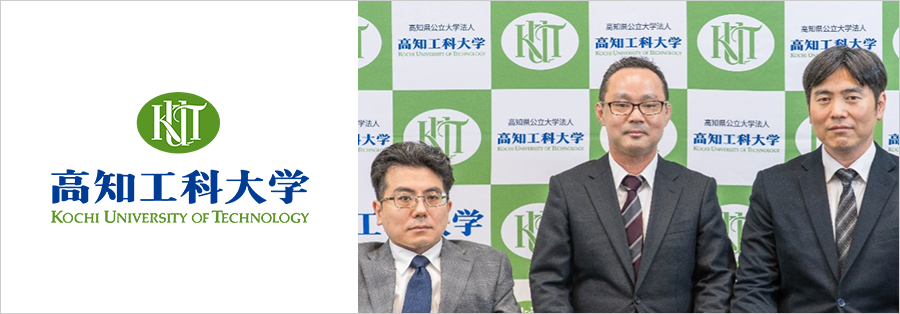
Kochi University of Technology, a public university corporation in Kochi Prefecture that has been quick to adopt advanced educational systems such as a cross-disciplinary cluster system, had education-related data such as entrance examination results, grades, and employment data, as well as management data, scattered across different departments. This necessitated sophisticated information management under appropriate supervision. Therefore, they are utilizing data integration tool" DataSpider Servista" as data integration platform to consolidate data by developing an integrated database.
Customer Issues
We want to develop data integration platform that smoothly connects partially optimized business systems, enabling flexible use of academic and management data scattered throughout the university.
Benefits of implementation
This enables in-house development of data integration, expanding the scope of data utilization.
data integration improves operational efficiency and prevents data omissions and input errors.
Developing a foundation to revitalize Institutional Research (IR)*1 in education.
We aim for overall optimization by interconnecting the most suitable systems for each background task.
Founded in 1997 as a publicly funded, privately operated university, Kochi University of Technology is now a public university that actively incorporates advanced educational systems with the motto of "a university where people grow." In 2024, it established the Data & Innovation School, aiming to cultivate interdisciplinary human resources who possess both an engineering perspective, including data utilization skills, and a broad view of society. It now operates five schools spanning science and humanities: Systems Engineering, Science and Engineering, Information Science, and Economics & Management. In particular, it is focusing on promoting DX in the education sector and is advancing educational reform based on data.
The catalyst for the university's promotion of data integration was the establishment of an Information Gathering Headquarters following a reorganization of the university, which initiated discussions on how information should be managed. "Previously, student data such as entrance exams and employment was managed separately by each department, and one of the challenges was that data utilization was limited to only a few members," recalls Shinichi Yoshida, Professor and Director of the Information Center, Department of Data & Innovation, School of Informatics. In fact, there was a business system that aggregated educational data, but the integration of management data, including financial accounting and personnel and payroll, was insufficient. Therefore, they decided that the most realistic approach was to aim for overall optimization by linking the most suitable systems for each business function.
We highly appreciate the flexible access to various data sources and the fact that it is a platform that can be developed in-house.
One of the requirements for creating a new environment for data integration was that it should be possible to develop the system in-house. "We needed a user-friendly platform that could be developed to a certain extent in-house by general administrative staff in charge of the system, and that could be controlled within the university," says Akihiko Mori, head of the Information Systems Division in the General Affairs Department.
Furthermore, they considered accelerating data utilization by leveraging Dr.Sum, a BI tool they had been using with their existing business systems. However, while access was easy, the number of people who could use it was limited. Therefore, they decided to start by considering how to effectively link the dispersed campus data and build a platform that would allow for proper management and easy data utilization.
When selecting data integration platform, the requirements included flexible access to various on-campus databases such as Oracle and PostgreSQL, the ability to flexibly convert data from various business systems, and the capacity to perform complex calculations, including those for a faculty evaluation system that multiplies various parameters such as the number of pages and the number of authors of published papers. After conducting a bidding process based on these requirements, DataSpider Servista was the only one that met them. "We highly valued its ability to process data in a local environment and its superior calculation capabilities compared to other companies," says Hideji Fukutomi, Deputy Manager of the department.
One of the key factors was that some staff members had experience programming in Java, so they felt a sense of familiarity with the Java Exception error display and highly valued the reliability of the system. "Considering that development can be done through a GUI even without knowing Java, we thought we could establish a system where internal staff could handle it," said Fukutomi, who also evaluated it from the perspective of in-house development.
Because access permissions can be set strictly yet flexibly, it was determined that the security governance requirements could be fully met, and as a result of the bidding process, DataSpider Servista, which demonstrated the best cost performance, was selected as data integration platform.
Effectiveness: Utilized as a core component of the data distribution infrastructure within the university, expanding the scope of data utilization.
Currently, DataSpider Servista is being used as data integration platform within the university. It provides data to over 20 systems and file output destinations, including the academic affairs system, faculty evaluation system, and job information system, as well as the access control system that links with the student master database and the library's automated lending system. It also aggregates information into an integrated database for data utilization. Furthermore, it has been integrated with cloud services such as the safety confirmation system. "DataSpider Servista not only acquires and integrates data from each system, but also provides feedback to input sources such as the academic affairs system," says Mr. Fukutomi. The integration method is also selected according to the specifications of the system being integrated, including ODBC, FTP file transfer, and API integration.
Regarding the daily operation of DataSpider Servista, we check the daily operational status by displaying a list of processing results, and we visualize the integration status using the specification output function. As for data integration, DataSpider Servista has been selected as one of the integration methods when new systems were introduced or when various departments consulted us about data integration, and we have been able to continue stable operation without any major problems.
The company believes that the introduction of DataSpider Servista has enabled them to internalize data integration, expanding the scope of data utilization more than ever before. "If we had been outsourcing data integration work, there would have been many integrations that we couldn't achieve due to budget and time constraints. Acquiring the data necessary for analysis would also have taken more time. Being able to data integration from the user's perspective is a huge advantage," says Mr. Mori. In addition, data integration has made it possible to use student information that was previously entered separately by each department, resulting in various benefits such as increased work efficiency and a reduction in the risk of data omissions and input errors.
Regarding DataSpider Servista, we appreciate its ability to create a highly scalable environment by utilizing a variety of adapters, and its high flexibility in data input and output. We also cite the fact that there are no charges based on the number of projects or scripts as a major advantage, allowing users to easily experiment with ideas such as changing output methods or sending notifications via email.
Outlook: Expectations are high for contributing to the local community through data integration not only within the university but also across the entire organization.
Regarding institutional research (IR), which serves as an important guideline for university management, the need for it has not yet spread widely, as the environment originally allowed for individual staff to acquire and analyze data. However, the infrastructure, including an integrated database, for realizing IR has already been established.
"We feel the need to shift to objective, data-driven decision-making, and we will continue to link entrance exam information, academic performance, and employment data to conduct analyses that lead to the learning of each individual student, as well as to provide information to high school students before they enroll, and to further promote effective data utilization," said Fukutomi. Mori also expressed his expectations, saying, "In the midst of a declining birthrate, we want to reduce the mismatch between universities and students, which will lead to securing and nurturing talented individuals. We plan to make further use of DataSpider Servista from the broader perspective of educational DX."
Furthermore, they aim to promote regional contributions through data integration in regional partnership projects, primarily through the newly established Data & Innovation Faculty. "There is a strong possibility that this will also be used as a common data platform for the entire Kochi Prefectural Public University Corporation," Fukutomi emphasizes.
Furthermore, given that cloud migration is a major trend across educational institutions, iPaaS like "HULFT Square" is a significant development.*2While also considering its use, they are also paying attention to "HULFT DataCatalog," a metadata management tool that promotes data utilization. "As a stepping stone to investor relations, we will continue to actively utilize DataSpider Servista as a foundation for data integration," Mr. Mori said regarding the future.
- Institutional Research (IR) is an activity that involves collecting and analyzing information within the university to improve university management, support students, and enhance the quality of education. This includes formulating, implementing, and verifying improvement measures.
- iPaaS (Integration Platform as a Service) - A cloud service that provides a platform for integrating and linking systems and data.
Kochi University of Technology, a public university corporation in Kochi Prefecture.
- LocationEarth:
- Kami Campus (185 Miyanokuchi, Tosayamada-cho, Kami City, Kochi Prefecture)
- Nagakoji Campus (2-22 Nagakoji-cho, Kochi City, Kochi Prefecture)
- OpenAcademic: April 1, 1997
- Capital: 29,050 thousand yen
- Business Description: We operate with a high aspiration to "constantly pursue the ideal form of a university and aim to become a world-class university," and we conduct innovative university management.
- The content of this case study is current as of the time of the interview. The content of this case study may change without notice.