

Seven Bank, whose purpose is "To go beyond our customers' 'wouldn't it be nice' and continue to create the future of everyday life," has earned the trust of many customers through its convenience and innovation. As a financial institution of a major domestic retail group, the company has been promoting the company-wide utilization and establishment of AI and data since 2018, based on bank account data and detailed shopping data held by the group. In recent years, it has also been actively utilizing generative AI and is undertaking various initiatives to improve business results. HULFT Square was adopted by the company as data integration platform to collect all kinds of data within the company, and as a means for generative AI verification projects. The deciding factors were its ease of use and reliability, comprehensive support, and the ability to build a secure generative AI utilization environment that can be adapted to various environments, which is unique to Japan's iPaaS *.
Customer Issues
- We want to develop a platform that allows us to easily integrate all kinds of data in-house, including business systems, corporate systems, and data from various service systems.
- We want to verify whether this can be used as a means of utilizing generative AI.
Benefits of implementation

From on-premises
From SaaS to all
Compatible with system environment
Easy data integration
realization

It was in line with Japanese customs
easy to use
Interface
In-house development is also easy.

Azure OpenAI Service and
In cooperation, By natural language
For data analysis and verification
contribution
Seven Bank is working on the internal implementation of AI data utilization and generation AI.
Aiming to build a platform that allows for easy data integration
Seven Bank was founded in 2001 in response to customer requests for ATMs in convenience stores. Currently, it operates approximately 28,000 ATMs in Japan and has partnerships with 670 companies. It is also actively expanding globally, and following its expansion into the United States, Indonesia, and the Philippines, it will enter Malaysia in 2024.
Seven Bank's distinguishing feature is that it is the financial institution of one of Japan's leading retail groups. In addition to bank account information, it holds a vast amount of shopping data generated from its stores as a group asset. While payment data can also be obtained through credit cards, the data held by Seven Bank is detailed receipt information that details "when, where, and what kind of purchase was made." Naturally, the level of granularity of the insights obtained is also different.
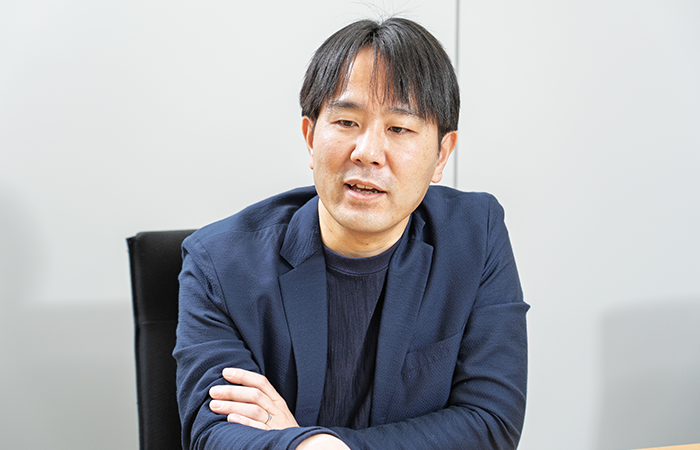
Head of AI & Data Strategy Department
Yoshiyuki Nakamura
To leverage these data assets for business purposes, the company has been working since 2018 to promote and establish company-wide AI and data utilization. At the core of this effort is Seven Bank's AI and Data Strategy Department. Yoshiyuki Nakamura, head of the department, explains, "Even if employees participate in training and acquire data utilization know-how, it's meaningless if it's not put into practice in actual business. Our biggest goal is to 'establish' data utilization in the field."
Therefore, in addition to training, the company is promoting the establishment of data utilization in the workplace through practical boot camps. At the same time, they have also been focusing on AI and working to integrate it into their operations.
AI is a new technology that follows existing IT, a groundbreaking technology that can extract insights that humans have not yet noticed. By quickly utilizing such AI and data in actual management and business operations, significant business benefits can be obtained.
Results are already starting to show. One example is the provision of card loans based on shopping history. Conventional card loans assess creditworthiness based on financial data such as monthly income and borrowings from other companies. As a result, even people with sufficient repayment ability and the ability to repay systematically, such as gig workers who earn income through job search apps for one-off part-time work, had difficulty obtaining loans. In contrast, Seven Bank has improved the accuracy of its screening process by utilizing shopping data in addition to financial data, and has been able to find customers who are eligible for loans but who could not be provided with loans using conventional screening methods.
The company has recently been focusing on the use of generative AI. "Generative AI will undoubtedly become increasingly integrated into our daily lives. Therefore, we will be working seriously on generative AI in fiscal year 2025 to utilize it in our business," says Nakamura.
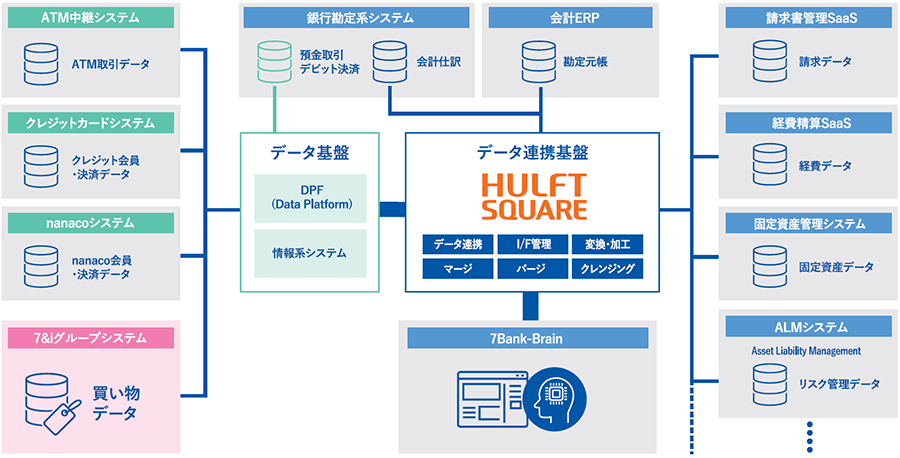
To achieve this, building an internal data infrastructure is essential. The company has a vast number of systems indispensable to its business, including banking accounting systems, credit cards, electronic money, and group-wide CRM. While they had been building a data infrastructure to utilize the data from these systems, considering future development, they needed a more convenient, in-house system that could easily data integration from various data sources.
We introduced HULFT Square in conjunction with the renewal of our accounting system.
Furthermore, it was also adopted for the generation AI verification project.
Seven Bank decided to adopt "HULFT Square," a cloud-based data integration platform (iPaaS), as a mechanism that allows for easy data integration. However, they didn't originally decide to adopt it for its data infrastructure; "the impetus was the overhaul of our accounting system," explains Nakamura.
Seven Bank's accounting system is complex, consisting of a core on-premise banking system as well as SaaS environments for invoice management, expense reimbursement, fixed asset management, and Asset Liability Management (ALM). The process was complicated, with some manual verification required when linking the fixed asset system to the banking system, and accounting operations themselves were becoming highly dependent on individual employees.
To improve this situation, the accounting system was revamped based on the Fit to Standard policy. At the same time HULFT Square was adopted to optimize data integration with surrounding systems. HULFT Square incorporates the technologies of "HULFT," file transfer tool that has been used for over 30 years, and "DataSpider Servista "data integration tool, enabling flexible integration across all system environments, including on-premise, SaaS, cloud, and web.
We decided to utilize HULFT Square for integration with our data infrastructure as well. Mr. Nakamura explains the background as follows:
"Our data infrastructure's data sources include a diverse and robust array of systems, such as banking accounting systems, ATM relay systems, smartphone apps, group CRM, and credit card systems. Some of these are mission-critical systems whose downtime would impact customer service, so until now, we've built our infrastructure using one-to-one data integration to ensure security. However, as we move forward and need to collect data from even more surrounding systems, we'll need a more convenient mechanism. That's why we decided to utilize HULFT Square, which has overwhelming strengths in the data integration field, not only for data integration with our accounting system but also as a bridge to our data infrastructure."
The deciding factors for adopting HULFT Square were that it is a Japanese-developed iPaaS, offering exceptional ease of use and reliability, as well as robust support due to its Japanese origins. In particular, the user-friendly GUI and reliable support were major advantages.
"Actually, we previously considered introducing an iPaaS product when building our data infrastructure, and we looked at major products. However, we decided against it due to issues with reliability, ease of use, and support. HULFT Square is a service originating in Japan, and it was the perfect choice for our company, which plans to develop data integration in-house in the future," says Nakamura. Thus, in the spring of 2024, the project to refresh the accounting system and build data integration platform began.
The use of HULFT Square didn't stop there. HULFT Square was also adopted in the company's generative AI implementation and verification project. This is part of the efforts toward the "full-scale deployment of generative AI from fiscal year 2025" mentioned earlier. The company has developed "7Bank-Brain," an interface that allows for the use of generative AI within the company, and is working to establish generative AI in the field. Currently, they are working on implementing data analysis using natural language.
To implement data analysis using natural language, it's first necessary to generate SQL using an AI based on the input natural language prompt. Then, the SQL query accesses the data source, retrieves the desired data, and executes the analysis—multiple processes are involved. A mechanism for data integration with the original data source is also required. Furthermore, attention must be paid to data security and confidentiality, making the use of generative AI in business settings currently quite challenging.
HULFT Square solved this problem. HULFT Square has a job configuration function that allows multiple processes to be executed. Leveraging this function, the company decided to securely utilize generation AI in the Azure environment for its verification project. A portion of the company's data source, which is in a closed environment, is manually copied and uploaded to the Azure environment, and Azure and HULFT Square are linked. When a user enters a natural language prompt in 7Bank-Brain, HULFT Square calls the generation AI in the Azure environment to generate SQL, graphs, and insights.
"Considering the complexity and security of the implementation, we were hesitant to start verifying natural language data analysis. We looked at several tools, but all of them required us to upload the data to the vendor first, which made us reluctant. When Saison Technology heard about this, they made a proposal, and we realized that we could implement the analysis environment we wanted with HULFT Square, so we decided to proceed with development. I'm really glad we adopted HULFT Square," says Nakamura.
The expected effect is that data analysis using natural language will accelerate the speed of decision-making.
The company is currently on the verge of launching a project to revamp its accounting system, build data integration platform using HULFT Square, and implement and verify a generation AI. Regarding the implementation of data integration, Mr. Nakamura says, "It's HULFT Square 's strong suit, so we feel it will be easy." He adds, "Saison Technology has professionals with deep expertise in data integration and utilization, so we consult with them as needed." Above all, he is optimistic, saying, "Once data integration is achieved, processes that were previously done manually will be automated, making things more efficient and eliminating errors."
One of the goals is to accelerate data integration through in-house development. Currently, the development partner is primarily focused on completion, but after the accounting system renewal and data integration platform are operational, we plan to accumulate expertise in data integration while also utilizing support from Saison Technology.
Further potential benefits can be expected from data analysis using natural language. Nakamura expresses his hope that if this can be realized, "it will significantly change decision-making processes such as management meetings."
"Even when developing new services, we can't take action without analyzing customer situations and trends in their needs. Currently, data analysis requires the use of SQL and BI, so the number of people who can perform this analysis is limited. To address this, we are training individuals like data analysis ambassadors in each department, but the problem will be solved if they can perform data analysis using natural language. In meetings, we can simply ask questions like, 'What are the usage trends of debit cards for customers with a deposit balance above a certain amount?' or 'What are the characteristics of this customer segment?' and we will get answers back, which should significantly speed up decision-making. I expect this to lead to major innovations."
With easily accessible data integration, possibilities expand even further, and we are also considering further utilization of HULFT Square.
Following the completion of the current project, the company has high expectations for Saison Technology's support and follow-up as it aims to promote full-scale in-house data integration. Once data integration platform is established and easy data integration becomes possible, the possibilities will expand even further. HULFT Square not only enables flexible and easy data integration, but it has also been found to be usable for data processing before and after data analysis, so the company is also looking to explore its software applications.
One example is the use of ATM data. Currently, we are testing bank account data, but the landscape will change completely once we can also analyze ATM data.
"For example, ATM services used in urban areas differ from those used in rural areas. Also, usage patterns change when the number of partner banks increases or when fees change. There are 1 billion transactions alone, so it's difficult to analyze them in the usual way, but if we can ask questions in natural language and understand these things, our business will advance significantly. In the future, we would like to include ATMs deployed globally in our analysis," Nakamura said, sharing his outlook for the future.
- iPaaS (Integration Platform as a Service) - A cloud service that provides a platform for integrating and linking systems and data.
Seven Bank, Ltd.
- Head office address: Marunouchi Center Building, 1-6-1 Marunouchi, Chiyoda-ku, Tokyo
- Established: April 10, 2001
- Capital: 30,724 million yen
- Number of employees: 666
- Business activities: ATM platform business, retail, business, corporate, international business, and other general financial services.
- The content of this case study is current as of the time of the interview. The content of this case study may change without notice.