

How to integrate customer data to derive insights

Customer data held by companies contains a wide variety of information, including sales negotiation history, inquiry history, etc. By properly integrating and analyzing this data, it is possible to understand customer behavior patterns and latent needs, and derive insights that are useful for business.
In recent years, advanced data analysis techniques utilizing AI technologies such as Retrieval-Augmented Generation (RAG) and machine learning have been gaining attention. In this article, we will introduce a method for centrally integrating scattered customer data using iPaaS (Integration Platform as a Service) and gaining insights using generative AI.
Challenges in data utilization
To effectively utilize the data a company possesses, it is first necessary to organize the state of data within the organization and establish a system suitable for collecting and analyzing data.
Many companies handle a variety of data at the field level, but do not have a company-wide, centralized data handling policy that assumes data utilization. In such a situation, even if there is data, it is difficult to utilize it across the organization, and companies are likely to face the challenge of linking it to actual business results.
In recent years, it has become common for data to be stored on multiple platforms, such as cloud services and on-premise environments. As a result, even if analysts and decision makers want to quickly obtain accurate information to understand the current situation and make predictions, the multiple data sources can be a bottleneck, making it difficult to quickly use the data.
Furthermore, even if advanced analytical methods using BI and AI are introduced, accurate insights cannot be obtained if there are problems with the quality of the underlying data. Many companies are urgently required to create a system for properly organizing and integrating important information, including customer data.
I don't know where the data is
One of the major obstacles to utilizing data is not knowing where the information resides. When information is scattered across multiple databases and file servers, simply checking all of the sources of information requires a huge amount of effort.
Furthermore, when data is stored in different locations, such as in the cloud and on internal systems, management of access rights and security can become complicated. Unless this situation is resolved, it will be difficult to perform appropriate data analysis.
The first step in utilizing data is to create a data map within the company and visualize what is stored in which system.
I don't know how to analyze the data
When faced with huge amounts of customer and product data, it is often unclear from what perspective the analysis should proceed.Analysis methods vary widely, including statistical analysis and machine learning, but field staff need specialized knowledge to analyze the data themselves, and this skill barrier is one factor hindering data utilization.
One approach to breaking down skill barriers is to provide training for on-site staff on coding skills using SQL or Python, or skills for building dashboards using BI tools. While these efforts contribute to improving the IT literacy of on-site staff, there are limits to how much everyone can acquire these skills.
Generative AI is expected to be a tool to overcome this "skill barrier." The shortcut to success is to properly incorporate generative AI into a data utilization framework and create an environment that is not dependent on skills.
▼I want to know more about machine learning
⇒ Machine Learning | Glossary
▼I want to know more about generative AI
⇒ Generative AI | Glossary
I don't know how to interpret the data
Even if analysis results are obtained, if people don't know how to interpret the numbers and graphs, they won't be able to use them in decision-making.In particular, people with little business experience or staff from other departments often have limited opportunities to acquire specialized data analysis knowledge.
The key to data analysis is discovering new discoveries, or "insights." By uncovering previously unnoticed trends and relationships from the analysis results, you can take action.
When considering how to utilize data, it is necessary to design not only the data itself and the methods for analyzing it, but also how to reflect the results in business.
Where is the data you want to use?
The first step in utilizing data is to clarify what information currently exists and where it resides.
Within a company, data exists in a variety of locations, including on-premise environments, cloud services, and systems managed independently by each department. Without understanding this dispersed information, it is impossible to properly narrow down the targets for analysis.
The longer a company has a history of system migration and consolidation, the more likely it is that data is scattered. It is not uncommon for systems that are common knowledge to field staff to be unaware of their existence by management or other departments.
In particular, customer data is often managed across departments, such as marketing and customer support.

Data is also on-premise
Convenient cloud services are being released one after another these days, but many companies still use on-premise systems due to their security requirements, high customisation capabilities, etc. Nowadays, hybrid configurations that use both on-premise and cloud services according to company policies are on the rise.
When integrating on-premise data, operational hurdles often arise, such as interconnection with existing systems and network configuration, and as a result, the on-premise data can become a bottleneck in the integration.
To solve these issues, it is important to consider migrating to the cloud with an eye toward future scalability, or to create a system that seamlessly connects on-premise data to the cloud using a collaboration platform such as iPaaS.
▼I want to know more about iPaaS
⇒ iPaaS | Glossary
Data ownership is cross-functional
It is very common for data owners to be spread across multiple departments within a company, such as the marketing department for customer data, the sales department for the company's sales performance, and the customer support department for support inquiry history.
Problems that arise when integrating data include differences in departmental organizational structures and approval processes. To overcome these issues, it is important to promote the project as a joint effort that transcends departmental boundaries and build a cooperative system.
Data formats vary
Generally, different systems have different data formats. For example, data in an SFA used by the sales department or a CRM/MA used by the marketing department may be available via a JSON-formatted API, while an inquiry management system used by the customer support department may store data in a CSV file in an on-premises environment.
Another characteristic of the modern corporate environment is the existence of information in a variety of formats, from text data such as emails and social media exchanges to unstructured data such as images and audio.
Integrating this data based on the customer requires format conversion and normalization. Building a data pipeline using iPaaS is effective in streamlining the format unification and preprocessing process.
Customer Data Integration with iPaaS and Generative AI
The key to smoothly connecting dispersed data and enabling advanced analysis and automation is to effectively utilize iPaaS and generative AI. iPaaS functions as a data integration platform that connects various systems and platforms, providing a mechanism for automating the exchange of multiple data sources. It absorbs the differences in APIs and formats that are hurdles to data integration and centrally manages the necessary information, quickly supplying the data required for data utilization.
On the other hand, generative AI can perform advanced analysis on integrated data and produce a variety of outputs, such as natural language reporting and predictive analysis. For example, the technique of generating text while extracting information using Retrieval-Augmented Generation (RAG) makes it possible to present persuasive analysis results by cross-referencing multiple data sets.
In this way, combining iPaaS with generative AI makes it easier to comprehensively resolve existing data utilization issues. A wide range of benefits are expected, including optimizing customer service and after-sales service based on customer data in corporate sales, marketing, and customer support departments, and improving the accuracy of quality control and demand forecasting in production and manufacturing departments.
▼I want to know more about RAG
⇒ Retrieval Augmented Generation (RAG) | Glossary
Integrate customer data
Integrating customer data requires aggregating information from multiple systems, such as CRM and MA tools, and linking it based on a single customer ID or name. By utilizing iPaaS, you can detect data discrepancies and duplicate registrations that occur between different systems, process data such as name matching, and maintain a standardized customer data set.
Based on a standardized customer data set, each department that deals with customers can share and use the information they have about customers.
Generating insights with generative AI
By feeding integrated customer data to generative AI through iPaaS, and the generative AI analyzing it through natural language processing, it is possible to provide suggestions on what is happening and what will happen in the future. For example, when a new or mid-career employee takes over a customer, they can share a summary of past interactions with the customer, or quickly obtain a report detailing what actions should be taken for the customer.
Another potential use case is tracing the effects of new initiatives and changes in customer loyalty by clustering similar customers and extracting purchasing patterns.
Generative AI, which organizes various customer data scattered throughout the company and uses words to organize information, makes it easy for anyone to utilize the results of data analysis.
Realizing AI agents with HULFT Square
HULFT Square, an iPaaS provided by Saison Technology, enables data integration and integration with generative AI without coding.
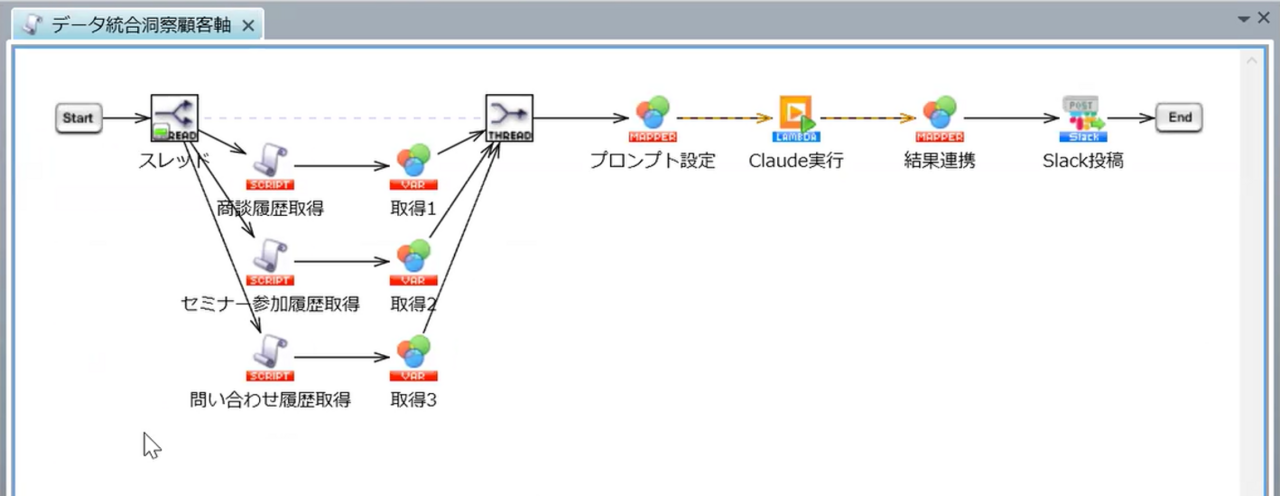
For example, in the above process, sales negotiation data held by the sales department, seminar participation data held by the marketing department, and inquiry data held by the customer support department are integrated, the data is linked to a generative AI (Claude Sonnet model), and the results are posted to a communication tool (Slack).
For example, this series of processes is run every night, and the next morning, an integrated analysis report of customer data as of the previous day is available on Slack, and you can use the contents of the report to devise a strategy for how to promote sales.
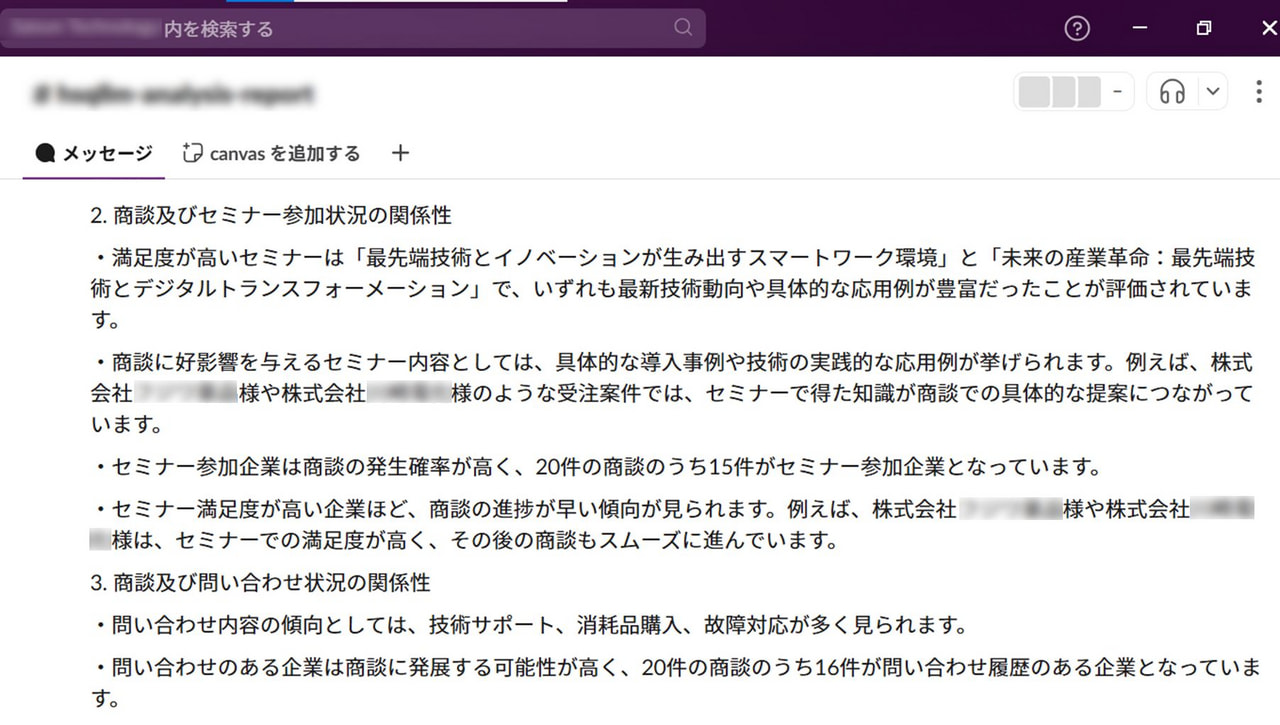
Collecting, integrating, and analyzing this data manually would require a huge amount of time and effort, including coordination between departments and development work. However, by connecting various data sources with generation AI using HULFT Square, it is possible to promote data utilization as an agent that works together with business operations.
summary
By integrating and analyzing customer data using iPaaS and generative AI, it becomes possible to solve issues arising from differences in data location and format, and to create insights from data more quickly than ever before and apply them to business purposes.
This time we used customer data as an example, but useful insights are needed in a variety of business processes, including not only customer data but also product data, employee data, and more.
Use Saison Technology's "HULFT Square" to integrate data lying dormant within your company and extract maximum value from it.
The person who wrote the article
Recommended Content
-
Why we recommend iPaaS for data integration | A thorough explanation of iPaaS
We will thoroughly explain why iPaaS is suitable for data integration, how it differs from traditional methods, and how it is actually used. -

Generative AI opens up the "democratization of data"
Through our use case studies of generative AI, we will explore specific approaches to breaking through the "two barriers" that prevent all employees from utilizing data. -

Get an online consultation about data utilization
If you would like to hear more about our data utilization platform, we also offer online consultations.
Related Content
-
The Use of Generative AI in Talent Management: From Intuition to Data-Driven Approaches
-

What is CDC (Change Data Capture)? – A method for securely and reliably transporting data from on-premises systems.
-

data integration techniques for character code conversion—preparing for a mix of SJIS, JEF, and Unicode.