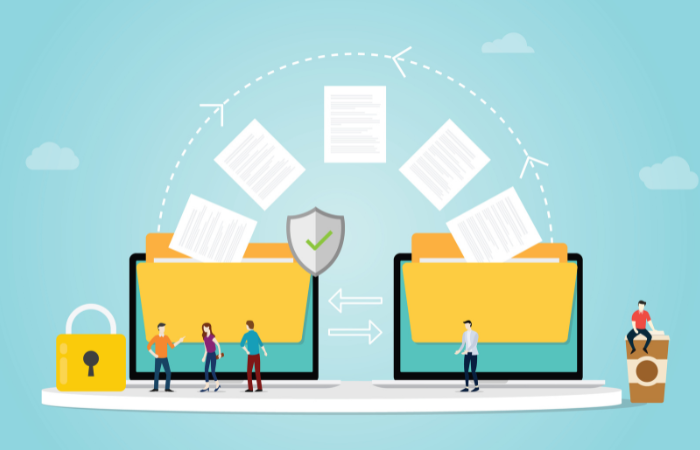

Understand the roles and types of protocols used for file transfer

For safe and fast file transfer
Understand the protocol!
Large volumes of data cannot be sent or received as email attachments. When exchanging such data both internally and externally, it is common to use file transfer services. Anyone who has ever updated a website, either internally or privately, has likely used file transfer software.
As you can see, many people are adept at using file transfer services even if they don't know the details of file transfer works.
Behind the scenes of file transfer services, there are things called "protocols" that we don't usually pay much attention to. We've summarized the mechanisms, roles, and types of "protocols" that are inseparable from file transfer.
1. A protocol is the "convention that computers use to exchange data" when file transfer
1-1 Why do we need protocols for file transfer? - Protocol mechanism
When sending a file using file transfer service, you are not sending large amounts of data as is. Large file transfer are transferred by breaking down the data into pieces of a certain size, sending it all, and then reassembling it (these broken down pieces of data are called "packets"). For this reason, it is necessary to decide in advance how to exchange packets and how to reassemble the received packets into the original data. This agreement is called a "protocol."
1-2 When file transfer, large amounts of data are sent and received in separate chunks.
Let's explain this with a more concrete example. Let's say you are sending a 1GB image file using file transfer service. In this case, you cannot send the entire 1GB of data to the receiving computer. The 1GB of image data is broken down into smaller pieces according to a predetermined protocol, and then these smaller pieces are sent one by one to the destination computer, where they are reassembled into the original data. When sending and receiving,
- How to decompose the data
- How to deliver packets
- How to reassemble the packets into the original data
This decision is the protocol.
file transfer services exchange packets at high speeds, so it feels as if you are sending a large file in its entirety all at once.
1-3 Sending and receiving packets is like two people handing over a package while checking in with each other.
The process of sending small pieces of data (packets) is similar to a bucket brigade run by humans. It may be easier to understand if you imagine two computers passing packets back and forth while "verifying" each other.
- PC-A: "I'm going to send you 1GB of image data now."
PC-B: "Got it. Let me know when you're ready to break it down into packets and send it." - PC-A: "Disassembly complete. I'll send the divided data packets now."
PC-B “Understood” - PC-A: "I'll send the packet now."
PC-B: "Received." - PC-A: "Sending the next packet."
PC-B: "I received everything. I'll reassemble it into the original data."
Large amounts of data are transferred by two computers communicating with each other, exchanging small pieces of data down to the last one, and then restoring the data to its original state.
2. Types and characteristics of representative file transfer protocols
There are several types of protocols that are actually used for file transfer. Below we will introduce the most commonly used protocols.
(1) HTTP (HyperText Transfer Protocol)
This is a protocol that is often used by software (web browsers) used to view homepages.
(2) FTP (File Transfer Protocol)
It is a protocol used when updating websites and sending and receiving data via computers called servers. However, there are concerns about security when sending and receiving important information such as passwords.
(3) SCP (Secure Copy Protocol)
It is basically the same as FTP, but it uses a method called SSH to encrypt data before sending and receiving it, so you can transfer important data such as passwords safely.
(4) SFTP (SSH File Transfer Protocol)
Like SCP, it is a highly secure protocol that encrypts data before sending and receiving it.
The difference between SCP and SFTP is speed and whether transfers can be resumed. SCP transfers data quickly, but cannot be resumed if interrupted. SFTP transfers data slowly, but has the advantage of being able to resume transfers even if they are interrupted.
3. Summary
The most commonly used protocols for file transfer are:
- What to use when safety is a priority
- What to use when data transmission speed must be prioritized
They can be broadly divided into:
Generally, when it comes to file transfer protocols, safety and speed are not proportional. If you are sending important data that requires confidentiality, it is better to use file transfer service that uses a highly secure protocol, even if it takes longer.
It may be worth checking what protocol your company's file transfer system uses. Using the optimal protocol will ensure safe and speedy file transfer, ultimately making your daily work even smoother.

File Sharing: A Beginner's Guide Column List
- File Sharing: An Introduction
- The dangers of "shadow IT" that you should be aware of before using data integration services
- File sharing services: 5 things you need to know when selecting one
- Pitfalls of free file transfer services! Information leakage prevention
- Understand the roles and types of protocols used for file transfer
- Is a file sharing service the best option for sending and receiving large files?
- The ever-increasing volume of data is making file transfer a struggle.
- Three benefits of large-capacity file transfer software that prioritizes ease of use
- Four things to be aware of when data integration
- How to data integration?
- file transfer via HTTP? ISDN will end in 2020
- MFT enables file transfer that FTP cannot.
- No more need for USB flash drives? 3 ways to transfer data over LAN
- Improve business efficiency with data integration platform! Three benefits
- Convenient! How to use Bluetooth for file transfer
- How to use file transfer services that you may have thought you knew about
- Key points to consider when choosing data integration middleware
- Recommended file transfer services to improve business efficiency
- A reliable ally for data integration! Efficient conversion and effective utilization through ETL
- How to data integration with Salesforce
- data integration middleware makes your work more efficient
- This is recommended! data integration service that is conscious of security
- Efficient data integration and siloed system integration through EAI
- When integrating systems with overseas bases, improve work efficiency with English-language tools!
- Three benefits of centrally managing system integration
- A DI platform that data integration scattered throughout the company