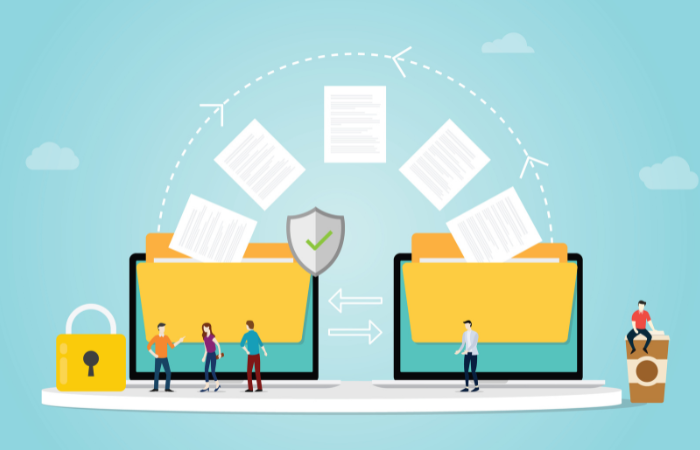

How to use file transfer services that you may have thought you knew about

What is file transfer service? Basics you need to know and tips for choosing
When file transfer as a company, there are many things to consider, such as security, speed, and the ability to file transfer at once. Choosing file transfer service that combines all of these is extremely important in terms of improving business efficiency and reducing the risk of information leaks. In this article, we will introduce the basics and types of file transfer services, as well as explain what kind of service a company should choose.
1. Representative file transfer services
In the past, when exchanging files between headquarters and branches, or with business partners, media such as email, FTP, USB, and CDR were commonly used.
However, email has a limit on the amount of data that can be sent at one time, FTP requires specialized knowledge, and media such as USBs and CDs are at risk of being lost or stolen, and take a long time to reach the recipient, so they are not used much these days.
Currently, the most common file transfer methods used by businesses are online storage and file transfer services. Let's take a look at the features of each.
(1) Online storage
This is a service that allows you to upload and store files on disk space provided online. Also known as cloud storage, well-known services include Google Drive and Dropbox. It is generally free to use, but you will need to pay if you want to increase the storage capacity or add features.
The method for file transfer using online storage varies slightly depending on the service, but basically the sender creates a shared folder on the online storage, saves the file, and obtains the URL for that folder. The recipient can then access the URL to receive the file.
(2) file transfer service
Similar to online storage, you upload files online and exchange them by sending their URLs. However, file transfer services do not rent the same disk space forever, but rather upload files to a different location each time. This service is also free, but there is a fee if you want to file transfer at once.
Both services are frequently used by businesses because they allow for high-speed transfer of large files, which is difficult to achieve using media such as email, FTP, or USB. However, these services have not only advantages but also disadvantages.
2. Problems with file transfer services
Online storage and file transfer services, which are generally free, are convenient because they allow you to transfer large files at high speeds. However, these services have two major disadvantages: the risk of information leaks and the difficulty of managing file transfer.
Both services offer a certain level of security when they become paid services. However, they still require many users to share a single server. Furthermore, the URL of the file's saved location must be communicated via email, which leaves room for human error, such as sending an email to the wrong person. Therefore, the risk of information leaks remains.
Additionally, the inability to keep a record of file transmissions is a major compliance issue when companies use these services for business purposes. Another disadvantage of using these services is that you cannot manage important files in-house.
3. Why we recommend corporate file transfer services
Despite security and management issues, many companies still use file transfer services and online storage, despite many anxieties. However, companies that are sensitive to security risks are increasingly banning the use of online storage and file transfer services. These companies are turning to corporate file transfer services.
Corporate file transfer services offer high-performance services, including security features such as encryption of communications, restrictions on sending permissions, and restrictions on recipient addresses, as well as high-speed transfers, transfer history management, resend in the event of a transfer error. Furthermore, if you choose a service with an interface that anyone can use intuitively, it doesn't require specialized knowledge like FTP. Furthermore, there's also the flexibility to customize the features you need based on each company's frequency of use, purpose, and the volume of files being sent.
Some of file transfer services introduced in the previous section also offer paid services aimed at businesses. However, they do not necessarily have all of the features mentioned above. The reason we recommend corporate file transfer services is that they offer a full range of features that solve the issues and concerns of traditional file transfer.
summary
There are a variety of services available for transferring files. Individuals can handle any file transfers within the scope of their personal responsibility, regardless of the service they use. However, this is not the case for businesses. Many issues, such as security and speed, must be resolved. To reduce the risk of information leaks and improve business efficiency, why not consider introducing a corporate file transfer service?
Eliminate the issues and concerns you have had up until now and enable safe, high-speed transfer of large volumes of files!
File Sharing: A Beginner's Guide Column List
- File Sharing: An Introduction
- The dangers of "shadow IT" that you should be aware of before using data integration services
- File sharing services: 5 things you need to know when selecting one
- Pitfalls of free file transfer services! Information leakage prevention
- Understand the roles and types of protocols used for file transfer
- Is a file sharing service the best option for sending and receiving large files?
- The ever-increasing volume of data is making file transfer a struggle.
- Three benefits of large-capacity file transfer software that prioritizes ease of use
- Four things to be aware of when data integration
- How to data integration?
- file transfer via HTTP? ISDN will end in 2020
- MFT enables file transfer that FTP cannot.
- No more need for USB flash drives? 3 ways to transfer data over LAN
- Improve business efficiency with data integration platform! Three benefits
- Convenient! How to use Bluetooth for file transfer
- How to use file transfer services that you may have thought you knew about
- Key points to consider when choosing data integration middleware
- Recommended file transfer services to improve business efficiency
- A reliable ally for data integration! Efficient conversion and effective utilization through ETL
- How to data integration with Salesforce
- data integration middleware makes your work more efficient
- This is recommended! data integration service that is conscious of security
- Efficient data integration and siloed system integration through EAI
- When integrating systems with overseas bases, improve work efficiency with English-language tools!
- Three benefits of centrally managing system integration
- A DI platform that data integration scattered throughout the company