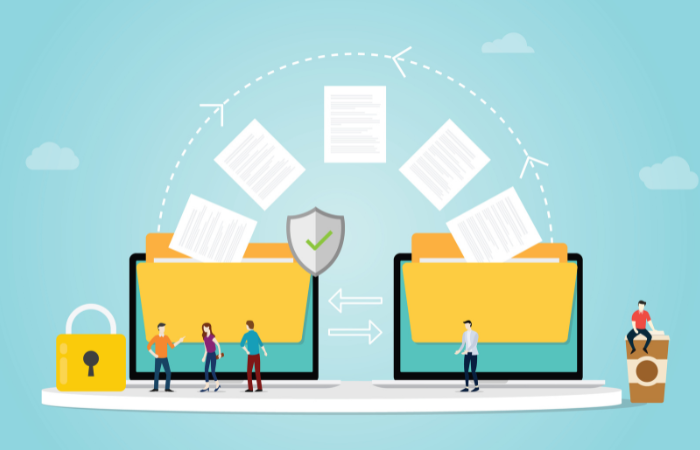

How to data integration with Salesforce

Two ways to data integration Salesforce with your internal systems
The number of companies utilizing cloud services is rapidly increasing. However, many companies still prefer to operate mission-critical system, core system, which handle important customer and accounting data, on-premises. As the system environment changes, there is a growing need to link "cloud data, which is advantageous in terms of cost and speed of implementation," with "on-premises data that cannot be sent outside." In this article, we will introduce two methods for data integration between cloud services and on-premises systems, using Salesforce, a particularly popular cloud service, and the cloud-based system integration service "HULFT Square" as examples.
1. If you want to data integration with Salesforce in real time, we recommend "Database Integration"
"Database integration" is a method of data integration between Salesforce and internal systems by using the cloud-based system integration service "HULFT Square" to directly access the database on the internal system.
Specific examples
- In Salesforce, the user clicks the "Check Inventory" button.
- "HULFT Square" on the Internet directly accesses the company's inventory database
- "HULFT Square" acquires inventory information and passes it to Salesforce
- Inventory is displayed in a popup on Salesforce
merit
- "HULFT Square" directly accesses the database of the company's internal system, enabling real-time data integration with Salesforce.
- By simply introducing "HULFT Square," you can data integration between Salesforce and on-premise systems.
Points to note
Since "HULFT Square" directly accesses the company's internal database via the Internet, network security must be taken into consideration.
2. If you want to data integration with Salesforce but are worried about security, we recommend "File Integration"
"File integration" is a method of data integration that involves sending and receiving files between Salesforce and internal systems via the cloud-based system integration service "HULFT Square," rather than directly accessing the database of the internal system.
This is suitable for companies that cannot (or do not want to) directly access their internal systems due to security or system specifications.
2-1 If you want reliable file integration with Salesforce, we recommend HULFT interface
There are several ways to "link files" between Salesforce and your internal systems, but here we will explain how to use HULFT, a Japanese file transfer and data integration tool that has held the top domestic market share for 12 consecutive years (*1) and the fourth largest global market share (*2).
Specific examples
- The internal system file transfer inventory data to "HULFT Square" via HULFT.
- "HULFT Square" processes the received inventory data and updates the Salesforce data via HULFT.
- A user views a report of inventory data in Salesforce.
merit
Using HULFT unique features, such as encryption of communications and files, delivery confirmation, retry processing, and data compression, you can achieve safe, reliable, and high-speed data integration.
Points to note
It is not suitable for real-time data integration.
2-2 Other "File Linkage"
As a method of "file integration" with Salesforce without using HULFT,
- "FTP integration"
- "WebDAV integration"
- "Collaboration via cloud services"
etc.
Both are examples of integration methods that utilize the cloud-based system integration service "HULFT Square."
Each method has its advantages and disadvantages, so choose the best integration method based on your requirements.
summary
Salesforce has been ranked the No. 1 CRM software vendor for three consecutive years in Gartner's worldwide CRM software market share report (*3).
The report also states that the market share of sales force automation (SFA) systems in Japan is 60.4%.
As more companies utilize cloud services, the need to connect with data from on-premise systems will increase.
DataSpider, data integration tool developed and sold in-house by Saison Technology, is a "connecting" tool with a long track record, having achieved the No. 1 share (*5) in the EAI/ESB and SaaS markets. HULFT Square, a data integration platform and iPaaS developed in Japan, is a "connecting" cloud service developed using DataSpider technology, and seamlessly supports integration processing using HULFT, a file integration middleware.
Please use this as a reference for one way to data integration between cloud services such as Salesforce and your internal systems.
- 1 Source: Chimera Research Institute, Inc., "2004-2010 Package Business Solution Marketing Handbook," "Software Business New Market 2010-2015 Edition," (Package and value basis)
- 2 Source: Chimera Research Institute, Inc. "Software Business New Market 2016 Edition" (Package and Value Basis)
- 3 Source: Salesforce.com, Inc., news release dated May 25, 2015
- 4 Source: Gartner, Inc., March 6, 2014 news release
- 5 Source: Fuji Chimera Research Institute, "New Software Business Market 2014 Edition"

HULFT Square
By facilitating distributed data integration and reducing the risks and hassle of data utilization, we strongly support our customers' digital transformation efforts.
File Sharing: A Beginner's Guide Column List
- File Sharing: An Introduction
- The dangers of "shadow IT" that you should be aware of before using data integration services
- File sharing services: 5 things you need to know when selecting one
- Pitfalls of free file transfer services! Information leakage prevention
- Understand the roles and types of protocols used for file transfer
- Is a file sharing service the best option for sending and receiving large files?
- The ever-increasing volume of data is making file transfer a struggle.
- Three benefits of large-capacity file transfer software that prioritizes ease of use
- Four things to be aware of when data integration
- How to data integration?
- file transfer via HTTP? ISDN will end in 2020
- MFT enables file transfer that FTP cannot.
- No more need for USB flash drives? 3 ways to transfer data over LAN
- Improve business efficiency with data integration platform! Three benefits
- Convenient! How to use Bluetooth for file transfer
- How to use file transfer services that you may have thought you knew about
- Key points to consider when choosing data integration middleware
- Recommended file transfer services to improve business efficiency
- A reliable ally for data integration! Efficient conversion and effective utilization through ETL
- How to data integration with Salesforce
- data integration middleware makes your work more efficient
- This is recommended! data integration service that is conscious of security
- Efficient data integration and siloed system integration through EAI
- When integrating systems with overseas bases, improve work efficiency with English-language tools!
- Three benefits of centrally managing system integration
- A DI platform that data integration scattered throughout the company