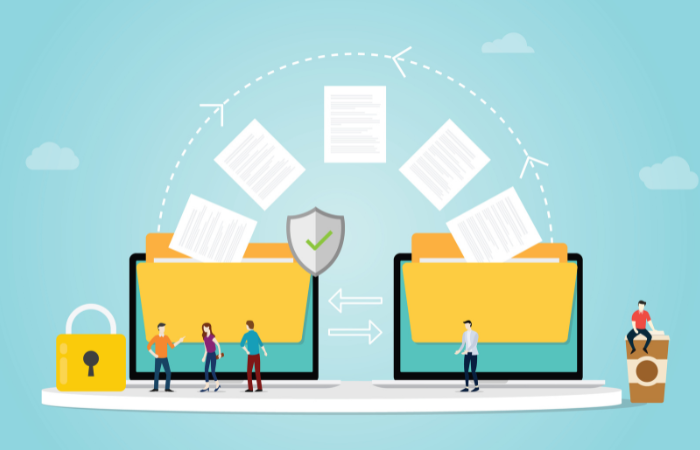

This is recommended! A data transfer service that is conscious of security
The dangers of companies using data transfer services they cannot control
In recent years, the volume of data exchanged has grown exponentially, making it difficult to transfer data using traditional methods such as email attachments and FTP. Therefore, it has become common to use free data transfer services and online storage services that allow for high-speed transfer and sharing when exchanging large amounts of data. However, with the proliferation of various transfer service options, companies are no longer able to standardize on one service, leaving it up to individual employee discretion as to which service to use. Leaving it up to individuals makes it difficult to identify and understand the cause of an information leak in the unlikely event that one occurs. From a risk management perspective, it is important to standardize data transfers across the company.
1. The problem with leaving it up to employees to use data transfer services
It is no longer uncommon to transfer large amounts of data, not just Word or Excel files, but also videos, images, and other large amounts of data. Although the survey is a little old, the results of a survey on data transfers conducted in March 2014 targeting companies (*) showed that 38.6% of respondents routinely transfer large amounts of data of 1MB or more. As of 2014, this figure was around 40%, so it is expected that this number has increased even further.
- Survey conducted by Hitachi, Ltd. and ITmedia, Inc. in March 2014
There is no doubt that a great deal of data contains confidential company information and important information. The current situation in which the transfer of such information is left to the discretion of each employee poses many problems, including the possibility of information leaks, the possibility of virus infection during data transfer, and the lack of a transfer history. The biggest problem is that companies are unable to manage data transfers that occur on a daily basis. Not managing data transfers, which often involve the exchange of confidential information, is a clear indication of a lack of risk management on the part of the company.
2. Why companies cannot consolidate their data transfer services
Ideally, it would be desirable to introduce a corporate data transfer service that allows for secure, high-speed transfer of large volumes of data, but there are several reasons why companies cannot standardize their data transfer methods.
- Unable to secure the budget to introduce a corporate data transfer service
- No time or budget to spend on employee training for corporate data transfer services
- I don't know which business data transfer service to choose from the many options available.
In fact, there is another major reason. That is that management does not understand the risks that can arise from not centralizing data transfer. "There haven't been any problems so far, so I'm sure it will be fine in the future. I would rather invest my budget in things that directly lead to sales."
In fact, according to a December 2016 report on "Management Issues for Japanese Companies" published by the Japan Management Association (JMA) Management Institute, the top management issue felt by managers nationwide (multiple answers allowed) was "improving profitability" at 44.5%, followed by "strengthening human resources (recruitment, training, and responding to diversity)" at 39.3%, and third place was "expanding sales and market share (including strengthening sales power)" at 33.6%. In comparison, "utilizing IT technology and strategic IT investment" came in 17th place at 2.8%, and "formulating risk management and business continuity plans" at 18th place at 2.4%, all ranking quite low.
These results also show that business managers have a low sense of crisis about security risks and a low level of willingness to invest in IT technology, which may be one of the reasons why companies are unable to standardize their data transfer services.
3. We recommend a data transfer service that anyone can use easily.
While investing in a data transfer system certainly does not directly improve profitability or lead to increased sales or market share, from a long-term perspective, consolidating into a single corporate data transfer service can significantly reduce the risk of information leaks and improve operational efficiency, ultimately contributing to increased profitability and sales for the company.
Additionally, issues that arise when implementing the system include the need for employee training and concerns about the system being dependent on individual personnel, but there are also easy-to-use services available, such as free data transfer services and online storage. We recommend first trying out services that allow anyone to transfer data after a simple training course.
summary
Leaving data transfers to the discretion of employees is extremely dangerous from a security standpoint, and if something were to happen, the company's stance would be called into question. The best way to avoid this situation is to introduce a corporate data transfer service that anyone can use easily. Consolidate your company's data transfer service and create an environment where large files can be transferred safely and quickly.
File Sharing: A Beginner's Guide Column List
- File Sharing: An Introduction
- The dangers of "shadow IT" that you should be aware of before using data integration services
- File sharing services: 5 things you need to know when selecting one
- Pitfalls of free file transfer services! Information leakage prevention
- Understand the roles and types of protocols used for file transfer
- Is a file sharing service the best option for sending and receiving large files?
- The ever-increasing volume of data is making file transfer a struggle.
- Three benefits of large-capacity file transfer software that prioritizes ease of use
- Four things to be aware of when data integration
- How to data integration?
- file transfer via HTTP? ISDN will end in 2020
- MFT enables file transfer that FTP cannot.
- No more need for USB flash drives? 3 ways to transfer data over LAN
- Improve business efficiency with data integration platform! Three benefits
- Convenient! How to use Bluetooth for file transfer
- How to use file transfer services that you may have thought you knew about
- Key points to consider when choosing data integration middleware
- Recommended file transfer services to improve business efficiency
- A reliable ally for data integration! Efficient conversion and effective utilization through ETL
- How to data integration with Salesforce
- data integration middleware makes your work more efficient
- This is recommended! data integration service that is conscious of security
- Efficient data integration and siloed system integration through EAI
- When integrating systems with overseas bases, improve work efficiency with English-language tools!
- Three benefits of centrally managing system integration
- A DI platform that data integration scattered throughout the company