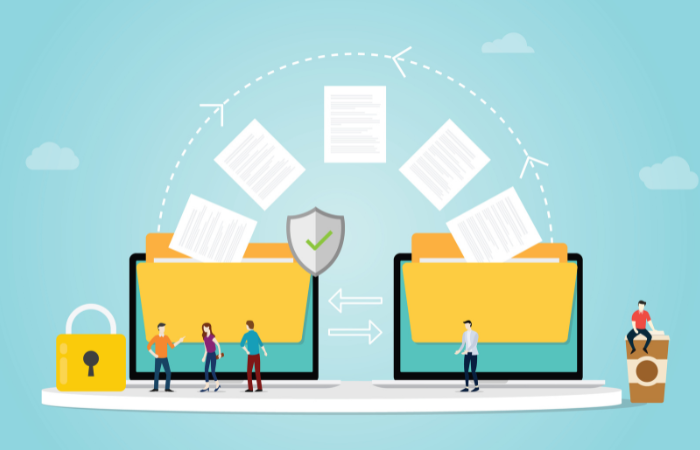

Three benefits of centrally managing system integration

Three benefits of centrally managing system integration
Are you troubled by inefficient system operations and opaque data integration?
Companies have a wide variety of systems, including core information systems, legacy business systems developed exclusively for their own companies, and cloud services. When systems are linked individually in a complex IT environment, the paths become complicated and redundant, and various problems arise. Here, we will introduce the concept of centralized management, which centrally links and manages distributed systems, and its three benefits.
1. Problems that arise from unified system integration
When integrating internal systems, it is often the case that specific data is transferred to multiple systems simultaneously, or that data transferred from one system is reformatted and transferred to another system.If data transfer is configured and operated separately between each system, when a failure occurs in one system, it can take time to determine which transfers have been completed and which have not, and retransmissions may have to be performed manually.
Furthermore, if data transfer is scheduled to involve reformatting or retransfer to another system, the failure of one data transfer will cause all subsequent processes to fail.Furthermore, the generation of a large number of alert emails notifying of the failure can place an unexpected load on the server, which can lead to secondary damage such as email delays.
Recently, an increasing number of companies are using the cloud for some of their internal systems. In order to individually link existing legacy systems with multiple cloud systems, it is necessary to implement a connection interface for each cloud system. As a result, it is not uncommon for large-scale changes to existing systems to be required and development times to be extended.
2. What is centralized management of system integration?
When linking individual systems, the larger the scale and number of systems that are linked, the more complex the routes become, making maintenance and management more difficult. For stable system linkage, it is urgent to build a relay point that connects different systems in a single location, rather than connecting distributed systems individually. Then, create a common data repository at that relay point, and each system can connect to the data repository at any time to retrieve only the data it needs. In this way, centralized management creates, manages, and operates a mechanism that centralizes system linkage.
3. Three benefits of centralized management of system integration
3.1 Improved reliability
Reliability is improved by centralizing the management of system integration. Centralized management allows data to be temporarily stored in a common data repository at a relay point. Even if data transfer fails due to a system failure, the stored data can be used to automatically redistribute the data to only the system where the failure occurred.
In addition, because all linked systems are connected to a relay point and visualized, it is possible to quickly identify the point where a failure occurred and the extent of its impact. Furthermore, if a failure occurs in one system, it is possible to automatically stop subsequent related processing, thereby reducing the sending of unnecessary alert emails.
3.2 Improved maintainability
Centralized management of system integrations makes it easier to manage changes to system integrations and improves maintainability.
Even if new systems to be integrated are added, the only thing that needs to be done is to connect the relay point to that system, so the setting changes are fixed. Even if a setting error occurs, the scope of the impact is limited. The entire system integration process can be visualized in one place, so even people without specialized knowledge can easily understand the whole picture.
3.3 Improved connectivity
With centralized management, the data to be linked is transferred via a relay point. This means that data integration can be achieved easily and quickly, regardless of the specifications of the existing system that actually stores the data or the type of application. In addition, once the connection function is created at the relay point, it can be used from other connected systems.
summary
Continuing to connect distributed systems individually can lead to complex data integration routes. This can make it time-consuming to identify and recover from problems when a failure occurs, and can make it difficult to quickly adapt to new systems or technologies. To avoid this situation, centralize system operation and management to ensure efficient and stable system connection.
»Optimize and automate operational management! HULFT-HUB centralizes system integration management
File Sharing: A Beginner's Guide Column List
- File Sharing: An Introduction
- The dangers of "shadow IT" that you should be aware of before using data integration services
- File sharing services: 5 things you need to know when selecting one
- Pitfalls of free file transfer services! Information leakage prevention
- Understand the roles and types of protocols used for file transfer
- Is a file sharing service the best option for sending and receiving large files?
- The ever-increasing volume of data is making file transfer a struggle.
- Three benefits of large-capacity file transfer software that prioritizes ease of use
- Four things to be aware of when data integration
- How to data integration?
- file transfer via HTTP? ISDN will end in 2020
- MFT enables file transfer that FTP cannot.
- No more need for USB flash drives? 3 ways to transfer data over LAN
- Improve business efficiency with data integration platform! Three benefits
- Convenient! How to use Bluetooth for file transfer
- How to use file transfer services that you may have thought you knew about
- Key points to consider when choosing data integration middleware
- Recommended file transfer services to improve business efficiency
- A reliable ally for data integration! Efficient conversion and effective utilization through ETL
- How to data integration with Salesforce
- data integration middleware makes your work more efficient
- This is recommended! data integration service that is conscious of security
- Efficient data integration and siloed system integration through EAI
- When integrating systems with overseas bases, improve work efficiency with English-language tools!
- Three benefits of centrally managing system integration
- A DI platform that data integration scattered throughout the company