

Starting Data Organization with the KonMari® Method Lesson 2: "Criteria for Selecting Data and its Impact on Business"
Lecturer: Takanori Sunako
▼Profile
KonMari Media Japan Co., Ltd. / KonMari Method Business School Founder
He is an active business owner and professional coach who has used the KonMari® Method more than anyone in Japan in corporate management, business management, and communication, both within his own company and other companies. He has been friends with Marie Kondo, the creator of the KonMari® Method, for over 12 years, and was a great understander and practitioner of the method until he joined the management of "Team KonMari." He gave up his career as the youngest branch manager of a foreign financial institution, despite opposition from those around him, and reset everything despite being a father of three children. While unemployed, he traveled around the world with his family. He has a long track record of corporate training, online training, lectures, and discussions with celebrities on the business application of the KonMari® Method. (Waseda University, Recruit, Facebook, etc.)
*Titles and affiliations are those at the time of interview.
KonMari Media Japan
KonMari Method Business School
"Data Selection Criteria and Business Impact"
In Lesson 1, we explained the relationship between the KonMari® method and data organization to business people who are looking to organize their data, and the first half of the process for actually organizing data.
In Lesson 2, following on from last time, we spoke with Takanori Sunako, CEO of KonMari Media Japan, who has introduced many companies to how to apply the KonMari® method in business, about data organization and its benefits.
1. Finally, the data is organized through "select" and "return"
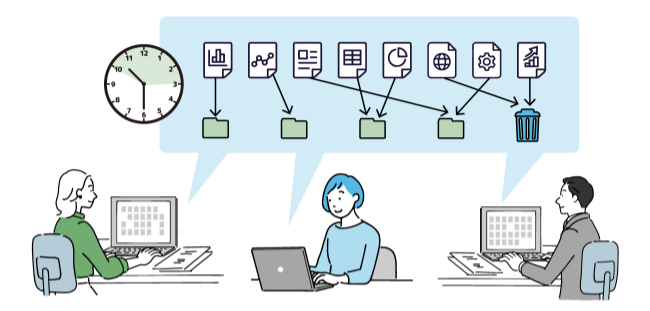
After "getting it all out," which we talked about last time, comes the process of "selecting." In the KonMari® method, the criterion of "whether it excites you" is important when it comes to this "selecting" process. However, it's difficult to base your data organization on "whether it excites you." It's possible that someone on your team might throw away an important file because "it doesn't excite me." Therefore, when it comes to "whether it excites me" when organizing data, we recommend "selecting" based on three criteria. The three criteria are:
- What I'm using now
- Things that are needed for a certain period of time
- Things you need for life
There are three. Basically, data that fits these three criteria will move on to the next process, which is to "return" it. If you are organizing data as a team, make sure to set up a certain safety net and have a final check on data that does not fit these three criteria. Many people are unable to distinguish between necessary and unnecessary data, so it is very important to check data using these three criteria.
Once you've finished "selecting," all you have to do is put the things you selected back. This is exactly the state where "only the things that spark excitement remain." If we look again at the four processes of data organization that we've discussed so far,
- ①Draw
- ② Put out
- ③Select
- ④Return
The process is as follows. The actual time it takes to organize data in this way varies greatly from person to person, so it's difficult to generalize. However, if I could offer one piece of advice, it's best to set a target time and do it all at once, rather than dragging it out over time. In the KonMari® method, the period of tidying and organizing is called a "tidying festival." When you think about why festivals are so fun, I think it's because they're done over a short period of time, like a day or a few days at most, rather than over weeks or months. The same goes for tidying up; it's important to enjoy it like a festival by doing it in a short amount of time. Set a time limit and approach it with a positive attitude.
2. The first step in organizing data is to visualize your ideal
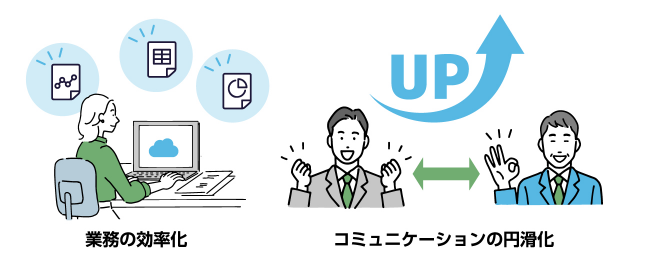
What happens when you organize data? First, you no longer have to search to retrieve data. A common occurrence is when you search to find data, but end up with a lot of data coming up because of the keywords you searched for, and you can't find the data you're looking for. However, when data is organized, it's numbered according to established rules and ideals, and the location of the data is clearly defined, so you can click and get to it faster than searching. Just like searching an index in a library, where you can immediately tell which shelf and which row the book you're looking for is on, organizing your data can create the same situation.
Eliminating the need for search in this way improves work efficiency and saves time. And time savings also lead to smoother communication. For example, when a boss instructs a subordinate to "please complete that task," both the boss and the subordinate know where the data needed to complete the task is, which increases the subordinate's speed in responding to the request. The pressure of the request is reduced, allowing the subordinate to work more relaxed. And because the hurdle for the boss to make a similar request is lowered, communication between the two becomes smoother and builds trust. Organizing data is also very useful for this type of communication. There are also cases where problems and errors have been reduced. During training at a transportation company, tidying up data and office equipment reduced unnecessary meetings and overtime, ultimately resulting in a reduction in the number of accidents. While it's difficult to say for sure whether tidying up and the number of accidents are directly related, I was surprised to see the reduction in accidents as a result of tidying up. In other industries, human error and typos in manuscripts may also be reduced.
Another benefit of data organization is that it clarifies what a company really needs to do and its USP (Unique Selling Proportion: a company's unique strength and point of differentiation that gives it a competitive advantage). It's easy to understand this with an individual analogy: for example, "Hey, you did this job last time, so please do it again this time," and employees are often forced to do work that doesn't fully demonstrate their skills. To use baseball analogy, it's like a pitcher being forced to play catcher for an extended period of time. In baseball, this can be easily adjusted, but in a company, this kind of thing continues to happen due to inertia and hierarchical relationships. That's why it's important to organize data after clearly defining your ideal as a team, so that everyone shares your USP.
3. What I would like to say to those who are about to start organizing data
Finally, I would like to say to those who are about to start organizing their data:
Let's stop and think for a moment
The KonMari® Method is not the optimal solution for everyone, but it is one option. With so many options available, it's important to clarify your own values and work style before making a choice. Even the question of "why do I work?" can be influenced by the way others think and not your true intentions. While we are born with the power to "make our own choices," living in a world overflowing with options and information can unknowingly bury our own opinions. By reconsidering why we work and what we enjoy, we may discover hidden feelings. Whether we choose the KonMari® Method or another method is up to us. So, first, take a moment to pause and reflect. I've observed many individuals and businesses from the perspective of tidying up, and I've seen many people solve their problems by reevaluating their values and challenges and organizing their data. Instead of rushing to organize data, take a moment to pause and think. This is the shortcut to organizing data and moving closer to your ideal.
That's all for today's lesson. Thank you very much.
Following on from Lesson 1 and Lesson 2, we have provided information on data organization. Sunako says that her goal will remain the same: "To continue creating an exciting and comfortable working environment for employees, the company, and our business partners." Why not start organizing your data and find a way to work that makes you happy?

Related Content
-

The Use of Generative AI in Talent Management: From Intuition to Data-Driven Approaches
-

What is CDC (Change Data Capture)? – A method for securely and reliably transporting data from on-premises systems.
-

data integration techniques for character code conversion—preparing for a mix of SJIS, JEF, and Unicode.