

Data Utilization Course by Professor Mai Sato: Lesson 1: "How do you utilize data in business?"

Lecturer: Mai Sato
▼Profile
Mai Sato is a data utilization consultant. She is the representative partner of Delta Create LLC and a member of the Marketing Science Society. Her introductory book on data utilization and statistics, "First Statistics: Which Line Moves Faster at the Cash Register?!" (Sogo Horei Publishing), has been ranked number one in many bookstores.
*Titles and affiliations are those at the time of interview.
LESSON 1 explanation video by Mai Sato
How do you utilize data in business?
In this lesson, we will provide information to help business people take the first step in utilizing data.
The goal of the lesson is
- Business people can get an overview of how to utilize data
- Understand the benefits of using data
There are two:
1. The need for data utilization
First, let's talk about the need for data utilization. Over the past few years, many terms related to digital data and digital communications, such as "5G," "IoT," and "DX," have emerged. I'm sure many of you have heard these terms before. Digital data development is progressing rapidly, and it's said that by 2025, the amount of data circulating through 5G will be more than double the current amount. Meanwhile, the current state of digital data utilization among Japanese companies is significantly lower than in developed countries. In other words, Japan's use of digital data still has room for growth. Furthermore, the COVID-19 pandemic has led to an expansion of telework, increased e-commerce use, and the spread of cashless payments, and the amount of data accumulated within companies is expected to explode. Given this background, it's been said that we need 10 times the number of data utilization personnel we currently have.
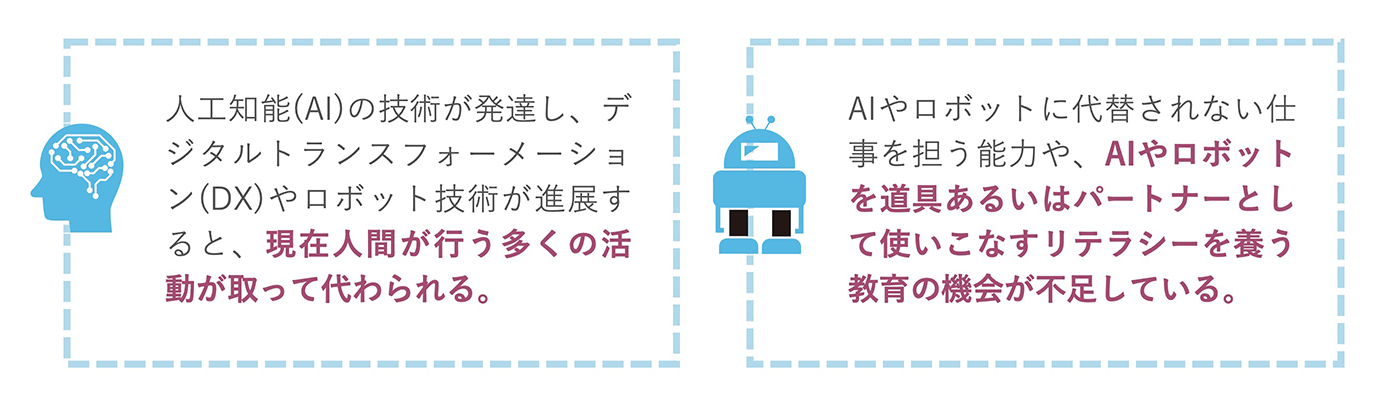
So far, I've focused on the situation in Japan, but data analysis education is a global issue, not just in Japan. A report titled "List of Social Issues Expected to be Solved by Innovation" (*1), published by the Innovation Network for Co-creating the Future (INCF), run by Mitsubishi Research Institute, mentions that many human activities will be replaced by AI and digital transformation, and that there are insufficient educational opportunities to develop the literacy to use AI and robots as tools or partners. In my own words, the report's content is that, "We will undoubtedly become a society where we will coexist with an abundance of data, so it will be extremely important for business people to acquire data literacy."
2. Typical examples of data utilization failure
However, even if you suddenly decide to use data, you may not know where to start. There are many cases where people rush into introducing expensive BI tools * only to end up failing to use them effectively. Here, we will introduce two typical examples of failure in data utilization.
- BI tool: A software tool that analyzes and visualizes various data (such as generating graphs of the analysis results) to help with management and operations.
- The system that was introduced at a cost of tens of millions of yen was difficult to use, and in the end, it was managed using Excel.
- They paid expensive external data scientists to analyze the data, and the results were limited to deriving known facts.
The first factor is the misconception that "if we just install some kind of tool, we can utilize the data." The second factor is the naive belief that if we ask a data scientist, who is an expert on data, they will make new discoveries that we don't know about.
I would like you to use the examples above as a negative example and read on with the perspective of "how to avoid this."
3. Successful examples of data utilization
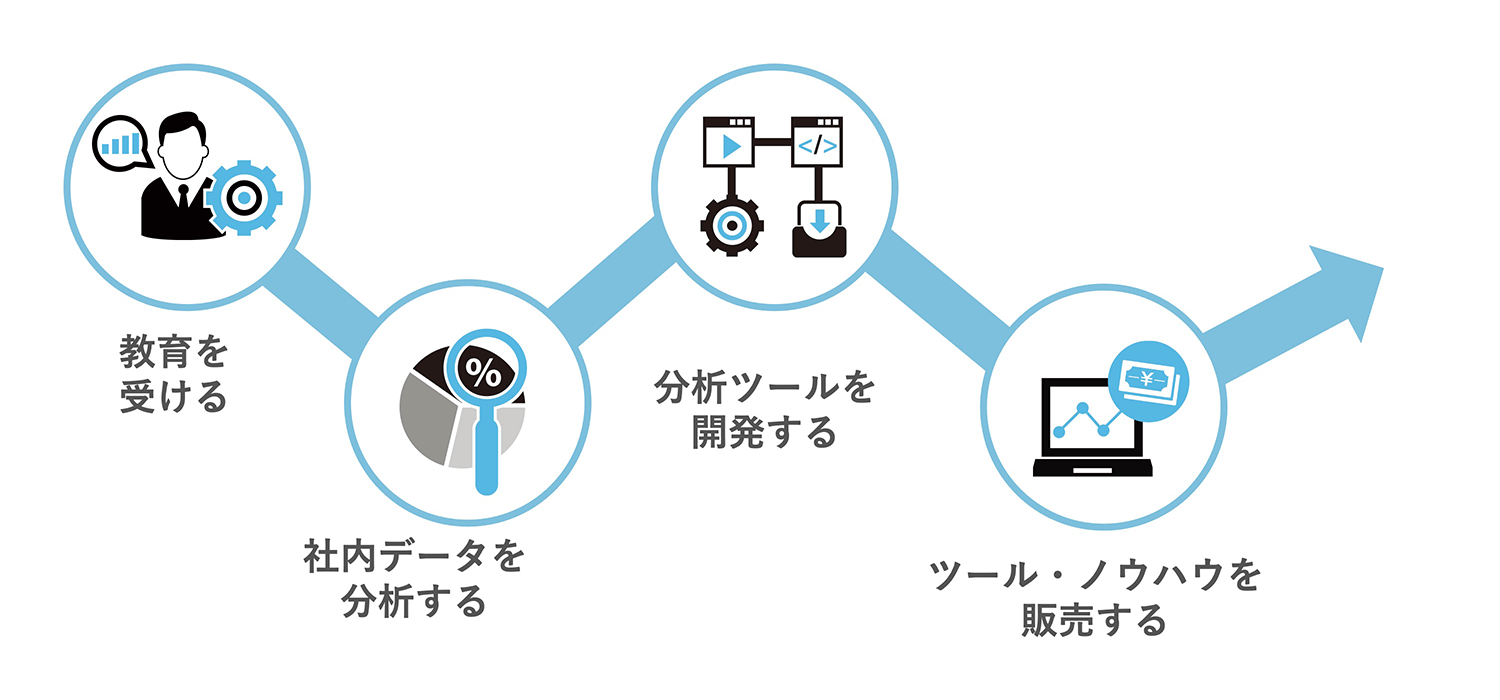
Let's take a look at some key points for successful data utilization. Workman Co., Ltd., arguably the most successful data utilization company in Japan, employs a management policy called "Excel Management for Everyone," placing the utmost importance on having on-site staff at each store view data in Excel and develop and verify hypotheses. This is due to a deeply rooted culture of data-driven decision-making. By making decisions based on data, rather than determining the importance of opinions based on position or title, the company has also succeeded in increasing the reproducibility of its business. As this initiative demonstrates, data analysis skills are, like reading, writing, or arithmetic, something anyone can acquire. Therefore, to successfully utilize data, we strongly recommend developing in-house the methodology (data utilization know-how) and personnel and systems capable of using BI tools (data aggregation and processing) rather than outsourcing. Data analysis capabilities can also be a competitive advantage for companies. In-house data utilization and selling the system as a tool to competitors can lead to increased profits. Furthermore, data analysis capabilities can be retained as an asset that is difficult for other companies to imitate. It's said that companies that have adopted the popular subscription-based business model are recording an average growth rate eight times higher than the S&P 500 stock index. However, it's not enough to simply introduce IT tools; the most important thing for a growing company is to analyze data and gain customer insights, that is, to utilize all the discoveries that can be made from data. Therefore, I would like you to make good use of IT tools, utilize data internally, discover new value in your company's data, and seize business opportunities.
4. What is the purpose of using data?
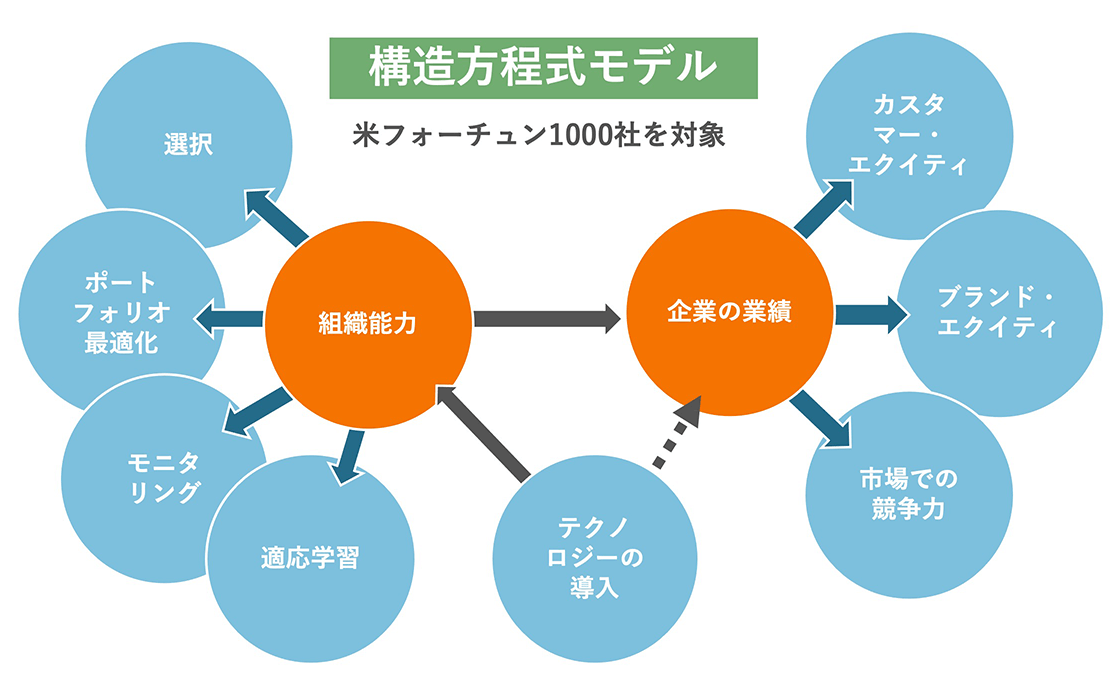
Next, I'll discuss the purpose of data utilization. Some of you may be thinking, "I want to get started using data right away!" However, just as cooking requires not only enthusiasm but also ingredients and utensils, data utilization also requires some preparation. Before considering the question of "what tools should I use?", which you may be wondering about, there's something I want you to keep in mind. Once I've covered that, I'll move on to more specific topics. As I've discussed so far, data analysis is an effective way to improve business performance, but it's also extremely important to be aware of the process involved. Statistics that compile information on the factors that influence corporate performance show that the introduction of technology does not directly affect performance. So what does have a significant impact? The answer is organizational capabilities—that is, a company's decision-making mechanisms. Statistics also show that the introduction of technology is highly effective in improving organizational capabilities. In other words, when introducing tools, it's important to choose based on whether they will promote the company's decision-making mechanisms, rather than whether they will improve business performance.
So far, I have been talking about the benefits of utilizing data for companies, but in fact, there are also great benefits for individual careers. In a nutshell, "Being good with numbers makes life easier." It's a pretty catchy phrase, but there is a lot of evidence behind it. For example,
- Improve problem-solving skills
- Higher income
- Increased life satisfaction and happiness
This is something that has been proven by research, so I would like you to hone your ability to handle numbers in order to advance your career as an individual.
5. What does it mean to be "able to utilize data"?
Now, let's start the summary. When using data, it is important to get an idea of what it means to be able to use data. Being able to use data may seem like an extremely high hurdle, but it's actually not that difficult. My idea of being able to use data is:
- A state in which numbers are used as a common language and communication is possible
- Share numbers in real time and have meetings based on those numbers
I would like you to aim for these states first. What benefits will you gain from this state? First, there will be no need to create reports. For example, in my experience, I have seen many companies where area managers tally up numbers, create beautiful graphs, and spend an entire day compiling materials for a 10-minute sales meeting. Spending time compiling materials for every meeting is quite a tedious task. One company I support chooses not to create reports for their twice-weekly sales meetings. Each sales representative keeps daily sales records and uses a spreadsheet system to automatically tally them. In meetings, they can simply share the spreadsheet and discuss things like, "Mr. A's current performance is here, so this is how far they are from their target." Sharing real data thus saves time, but it also has other benefits. While reports and reports are characterized by the ability to present only the data you want to see, depending on how they are compiled, from the client's perspective, showing real data rather than processed reports can also help build trust.
We will discuss the next step, "formulating hypotheses while looking at data and verifying them," in the next lesson, so that's all for today. Thank you very much.
- Innovation Network for Co-creating the Future (INCF) "Resolving Social Issues Through Innovation -2020 Listings of Societal Issues"
Related Content
-
The Use of Generative AI in Talent Management: From Intuition to Data-Driven Approaches
-
What is CDC (Change Data Capture)? – A method for securely and reliably transporting data from on-premises systems.
-

data integration techniques for character code conversion—preparing for a mix of SJIS, JEF, and Unicode.