

"Digital Transformation" Dialogue | Part 1 - DX is a Management Issue (Part 2)
This is a conversation between ITR Chairman/Executive Analyst Satoshi Uchiyama and Saison Information Systems Technical Advisor Kazutoshi Ono, on the theme of "Digital Transformation (DX)" from a management perspective. Following the first part, which discussed how to proceed with DX initiatives, the second part will discuss the importance of data, which holds the key to DX, as well as the role that the information systems department plays.
An era in which data becomes a business resource
Uchiyama
Going forward, data will become the most important business resource of all. We are entering an era where data itself will be sold for a fee, and the presence or absence of data will determine the success or failure of a business. Therefore, I believe that a prerequisite for management will be to first have a foundation that allows for a firm grasp of "what kind of data we have as a management resource," "where that data is located," and "how it can be used."
Currently, as is the case in the manufacturing industry, there are many cases where the importance of the huge amount of data generated every day is not recognized, and the data is simply stored without being utilized. It seems that large Japanese companies in particular are not taking sufficient inventory of their data.
Ono
There's a term called "data encapsulation." It refers to wrapping data in a capsule, like a medicine capsule, to hide its complexity and make it usable like a cold medicine, without even needing to think about what's inside. For example, HULFT and DataSpider have previously encapsulated various procedures for data exchange, including protocols and character codes. Going forward, as Uchiyama mentioned, we're entering an era where we must delve into the contents of the data being exchanged. I believe that the encapsulation of metadata, such as "where the data is" and "how frequently it is updated," is a requirement for digital transformation.

Uchiyama
That's right. Companies have a lot of data to monitor, such as power operation data at power companies and operation data for production machinery in the manufacturing industry. While some companies are unable to inventory their data, an increasing number of companies are considering whether they can generate insights from this data. In the past, it was the case that "even though using this data in a certain department would be extremely useful, the opportunity was missed because the department was unaware of the data's existence," but recently, more and more companies have realized that new discoveries can be made by reviewing operations and processes from a data perspective.
Ono
When trying to visualize what kind of data is available across the entire company, doing it manually is a lot of work. We thought that rather than each company having to go through this hardship, a tool vendor like us should absorb it and make it easier, and so we announced "DataCatalog" as a product that enables this kind of metadata encapsulation. Metadata will become increasingly important from the perspective of DX, so we feel that we have to take on that role.
There is a need for an environment where people can confront data
Uchiyama
When promoting DX, some companies create new DX promotion organizations, some look to their IT departments, and some drive it through business departments.While it's up to the company to decide which department takes the lead, in either case, if digital literacy, and especially "data literacy," is low, it will be difficult to keep up.
Ono
I had the opportunity to attend several data scientist gatherings in the past, and I discovered something interesting. I'm a programmer, and to develop an eye for programs, or the ability to tell at a glance whether a program is good or where the problems lie, you need to spend a certain amount of time looking at source code. It seems the same thing can be said about data. I heard that it's only by constantly facing data that you develop the intuition that "there's something wrong here" or "if we have this data, then if we also have this other data, we'll get some kind of result."
Uchiyama
This is what we call the skill of a master craftsman.

Ono
For example, at Saison Information Systems, materials used to be in Excel for management meetings, but we've switched to Tableau, a self-service BI tool. We extract data from various sources, convert, merge, and aggregate it, and then display it in Tableau. This is data integration for visualization purposes, but recently we've seen an increase in projects like this, where data integration to bring data scattered across various locations to the front line. The only way to improve data literacy is to continue to engage with data. To engage with data, it needs to be presented in a way that makes it easy to engage with. I think this is why projects like this are on the rise.
Uchiyama
When you have data in front of you, there are two types of intelligence that can make you realize that it may be related to your work: the intelligence that a data scientist discovers using their expert skills, and the intelligence that gives you insights in your daily work. Tools are necessary for experts, and as a fundamental element of daily work, it is necessary to be able to know what data is where at any time. I feel that the latter type of data that is buried in the field is actually a treasure trove.
What IT should do in DX
Ono
I believe that DX should primarily be "outward-facing," such as customer experience and business competitiveness. While there may be some internal business efficiency improvements that could be called DX, I believe we should focus on DX that faces customers. What do you think, Uchiyama?
Uchiyama
I thought the same thing at first, but recently my opinion has changed a bit. As in the case of visualizing data at the management meeting mentioned earlier, I think it's fair to call it DX if new value can be found in using digital technology to improve internal efficiency. For example, although RPA was previously said to not be DX, there are now cases where it has been used to achieve things that were previously impossible. Perhaps combining this with AI will enable even more advanced capabilities. If we consider the question of whether it is helping to establish a competitive advantage, these efforts could also be considered DX in a broad sense.

Ono
I see, so that's one way to look at it. Perhaps because DX has the word "digital" in it, it's often thought that IT departments should be in charge. If DX in the narrow sense is customer-facing DX, I thought it would be difficult for IT departments, which have been in charge of internal systems until now, to achieve this, but in a broader sense of DX that also includes internal efficiency, it seems that IT departments can also contribute directly. Also, even in the narrow sense of DX, even if IT departments themselves are not the main players, they will have no choice but to use new technology, so they will probably be indirectly involved.
Uchiyama
That's right. It's not enough for IT departments to stay as they are. This ties back to the "bimodal" idea we discussed earlier, but efforts will be needed to streamline the Mode 1 portion of the business that they have been responsible for up until now. On top of that, IT departments themselves will need to make efforts to adopt "ambidextrous management," incorporating the latest technologies, development methods, and operational methods, while simultaneously streamlining and upgrading existing operations and developing new businesses.
It's also important to provide a foundation that allows the on-site departments promoting DX to come up with creative ideas. When trying to promote DX, it would be problematic if the data infrastructure was fragmented or the data quality was poor, and it would be easier to move forward if there were sophisticated mechanisms for knowledge sharing and collaboration. It's also the role of the IT department to create and promote such an environment, including data visualization. Furthermore, when taking on new challenges, they may be expected to have the "eye for expertise" to advise on the latest technologies.
DX aimed at through bimodal
Ono
On a personal note, I became CTO of Credit Saison on March 1st. The financial industry is one where failure is not an option and there is a strong tendency towards Mode 1, but I believe that it would be very significant if we could bring about change here. I believe that DX should be something that faces the customer, so I would like to advance this at Credit Saison as well.
The biggest change in the digital age is the spread of smartphones. Almost all business companies are being asked to redesign their businesses to suit the smartphone era, so I would like to move forward with this with our in-house team. There is debate about whether development should be done in-house, but I believe that these Mode 2 areas, areas where customers can feel that they are working to change the customer experience through DX, should be primarily handled in-house. We are gathering engineers for this purpose from various places, but it is meaningless if they are not connected internally, so as someone who says "bimodal," I would like to move forward while saying, "I understand both sides' feelings."
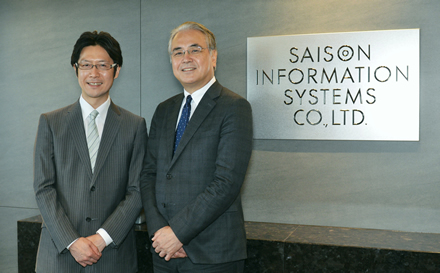
Uchiyama
Credit Saison is one of the companies in Japan with the most customer data, so there are likely many areas where it can be utilized in business. In the classification of "Aggressive IT Strategy Stocks" promoted by the Ministry of Economy, Trade and Industry and the Tokyo Stock Exchange, Credit Saison falls into the "Other Financial" category. This is a somewhat diverse field that includes leasing companies and non-banking companies, but on the other hand, it is also the field that is easiest to break into and take on. If this were to change significantly, I think the banking and securities industries would also start to feel anxious, so I hope that people will say, "Credit Saison has been doing something amazing lately."
List of "Digital Transformation" Dialogues
- "Digital Transformation" Dialogue Part 1 - DX is a Management Issue (Part 1)
- "Digital Transformation" Dialogue Part 1 - DX is a Management Issue (Part 2)