
Can't telework because of paper documents?! AI-OCR advances paperless workflow

As many companies are encouraging employees to work from home through telework to protect them from the raging novel coronavirus disease (COVID-19), many people may have become keenly aware of the importance of teleworking, along with the delay in their own companies' efforts to implement it.
On the other hand, one of the hurdles preventing the promotion of teleworking is the existence of paper documents. With a large amount of paper documents such as slips and application forms, it is not possible to take these documents home, which hinders the progress of teleworking.
This time, we will introduce "AI-OCR," which is said to be effective in going paperless, which is essential for promoting telework.
"Paperless" is a prerequisite for promoting telework
"Telework" refers to "using information and communication technology (ICT) to work without being restricted by time or location." Because it allows people to work from home or other locations other than the office, it makes it possible to work from home while raising children or caring for the elderly, and in recent years it has been attracting attention as a means of "work style reform."
The introduction of telework is becoming increasingly important for companies, both to accommodate employees' diverse working styles and to enable employees to work from home amid restrictions on going out as a countermeasure against COVID-19.
To make teleworking a reality, it is necessary to create an environment where work can be carried out from anywhere. To achieve this, going paperless is essential. Tasks such as entering data into a company's system while looking at paper documents are difficult to perform from home due to physical issues and information security concerns, so it tends to be assumed that employees will have to go to the office.
To promote teleworking, it is essential to go paperless by digitizing paper information. There are several methods for going paperless, but one that is attracting attention is "AI-OCR."
Utilizing AI-OCR to automate everything from character reading to system integration
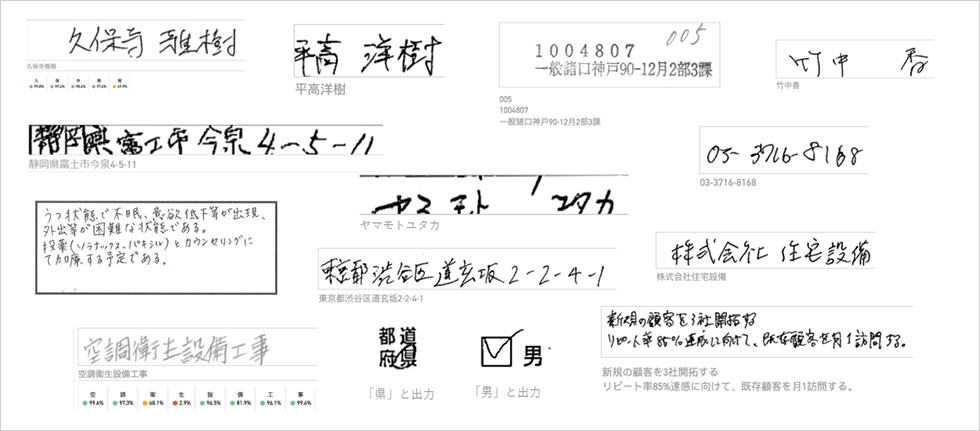
OCR uses an optical camera to read handwritten or printed text and automatically convert it into text data. For many years, the accuracy of handwritten text recognition has been an issue, but in recent years, "AI-OCR" has emerged, which combines rapid advances in technology with AI to achieve high accuracy, and is attracting attention as a trump card for going paperless. To give you an idea of how accurate it is, it can even read something like the image below!
Saison Information Systems (now Saison Technology) also provides AI-OCR services as one of its linkage services. Leveraging the strengths of the "connecting" technology that utilizes the HULFT Products group, it optimally links the high-precision handwritten character recognition service "Tegaki" with customer systems.
By utilizing the AI-OCR service, it is possible to automatically read handwritten characters and printed characters from scanned paper data and transfer the data to other systems. This eliminates the need to manually input data into the system while looking at the paper, and the process can be completed simply by checking the entered data. Another benefit is that it can be introduced with minimal system modifications.
Utilizing AI-OCR to automate everything from character reading to system integration
Now, let me introduce some actual use cases.
One company was printing out application documents sent by fax from agents on paper and manually entering them into the system (entry verification). To improve this process, they introduced an AI-OCR service along with electronic faxing. This completely automated the process, from receiving faxes from agents to reading the text and entering it into the system (entry). This allowed them to completely eliminate paper media and enable teleworking.
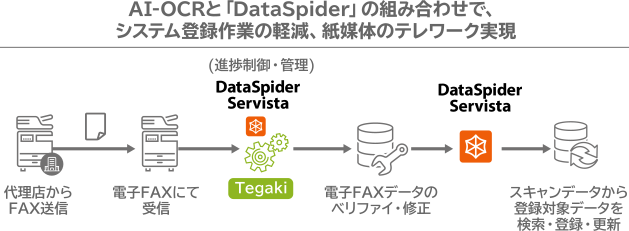
Furthermore, the work of inputting and checking (entry/verification) while looking at paper has now been reduced to just checking (verification) the registered data, which has cut the work time by about half!
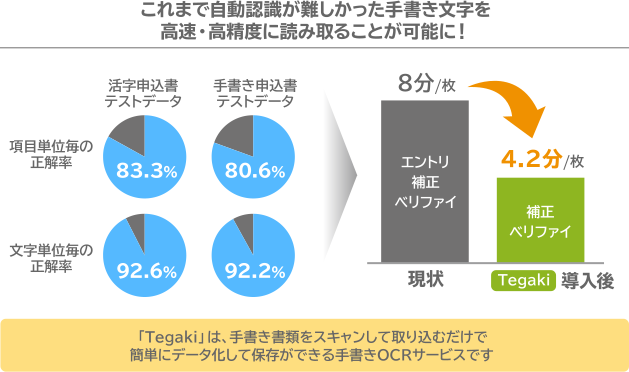
By utilizing the AI-OCR service in this way, it is possible to go paperless and also improve work efficiency, which will greatly contribute to realizing teleworking.
Promoting paperless operations, improving work efficiency, and realizing teleworking
Teleworking is a way of working that is not dependent on location, but as long as there is paper-based administrative work, it is necessary to go to the office for that. In order to ensure that all employees working remotely can work equally, going paperless is unavoidable.
Furthermore, if you are going to the trouble of going paperless, we recommend that you not only digitize documents but also review your work flow to avoid generating paper documents. For example, if you need to receive documents by fax for business purposes, you could change it so that it prints as an image instead of paper, or instead of attaching paper receipts and submitting expense claims as paper documents, you could take an image with your smartphone and use that to submit the claim. Such reviews should lead to truly effective paperless operations.
For Japanese companies where many paper-based processes remain, the impact of going paperless in improving operational efficiency is significant, and it could even be a catalyst for significant corporate growth. Why not take the first step and then promote teleworking to protect employees in the event of an emergency?