

- Development time reduced from 90 days to just 1 day through data integration and in-house development in a multi-cloud environment -
March 12, 2026
Saison Technology Co., Ltd.
Saison Technology Co., Ltd. has published a case study on how Yokohama Bank, Ltd. (hereinafter referred to as Yokohama Bank) implemented HULFT Square to build a foundation for financial digital transformation, explaining the background and reasons for selecting the service.
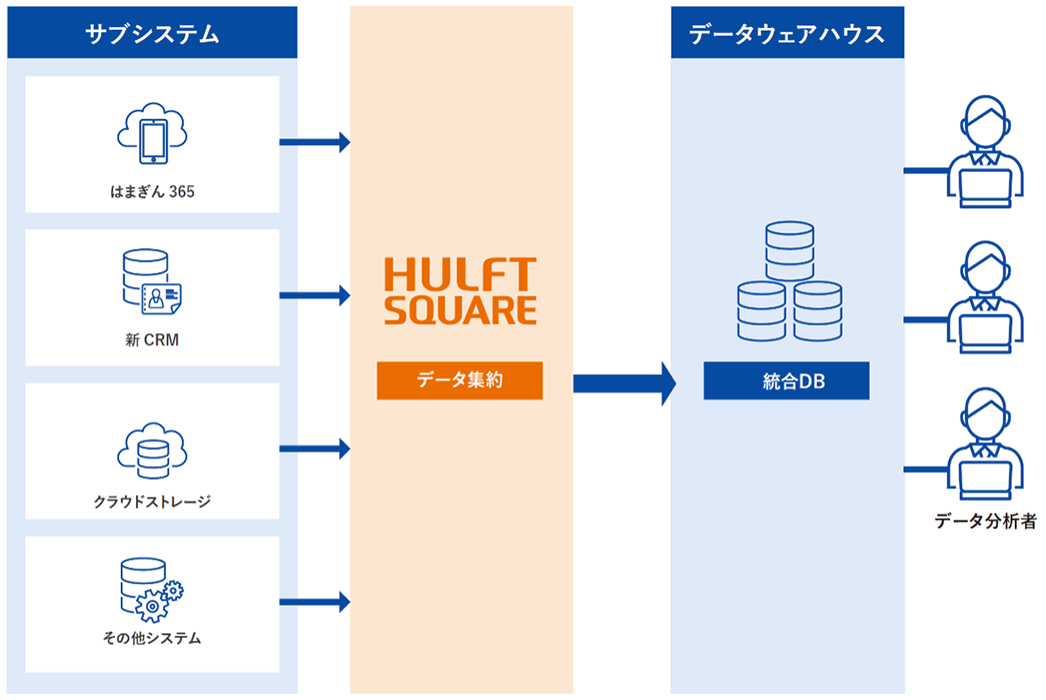
By using HULFT Square as a pipeline to aggregate data into an integrated database that serves as a data warehouse, Yokohama Bank has been able to in-house data integration, shortening the lead time for data provision from 90 days to just one day.It has also automated data aggregation work in Excel, achieving an 82.5% reduction in work hours.
background
Founded in 1920 as Yokohama Koshin Bank, the Bank of Yokohama works to resolve the issues faced by approximately 250,000 corporate clients and over 5 million individual clients through a branch network centered in Kanagawa and Tokyo. Boasting one of the highest levels of deposit and loan volume among regional banks, the bank has over 590 branches, mini-branches, and unmanned branches in Japan, as well as overseas bases in Shanghai and Singapore, and has established a system to support clients in expanding overseas through its domestic and international network. The bank is currently working on various measures aimed at "solid growth in its home market," as set out in its medium-term management plan through fiscal 2027.
One of the productivity improvement measures is the effective use of databases. In order to create an organization where anyone can utilize data, which contributes to data-driven management, the bank is promoting the sophistication and efficiency of its internal operations by promoting a system that allows anyone, anywhere, to utilize the data they need, anytime.
Reasons for adopting "HULFT Square" and the effects of its implementation
Although the Bank of Yokohama had built a data warehouse and put in place an integrated database as a data aggregation platform, it was unable to aggregate the data properly and was therefore unable to provide the data required by the field in a timely manner.
The bank decided to implement HULFT Square after focusing on the following features: it can easily realize data integration between the integrated database and each subsystem, and as an iPaaS it can be quickly started using without the need for server construction or maintenance, it can be integrated with various subsystems such as the new CRM that the bank has deployed and is running in a multi-cloud environment, and Hamagin 365, without coding, it can be flexibly connected using a dedicated connector for cloud services, and it has the same ease of use and UI as DataSpider Servista, an on-premise data integration platform that an external partner had been using.The bank also cited the following benefits of implementing HULFT Square HULFT Square:
- In-house development dramatically reduced the lead time for data provision from 90 days to just 1 day
- Automating data aggregation work in Excel reduces work time by 82.5%
- No-code development eliminates dependency on individual skills, and stable operation is achieved through rapid customer success responses
For a case study of Yokohama Bank, which has adopted HULFT Square, please see the following URL:
Case study page
"HULFT Square" accelerates data utilization and builds the foundation for financial digital transformation
Data integration and in-house development in a multi-cloud environment reduces development time from 90 days to just 1 day
https://www.saison-technology.com/casestudies/the_bank_of_yokohama
[Related information]
"HULFT Square" information site:
https://www.saison-technology.com/service/product/lineup/hulft-square/