

As a long-established bank with more than 100 years of establishment and boasting top-class deposits and loans among regional banks, Bank of Yokohama Co., Ltd. is promoting the use of data throughout the group, but it has been difficult to flexibly respond to on-site needs due to its dependence on development by external partners. In order to overcome such an environment, the cloud-based data integration platform (iPaaS) "HULFT Square" has been adopted as a data integration platform to seamlessly connect multi-cloud environments such as AWS and Google Cloud.
Customer Issues
- The development of data extraction and integration was dependent on external partners, resulting in a situation where the company was unable to respond flexibly and quickly to diverse data utilization needs from the field in terms of return on investment.
Benefits of implementation

By bringing development in-house, the lead time for data delivery was dramatically reduced from 90 days to just 1 day.

Automating data aggregation tasks in Excel resulted in an 82.5% reduction in work time.

No-code development eliminates reliance on specific individuals, and rapid customer success support ensures stable operation.
Providing timely information to the field is difficult, and reliance on external partners is a major challenge.
Established in 1920 as Yokohama Koshin Bank, Yokohama Bank, Ltd. is a leading regional bank in terms of deposits and loans, working to solve the challenges faced by over 250,000 corporate clients and over 5 million individual clients through its branch network centered in Kanagawa and Tokyo. With over 590 branches, sub-branches, and unmanned branches in Japan, as well as overseas locations such as Shanghai and Singapore, it has established a system to support its clients' overseas expansion through its domestic and international network. Currently, it is working on various measures to achieve "solid growth in its home market," which is outlined in its medium-term management plan until fiscal year 2027, and one of its key strategies is productivity improvement.
One of the measures contributing to this productivity improvement is the effective use of databases. In order to reduce the workload at headquarters and create more time to interact with customers, they are working to create an environment that promotes data utilization by eliminating the Excel bucket brigade. In order to create an organization where everyone can utilize data, which contributes to data-driven management, the IT Solutions Department's Data Management Group, which is promoting the advancement and efficiency of internal operations with the motto of "a system where anyone can utilize the data they need anytime, anywhere," had built a data warehouse and prepared an integrated DB as a data aggregation platform, but they continued to be unable to provide the data that the field needed in a timely manner.
"We were unable to consolidate all the data into the integrated database, and we were frequently exchanging data using Excel. Also, even when requests for data utilization came in from various departments, we had to ask our external development partners to add tables and collect data into the integrated database on an individual basis, and there were cases where we had no choice but to abandon the project due to cost and deadline constraints," recalls Hiromu Imokawa of the same group. Even though there was a need for data utilization on the ground, development could not be started from a cost-benefit perspective, and the stagnation of data utilization was resulting in lost opportunities.
iPaaS, aligned with the accelerating shift to the cloud, and the improved development efficiency brought about by no-code development are being recognized.
To overcome this situation, it was essential to advance infrastructure development and promote data utilization simultaneously, and to bring development in-house. In the rapidly changing financial industry, increasing agility had become the top priority. That's when they turned their attention to "HULFT Square," an iPaaS that makes it easy to data integration between the integrated database and each subsystem.
"Our bank is moving towards the cloud, and we are considering a cloud-first approach from the perspective of being able to select the appropriate scale according to the operating environment. With iPaaS, which does not require the construction or maintenance of servers, we can start using it quickly," said Imokawa. In fact, they thought that "DataSpider Servista," an on-premise data integration platform that an external partner was using, could also be used by the bank, and this was one of the deciding factors in adopting "HULFT Square," which has a similar ease of use and UI.
Furthermore, since the bank's new CRM and various subsystems such as "Hamagin 365" operate in a multi-cloud environment including AWS (Amazon Web Services) and Google Cloud, the ability to integrate without coding and flexibly connect via dedicated connectors for cloud services were also points that led them to evaluate "HULFT Square."
As a result, "HULFT Square" was adopted as a platform for flexibly linking multiple subsystems and an integrated database that aggregates data.
Development time was reduced from 90 days to just 1 day, and the increased efficiency of development operations broadened the scope of data utilization.
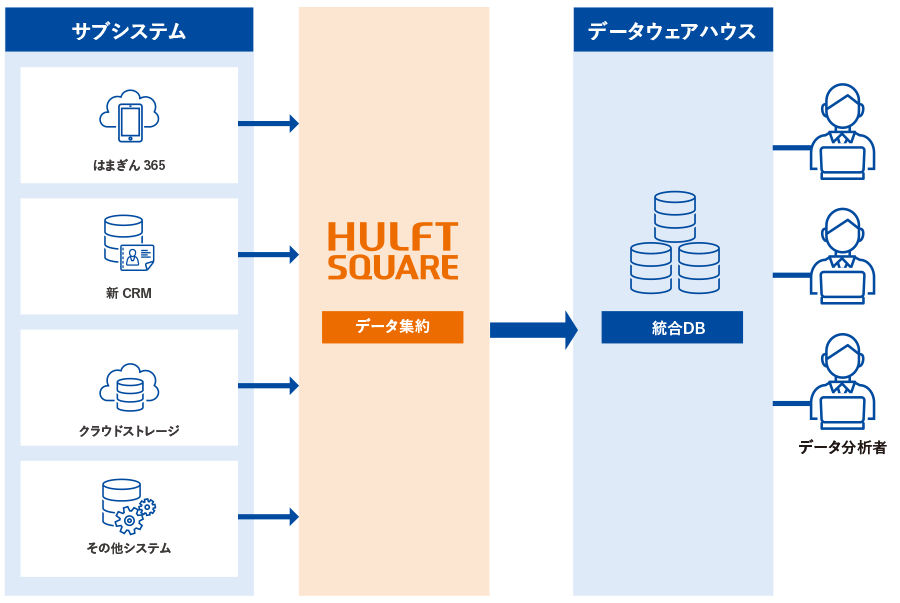
Currently, "" is being used as a pipeline to consolidate data into an integrated DB that serves as a data warehouse with various subsystems, including a new CRM linked to the sales branch reporting platform, the "Hamagin 365" smartphone application that allows customers to open accounts with banks, inquire about balances and deposit and withdrawal details, and make transfers and transfers, as well as the "Box" cloud storage system. HULFT Square" is used as a pipeline to consolidate data to the integrated DB, which serves as a data warehouse, and a flow to acquire data on a monthly or daily basis, depending on the purpose. Each department in the headquarters that has been granted access to the integrated DB analyzes the data, and the data is utilized in the operations of each department, for example, the audit department monitors examination operations, and the risk department calculates various types of numerical information.
By internalizing data integration using "HULFT Square," the costs previously outsourced were eliminated. In one instance, the development period, which previously took about 90 days from estimation to internal procedures and implementation including the development process, was reduced to just one day. This agility has enabled a significant reduction in the development process. Furthermore, by using "HULFT Square" to integrate Excel tables, they were freed from the Excel bucket brigade method used for aggregation work, successfully reducing working time by 82.5%. Not only did this reduce working hours, but it also eliminated manual work that relied on individual employees. "The biggest benefit is that we can now receive more consultation from the field than ever before," says Imokawa, highly praising the results.
In the process of bringing development in-house, they also referenced how external partner "DataSpider Servista" was used, which enabled a smooth implementation with "HULFT Square." "Since it mainly involved simple processing, I was able to implement it myself by following the tutorial. I also checked the documentation, and received careful and prompt support from customer success for anything I didn't understand. They were able to answer any questions on the same day, which was very helpful in proceeding with in-house development," says Imokawa.
Expanding data integration partners will further promote data utilization, and we are also exploring integration with generative AI.
Looking ahead, while they currently use "HULFT Square" to link four systems to their integrated database, requests for expanding the number of linked systems have already come in from the sales and audit departments. Therefore, they hope to eventually use "HULFT Square" to link with over 40 systems. "We expect the number of data integration destinations to continue expanding to include cloud services like 'Salesforce' and 'SharePoint.' When consolidating data into the integrated database, we want to make good use of 'HULFT Square'," says Imokawa, expressing his expectations.

IT Solutions Department, Data Management Group
Hirotake Imokawa
Furthermore, they are eager to expand the applications to include more efficient natural language preprocessing, such as by combining generative AI with "HULFT Square." "Currently, we are keeping it at a level that our group can handle, so we are not actively conducting awareness campaigns, but we would like to raise awareness more than ever about the usefulness of data utilization so that people will realize that simply adding tables can significantly improve the efficiency of their work," says Imokawa.
Mr. Imokawa concluded by stating that HULFT Square is a valuable partner for the bank in internalizing its operations, and will undoubtedly continue to be an important foundation for its data utilization strategy.
Recommended Content

The Bank of Yokohama, Ltd.
- Head office address: 3-1-1 Minatomirai, Nishi-ku, Yokohama City, Kanagawa Prefecture
- Established: December 1920
- Capital: 215.628 billion yen
- Number of employees: 4,051
- Business activities: General banking services (deposits, loans, foreign exchange, sales of investment products, financial product brokerage, inheritance-related services, investment banking services, etc., providing a wide range of financial products and services to meet diverse needs).
- The content of this case study is current as of the time of the interview. The content of this case study may change without notice.