
HULFT DataCatalog
Collect, organize, and catalog scattered metadata
HULFT DataCatalog Ver.1 Release Announcement on Wednesday, April 5, 2023
Release date
Wednesday, April 5, 2023
Product name
HULFT DataCatalog Ver.1
Main new and additional features
Data profiling
When data quality is low, such as when there are missing data, unexpected values exist, multiple data patterns are mixed, etc., it becomes difficult to perform effective analysis. To address this issue, we have equipped the system with a data profiling function that grasps the overall picture of data quality, making it possible to automatically visualize the state of the data.
By being able to analyze database columns and CSV file schemas and check data quality on screen, it helps determine whether the data can be used as is for data analysis or whether cleansing is required, preventing incorrect analysis and rework, and enabling efficient data utilization.
Data Test
When supplying data from a source system to a data integration platform, it takes a lot of time to test whether the data quality meets requirements, such as whether the number of digits is consistent, whether full-width and half-width spaces are standardized for delimiters in names, etc. Therefore, we have added a function to verify whether columns in databases and CSV files meet the requirements for data utilization.
By centralizing tests that are conducted for each individual data source on a data catalog, it becomes possible to increase the reusability of test patterns and reduce the time and cost spent on testing.
Check items that can be implemented
- Whether there is a null value
- Are there any duplicate values?
- Are there any numbers below the specified number?
- Are there any numbers above the specified number?
- Does the data match the specified regular expression?
Custom Views
When users utilize data, it is sometimes difficult to use it in its original format, and they must reshape the data to suit their purpose by combining multiple data sets, sorting, filtering, etc. To address this issue, we have added a function that allows users to freely customize data (extract, combine, sort) and create virtual tables.
Data can be formatted as desired without affecting the existing environment, improving data usability. Customized data can also be shared with other data users, encouraging joint data use.
Other release contents
- View asset views
On the asset details screen for databases, tables, etc., you can now see the number of users who have viewed the asset. This allows you to see which data is frequently used among a large amount of data, and understand the needs of users regarding data assets. - Exact asset search
When searching for assets, you can now perform an exact match search for specified keywords. This allows you to efficiently search by filtering out noise from vast amounts of data, making it easier to obtain only the information you need. - Assigning ownership to assets
In the previous version, you could only set owners for individual connection destinations such as databases and object storage, but in the new version, you can also assign owners to individual subordinate assets of the connection destinations. By being able to set owners for individual databases, schemas, buckets, and files, you can transfer responsibility and manage data in a more granular manner.
Other improvements and bug fixes have been made.
- For more information, please refer to the release notes included with the product.
June 3, 2022 (Friday) HULFT DataCatalog Ver.1 Release Announcement
Release date
Friday, June 3, 2022
Product name
HULFT DataCatalog Ver.1
What is HULFT DataCatalog?
As digitalization continues to advance, the amount of data assets held by companies is increasing explosively, making effective use of that data has become an essential element of business strategies in the digital age.
With data becoming increasingly diverse and scattered across various systems, it is extremely difficult to quickly obtain data that can be used to make decisions. HULFT DataCatalog, a metadata management platform, solves these challenges.
HULFT DataCatalog automatically collects and catalogs "metadata" such as the location of data, the date and time of update, and the data administrator.
By searching across data scattered across systems, data users can quickly find and obtain the data they want, and by correctly understanding the business meaning of the data, they can make better decisions backed by data.By supporting the discovery and understanding of the data necessary for decision-making, we promote the use of data in companies.
HULFT DataCatalog Ver.1.2
Single Sign-On Authentication and Active Directory Integration
In addition to the traditional local authentication (password authentication), you can now choose between single sign-on authentication via SAML 2.0 (SSO/SAML authentication) and Active Directory authentication.
It is now also possible to synchronize Active Directory users with HULFT DataCatalog users.
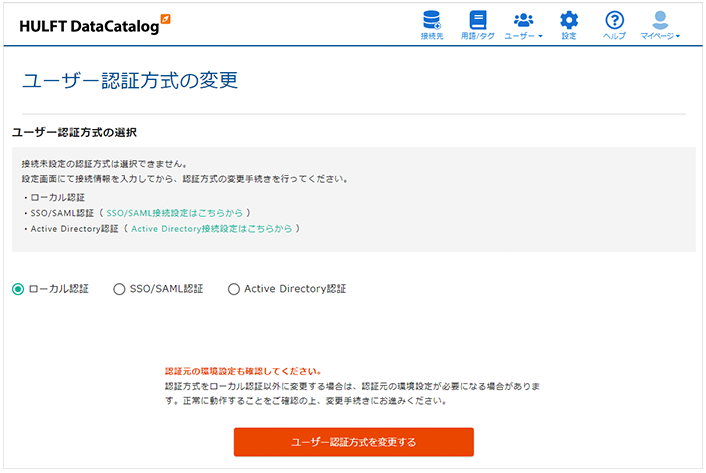
- SSO/SAML authentication
With support for single sign-on, you can now manage multiple service accounts, including HULFT DataCatalog with a single account. - Active Directory Integration
You can now log in to this product using Active Directory authentication.
In addition, by synchronizing with Active Directory user information, there is no need to create a dedicated user account for HULFT DataCatalog, reducing the burden on system administrators.
Supports Google BigQuery and Google Cloud Storage
Google BigQuery and Google Cloud Storage have been added as new connection types.
This product is now available to customers who operate their data infrastructure on Google Cloud Platform.
- Information that can be crawled with Google BigQuery
Dataset Information
Table/View Information
Field Information - What information can be crawled with Google Cloud Storage?
Bucket Information
Folder/File Information
Improved UI/UX for even easier use
The user interface has been improved to be more intuitive and easy to understand, making it easier to use.
- Added "Display Name" to indicate logical names for assets.
- Add search boxes and filtering options to each list screen
- Added the ability to schedule search index rebuilds
- Improved performance when there are a large number of records
etc.
Other improvements and bug fixes have been made.
- For more information, please refer to the release notes included with the product.
September 3, 2021 (Friday) HULFT DataCatalog Ver.1 Release Announcement
Release date
Friday, September 3, 2021
Product name
HULFT DataCatalog Ver.1
What is HULFT DataCatalog?
While the importance of utilizing data in corporate management has been emphasized more than ever in recent years, it is said that the majority of companies are not using data effectively.
One of the factors hindering data utilization is that data stored within a company is managed in a variety of different formats, making it difficult to fully grasp where and what data is stored.
HULFT DataCatalog is a metadata management product that enables anyone to utilize data by understanding the status of various scattered data and cataloging it.
HULFT DataCatalog Ver.1.1
HULFT DataCatalog Ver.1 adds and improves features that were highly requested in Ver.1.0.
Allows you to catalog more information assets
By supporting the general-purpose data access protocol "JDBC," it is now possible to manage metadata for many of the databases operated by companies.
You can trace back to the source of a view to see if the data is relevant to your purpose.
It is now possible to see which tables a database view references.
This allows you to trace back to the tables that make up the view and check whether the data is appropriate for your intended use.
Easier data integrity constraint checking
You can now view the integrity constraints assigned to database columns on the screen.
By making it easier to check the constraints that limit the types of data that can be stored in tables, data preparation work for data utilization can be made more efficient.
Monitoring data utilization status
We have added an "Activity Report" that allows you to monitor how users are using their data.
By referring to this activity report and considering measures to promote data utilization, you will be able to plan more effective measures.
Improved screen design for even easier use
We have added a progress bar that allows you to check the progress of the crawl, and the ability to narrow down the display of terms and tags. We have also improved the overall screen design, including fonts and colors, to create a more intuitive and easy-to-use user interface.
Other improvements and bug fixes have been made.
- For more information, please refer to the release notes included with the product.
Thursday, December 24, 2020: HULFT DataCatalog 1.0 Release Announcement
Release date
Thursday, December 24, 2020
Product name
HULFT DataCatalog 1.0
A metadata management platform that turns data into inspiration
A company's data assets are growing every day. HULFT DataCatalog collects and catalogs information (metadata) from various data managed in a distributed manner within the company. By visualizing the location and history of data and sharing knowledge about the data, it helps to streamline data exploration and understand the "contents" of the data. Anyone can select data themselves and use it more freely for business purposes.
[Features]

HULFT DataCatalog makes it easy to find the data you want, just like searching the web. It also helps you understand the meaning, history, and related terms of the data, making the process of selecting "trustworthy data" self-service. Furthermore, by linking with DataSpider, you can smoothly utilize and analyze the discovered data.
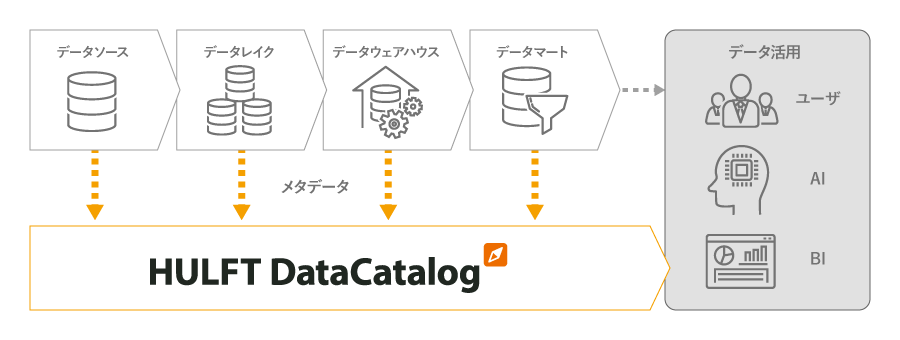
[Feature Overview]
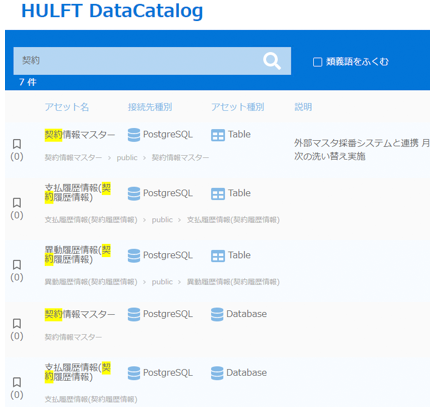
Metadata collection and search
The crawler automatically collects metadata (ancillary information) from various data stored within a company. You can search for the data you want from all the data scattered throughout the company (searches using synonyms, similar words, and related words are also possible). Search results are sorted by relevance score, and the most likely data is displayed. You can also preview and download the search results data.
It also makes it easier to check data quality and governance of personal and confidential information.
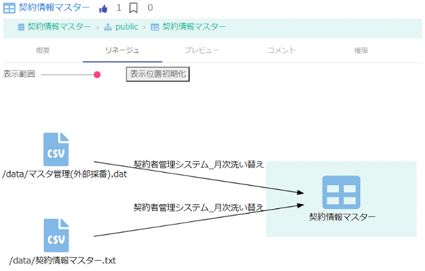
Data Lineage
The provenance (source, history, and connections) of the target data is displayed visually.
You can intuitively understand which systems the target data is linked from and which systems it is connected to. Understanding the data's provenance allows you to determine whether the data meets your needs and is trustworthy, improving the accuracy of data-based decisions.
- Data lineage is displayed when you use HULFT DataCatalog and DataSpider Servista in combination.
Business Glossary
It standardizes the terms and meanings used in business. Linking defined terms to data prevents misuse of data due to misunderstandings. It makes it easier to search for data using related terms. Linking business terms to system terms facilitates communication about data between business departments and system personnel.
Data enrichment (ratings, tags, comments)
Both data providers and data users can share knowledge such as data descriptions, usage methods, and precautions, allowing everyone in the company to utilize the data with the same knowledge.
- For details, please visit the product introduction site.