
Metadata Management
It visualizes the location, meaning, and update history of scattered data, making it easy for anyone to search.

Saison Technology solves issues such as inefficient data search and personalization with "HULFT DataCatalog," which automatically collects, organizes, and classifies data scattered across various internal systems. It collects meta information from a variety of data sources and creates a catalog linked to business terms. All employees can quickly find, understand, and utilize the data they need by searching by keyword, without relying on the IT department.
Are you wasting time searching for data and checking it?
- Data labels and descriptions vary by department and location, making classification and organization time-consuming and labor-intensive.
- Previously created reference data cannot be found, and the time required to recreate it is a burden on business operations.
- It takes time to check the meaning of data and update history, delaying business decision-making
- Unable to ensure data reliability, preventing the development of a company-wide culture of data utilization
Creating an environment where anyone can easily find and use data
In order to advance data analysis and the use of AI, it is important to first create a situation where the entire company can share information about "where what data is located" and "whether that data is trustworthy." However, many companies face the challenge of being unable to make quick management decisions based on data because only a few people in charge know where the data is and what it means.
The role of the "metadata management function" is to organize this metadata in a way that is easy for anyone to understand, allowing all employees to find the data they need and use it easily. By using "HULFT DataCatalog," you can establish a foundation for effective data collection, search, and analysis.
Transform "time spent searching for data" into "time spent utilizing data"
HULFT DataCatalog, provided by Saison Technology, makes in-house data searches easier and more efficient through "metadata management." It automatically collects summaries (metadata) of various scattered data, and classifies and organizes them in an easy-to-search format. This creates an environment where "you can quickly find the desired in-house data simply by entering a keyword." Workers can instantly find the data they need on their own, without having to contact the IT department.
This will free you from the hassle of checking questions like "Where is the data?" and "Is this data up to date?", allowing you to spend more time on the tasks you should be doing, such as analyzing aggregated data and developing plans, enabling you to make decisions based on highly reliable data.
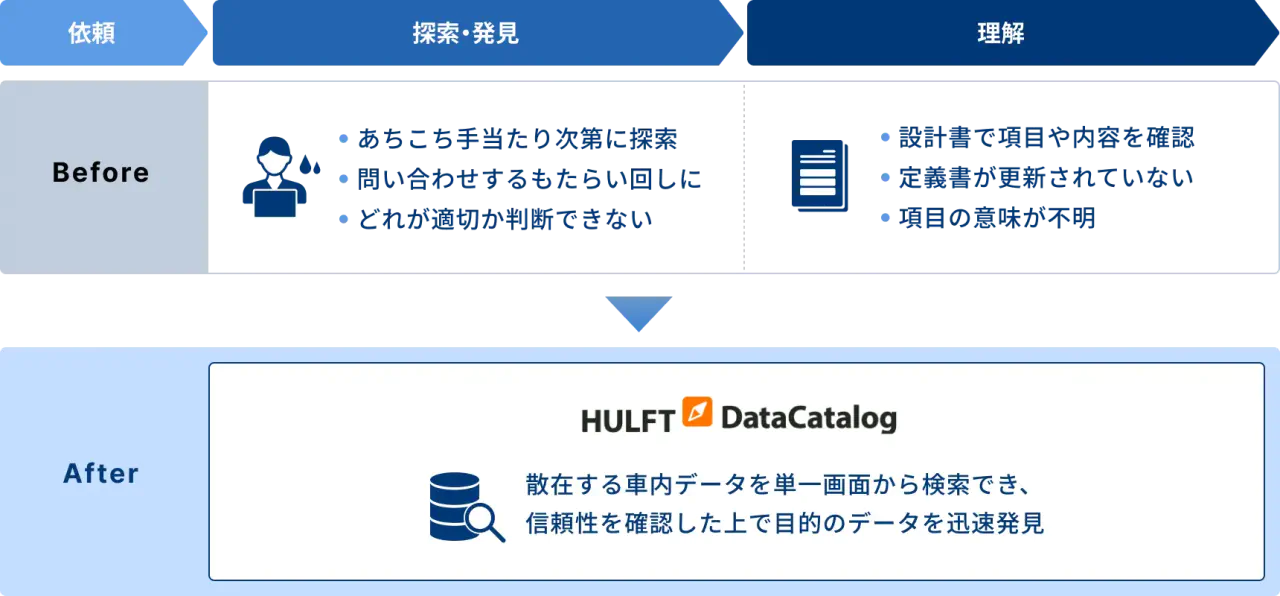
Data catalog tools for efficient metadata management
With over 60 adapters, you can connect data regardless of its format, including systems, files, and databases. You can also integrate data that has the same meaning but different labels, such as "customer name" and "business partner name," simply by using the interface, without any programming required. Even without IT knowledge, you can quickly connect and check data, creating an environment where "anyone can process business processes."
Automatic collection of metadata
It automatically collects data from various locations, such as internal databases, file servers, and HULFT transfer settings, and organizes it into an easy-to-search list. There is no need to manually create a data ledger.
Cross-search function
We standardize the terminology and meaning of metadata so that collected and organized metadata can be searched correctly. You can search all company data at once from various perspectives, such as business meaning (e.g., "monthly sales" or "customer master"), tags added by personnel, and descriptions.
Business Glossary
We standardize the definitions of terms that have the same meaning but differ between departments, such as "opportunity" in the sales department, "lead" in the marketing department, and "prospective customer" in the planning department. This prevents misinterpretation of data by staff.
 Technical Support Site
 FAQ
FAQ Product Manual
 HULFT On-Demand Seminar
 Version upgrades and changes to the installation environment
 Regarding application of new prices
 my HULFT (trial version)
 User Community