

Three challenges and solutions faced by companies when a client requests HULFT connectivity.


Are you having trouble connecting with your business partners using HULFT? HULFT is a highly reliable file transfer middleware with a proven track record in the industry, making it the de facto standard for file transfer. As a result, your business partners may request connections using HULFT. However, you may lack engineers with specialized knowledge of HULFT within your company, and you may feel uneasy about its implementation and maintenance.
Therefore, in this article, we will highlight "HULFT Square," a product highly compatible with our HULFT system, as a solution, and explain how it can be useful in connecting with business partners via HULFT.
Three common challenges in implementing HULFT
HULFT is widely used as a means of data integration between companies, but in actual implementation projects, unexpected challenges are often encountered.
In particular, companies that are considering implementing HULFT for the first time when a business partner requests it often face several common challenges, such as a lack of knowledge and the complexity of data integration.
Here, let's summarize some of the most common challenges encountered when implementing HULFT as a requirement for business partners.
▼I want to know more about data integration platform
⇒ data integration / data integration platform | Glossary
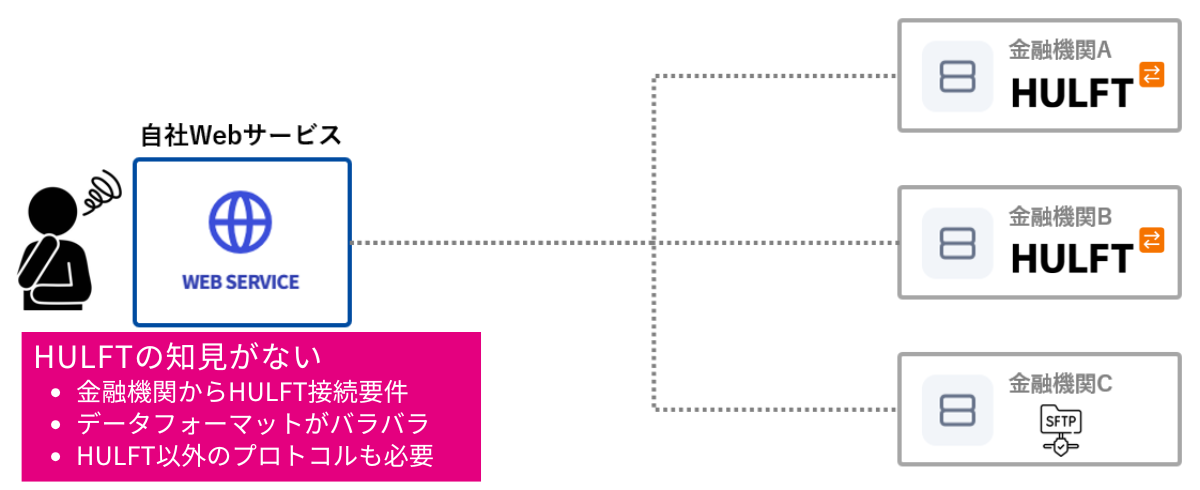
1. A client has made HULFT connectivity a mandatory requirement, but we lack knowledge of HULFT
Many people may be familiar with the name HULFT, but lack practical experience using it. You might be concerned about implementing HULFT connectivity even though your clients require it, due to a lack of internal HULFT.
Furthermore, many companies are promoting serverless architectures due to internal policies, and are exploring approaches that differ from traditional on-premises operations. Therefore, while they want to leverage managed services to achieve flexible and scalable systems, a major challenge is how to integrate with HULFT. It is necessary to consider expert support and solutions while ensuring a smooth HULFT implementation that meets the needs of their clients.
2. The data formats received by HULFT are inconsistent.
Because the data format received via HULFT differs for each business partner, ensuring data consistency when importing it into the company's internal database (DB) presents a significant challenge. This inconsistency hinders the proper utilization of received data and drastically reduces operational efficiency.
Addressing this problem with our current resources would require implementing data transformation through custom development. However, we lack the necessary engineers within the company, and there are many cases where we cannot respond immediately. In addition, we are concerned about the significant burden of maintenance and management that would result from custom development.
While more companies are considering using no-code tools to address these challenges, many seem to be concerned about whether efficient development can truly be achieved.
3. Considering future expansion of our business partners, we will need protocols other than HULFT
For companies expecting an increase in business partners in the future, diversifying connection methods will become a crucial issue. To flexibly meet the connection requirements of various business partners, the ability to integrate with SFTP, APIs, and various cloud services is essential. However, current system environments often struggle to support these diverse protocols, sometimes making it impossible to meet customer needs. This increases the risk of missing business opportunities and could impact a company's competitiveness.
Flexible data integration facilitates smoother collaboration with business partners and opens up new avenues for business expansion. In today's environment where rapid response is crucial, increasing protocol options is a key factor directly linked to a company's growth.
As described above, implementing HULFT presents several challenges, including a lack of knowledge, differences in data formats, and diversification of connection methods. However, these challenges can be efficiently resolved by selecting the appropriate tools and architecture.
In the next chapter, we will introduce specific solutions to these challenges.
Solution: Quickly establish a HULFT connection with your business partners using HULFT Square
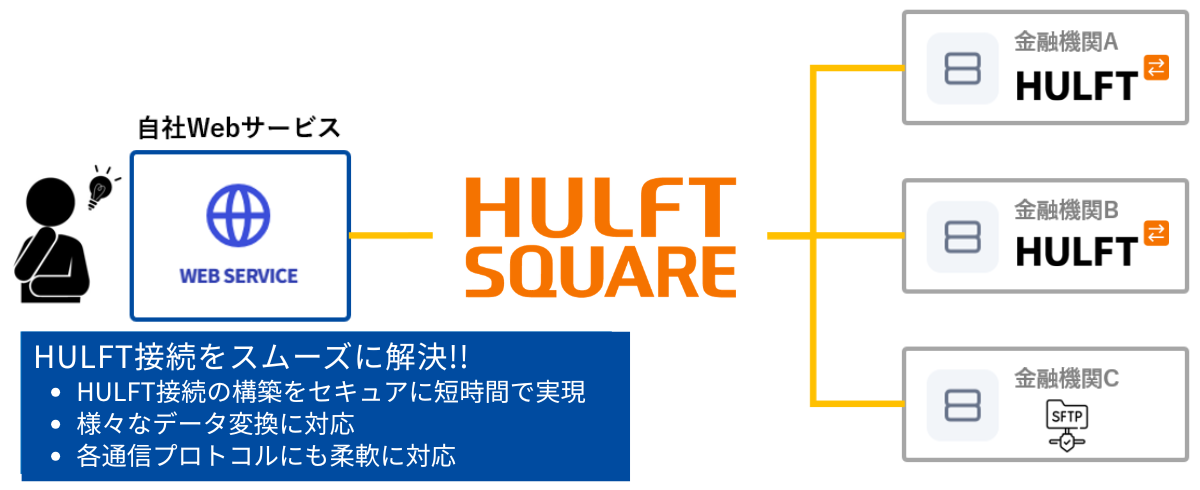
To address the challenges discussed in the previous chapter, we propose Saison Technology's iPaaS, "HULFT Square." HULFT Square is a cloud-based data integration platform that seamlessly connects HULFT system used by your business partners with your own cloud services. It enables secure and reliable data transfer using HULFT in a cloud environment.
▼I want to know more about iPaaS
⇒ iPaaS | Glossary
Features of HULFT Square
HULFT Square is a service that extends the conventional file transfer middleware "HULFT" as a cloud-based integration platform. A key feature of HULFT Square is that it incorporates HULFT 's data collection send engine as a fully managed function. This allows for secure connection with HULFT servers in the on-premises environment of trading partners, ensuring reliable data transfer using the HULFT protocol.
Many companies still store data in on-premises environments due to security requirements and the need to leverage existing assets. Therefore, integrating cloud services with on-premises data often presents operational challenges, such as network configuration and system connectivity. As a result, on-premises data can become a bottleneck in system integration.
To address this situation, it is important to either proceed with cloud migration with a view to future scalability, or to develop a system that seamlessly connects on-premises and cloud environments by utilizing data integration platform such as iPaaS.
Specific solutions available at HULFT Square
1. HULFT function is included as standard.
HULFT Square provides a system that allows for easy data transmission and reception in a cloud environment while maintaining the reliability of the original HULFT. Because it employs a no-code interface, it can be operated intuitively without specialized programming knowledge, enabling the rapid establishment of data integration. Furthermore, it supports private network connections and internet VPNs, allowing for flexible adaptation to the security requirements of business partners.
2. Capable of various data conversions.
HULFT Square allows you to define complex data transformation processes without coding. For example, you can configure processes such as data item mapping, calculations, date format conversion, and conditional branching using drag-and-drop operations. Because you can process data received from business partners via HULFT directly and integrate it with your own system, you can use the data for business operations while maintaining its freshness.
3. Supports various communication protocols.
HULFT Square supports not only HULFT but also a variety of other communication protocols. It supports diverse protocols such as HTTP/HTTPS, FTP, SFTP, and email, enabling the sending and receiving of information according to the trading partner's system and connection requirements. This allows for smooth data exchange between different systems, leading to increased efficiency in business processes.

iPaaS-based data integration platform HULFT Square
HULFT Square is a Japanese iPaaS (cloud-based data integration platform) that supports "data preparation for data utilization" and "data integration that connects business systems." It enables smooth data integration between a wide variety of systems, including various cloud services and on-premise systems.
Case Study: The Case of an Investment Management Company
One investment management company was asked by a client securities firm to connect to HULFT, and was considering how to achieve this. The company's policy was to achieve the connection using managed services with as little impact as possible on its own system. Therefore, they implemented HULFT Square to connect their own system with the securities firm's HULFT environment.
As a result, the following effects were obtained:
- Intuitive operation enables quick and easy setup of HULFT connections.
- Differences in data format and structure are also internally handled by the no-code data conversion function.
- Supports multiple communication protocols and flexibly accommodates the connection requirements of business partners.
The system went into full operation approximately two months after implementation, and its use in other data integration tasks is now being considered.

Summary: How to smoothly establish a HULFT connection with your business partners
This article introduced common challenges in establishing HULFT connections with business partners and their solutions. By utilizing HULFT Square, you can establish a HULFT connection with your business partners quickly and securely, in as little as one week from application.
- With HULFT Square, you can use a fully managed HULFT server.
- Implement various data transformations without coding.
- Supports communication protocols other than HULFT
This allows for more efficient data integration with business partners, leading to faster service delivery and an expansion of the business network.
If you are considering connecting with your business partners via HULFT, please feel free to contact our online consultation service.

Saison Technology Online Consultation
If you would like to hear more about our data utilization platform, we also offer online consultations.
The person who wrote the article
Related Columns
-

"SAP is difficult to use..." A solution to avoid the add-on hell: "SAP Offloading"
-

The Use of Generative AI in Talent Management: From Intuition to Data-Driven Approaches
-

What are the differences between ETL, ELT, and EAI? A thorough explanation of the key points for optimizing data integration platform

Recommended Articles
-

HULFT 10: The ultimate file transfer solution.
By ensuring safe, reliable, and efficient file transfer between systems, we enable smooth business collaboration between different companies and departments. -

Linking legacy systems with SaaS using HULFT
HULFT, file transfer tool with the largest market share in Japan, is middleware that transfers files safely and efficiently. We will explain its features and how it works. -

Good news for HULFT users! How to connect mission-critical system, core system to Salesforce in as little as one hour
We will pick out a product called "HULFT Square," which has high compatibility with our HULFT, and explain how it can help connect mission-critical system, core system with Salesforce.