

Is your company safe? Top 5 reasons why data utilization is failing


Is your company doing well with data?
The number of companies aiming to operate and operate based on data is increasing rapidly. However, there are also cases where companies are lamenting that they are not using data effectively. Here, we will introduce the top 5 reasons why this is not working, ranked.
The first step in utilizing data is to learn from "failure cases"
For decades now, it has been said that "management should be based on data, not on KKD (intuition, experience, and courage)." However, in recent years, particularly in what has been described as an age of uncertainty, the importance of data has been discussed more than ever before. Many readers of this column will have introduced DWH (Data Warehouse) and BI (Business Intelligence) tools at the recommendation of IT vendors. However, how many companies are currently properly analyzing data and conducting data-based management and operations? In reality, many companies are struggling with some kind of problem, and even with the advancements in IT, they are still unable to fully utilize data in their analysis.
So, today, I would like to share with you some common failure cases that are common among companies that have had some sort of problem with data utilization and are not "data-driven" among the cases that we consult with. If you are a company that can laugh this off and say "That's not true," you'll be fine. If you think "This might apply to us," then please consider making improvements immediately!
Now, let's start with number 5.
▼I want to know more about DWH
⇒ DWH|Glossary
5th place: "Leave it entirely to someone who can operate BI tools or the IT department"
With recent BI tools, it is possible to purchase just one or a few accounts and try out some analysis. As a result, an increasing number of companies are starting by purchasing a minimum number of licenses and giving them a try. This is not a bad thing, but companies that hand one of these tools over to an employee who seems to be able to use it, saying "try out a few things first," or that have the information systems department introduce it and try it out, don't actually do very well. This is because, even if the employee who is given the BI tool can use it, there are cases where they don't know what to analyze.
Only when you have a perspective on what issues exist and how to improve them can you see what kind of analysis you should do. The person who uses the tool and the person who thinks about the issues are not necessarily the same person, so leaving it all to one person or to the information systems department will not work.
To promote data utilization, it is ideal for the user departments that use the data to work together with the information systems department that will be driving the project. Furthermore, because multiple departments are involved, it is important to establish a cooperative framework in advance at the department head level. If possible, it would be even better if someone at the executive officer level could take the lead in this framework.
4th place: "The project period is long"
Because implementing a DWH or BI tool requires a significant investment, some companies proceed cautiously over a long period of time, such as six months to a year. It's understandable that some companies have an overwhelming number of tasks and problems to solve, or can only proceed during their spare time. However, if it takes a year to utilize the data, the business will have progressed rapidly in the meantime. Initially, focusing on what can be done within a short period of one to three months, reviewing what has been accomplished, and then moving on to the next stage in this cycle will vastly increase the chances of success. Keywords like "small start," "quick win," and "agile" should be common terms within your company.
No. 3: "The roadmap is not clear"
To implement data utilization throughout the company, simply introducing tools is not enough. As mentioned in the previous section, it is necessary to achieve quick wins and gradually step up over the course of one to two years. Also, it is best to allocate a budget that considers the costs involved as a one-time initial investment, but as a continuous investment over the course of the steps.
The steps up include the following:
- Further refine the dashboard created in the first two months
- Initially created for management, but expanded to include managers and field staff (or vice versa)
- Initially, the project was implemented for the ◯◯ department, but next it will be expanded to the △△ department.
- Deploy the created dashboard to each group company and view data on the same scale
If there is no established "roadmap" as described above, you will often face the following problems.
- 1. The tool was introduced, but it is not widely used or widely adopted.
- 2. It is used in certain departments, but has not been rolled out to other departments.
- 3. You made a large investment to introduce the tool, but are unable to make additional investments afterwards.

2nd place: "The purpose is to create a dashboard (analysis screen)"
I'm sure that everyone reading this column understands this well, but in fact, many people forget the purpose of a project.
What is the purpose of using data? I think the purpose is to analyze the data and review operations or improve performance such as sales and profits. However, in many cases, the introduction of tools such as DWH or BI, or the creation of dashboards (analysis screens created with BI tools) becomes the goal itself.
If you get into this state, you won't be able to make the right decisions about what kind of screens you should create, or be able to determine whether you have achieved results after implementing the system. It is important to clarify your objectives, and it is desirable that these be quantitative performance targets (performance goals).

No. 1: "Necessary data is not available"
The number one reason data utilization doesn't work is that the data isn't organized. Even if you try to utilize data by introducing tools like BI or AI, you might not have the necessary data in the first place. You might think, "What?! That can't be true!", but common cases include data being scattered across various systems and being unable to be collected, data being inconsistent for some reason and therefore unable to be used as is, or data being inconsistent for some reason and the figures not matching...
Our company has also participated in projects to introduce BI tools, but in the past there have been several cases where the project had to be restarted because the data was not available.
What's really important is not just how you use the data, but how you prepare it. If you don't do this properly, it's sure to not go well. I encourage you to check it out.
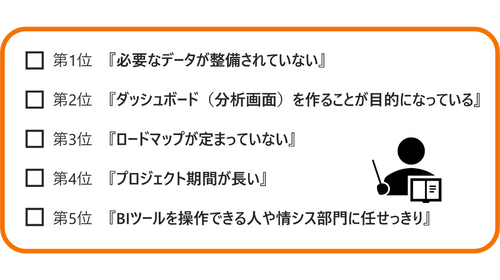
So far, we have introduced the top 5 reasons why data utilization doesn't work, but has your company been doing okay?
If you have any concerns about using data, please feel free to contact us.
▼If you would like to consult, please click here
⇒ Online consultation
The person who wrote the article
Recommended Content
-

What is data utilization? Basic knowledge to increase business value
We will explain the key points for increasing business value by organizing the basic concepts, benefits, approaches, and main challenges of data utilization. -

Why we recommend iPaaS for data integration | A thorough explanation of iPaaS
We will thoroughly explain why iPaaS is suitable for data integration, how it differs from traditional methods, and how it is actually used. -

Get an online consultation about data utilization
If you would like to hear more about our data utilization platform, we also offer online consultations.
Related Content
-

The Use of Generative AI in Talent Management: From Intuition to Data-Driven Approaches
-

What is CDC (Change Data Capture)? – A method for securely and reliably transporting data from on-premises systems.
-

data integration techniques for character code conversion—preparing for a mix of SJIS, JEF, and Unicode.