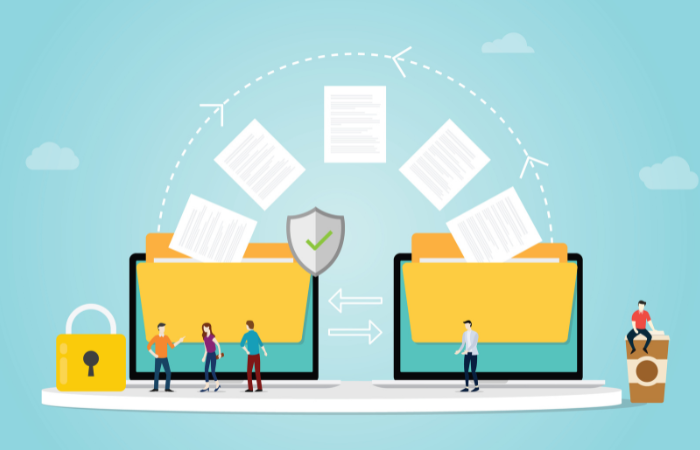

The ever-increasing volume of data is making file transfer a struggle.

Large file transfer.
Be careful not to slow down your work speed
The data that companies exchange on a daily basis is not just text. It is extremely diverse, including CAD, images, audio, sales, and POS data. These files are also large in volume and take time to transfer. Furthermore, changing the service used depending on the file size increases the complexity for both the sender and receiver, further slowing down overall business speed. Here, we introduce methods to prevent a decline in business efficiency due to the transfer of large files.
1. Current Status of Large file transfer in Enterprises
Many companies today analyze a variety of data and use it for product development, sales, and service improvement. Sales and product development data is collected from branches across the country, and the headquarters analyzes it and shares the results with the branches. The key to improving a company's performance lies in how quickly and accurately this cycle can be completed. However, to do this, it is necessary to transfer more files quickly than ever before. As a result, the volume of files handled by companies is steadily increasing.
As file volumes have increased, file transfer methods have also changed significantly. Previously, email was the primary method of transfer, but email has a capacity limit, making it impossible to transfer large files in one go. To file transfer via email, the file must be split into multiple files. However, this takes time, and the recipient must go through the extra effort of combining the split files into one, making it difficult to analyze quickly.
As a result, there has been an increase in the number of cases where small files are sent by email, and large files are sent using file transfer services or online storage. This allows for the quick transfer of large files, shortening the time it takes from analysis to important management decisions. However, this method is not the best, as it has some major problems.
2. Two problems with transferring large files
The problems that can be considered when transferring large files using file transfer services or online storage can be broadly divided into the following two points.
- file transfer that rely solely on the internet
file transfer services and online storage generally use an internet connection. Therefore, the transfer speed inevitably depends on the internet environment of both the sender and the receiver. As a result, even if you can transfer a large file in one go, depending on the speed of your internet connection, each exchange can take a long time.
Furthermore, if an internet connection fails, it may be unavailable for several minutes to several hours. This leaves no other way to transfer files. Having only one route for exchanging important files poses a major risk for companies. - Using multiple file transfer services creates operational complexity
Another problem is that by using separate services, such as email for small files and file transfer services for large files, it takes extra effort to send and receive files. In order to prevent a slowdown in work speed, it is necessary to reduce this extra effort as much as possible. Using multiple services to do one thing is a major obstacle to improving work efficiency.
3. To prevent slowdown in work efficiency due to large file transfers
To avoid various risks, speed up large file transfer, and prevent slowdowns in business efficiency, you should practice the following methods.
- Ensure there are at least two file transfer routes!
Using services with alternative transfer paths, such as Ethernet or SAN protocols, to prepare for any unforeseen circumstances will ensure safe and fast file transfer. - The key to improving business efficiency is to unify file transfer services!
Regardless of the file size, using one service instead of multiple services reduces the hassle of sending and receiving files, including operational errors, and significantly improves work efficiency. - By making files that are sent and received regularly into a routine, you can prevent them from becoming too complicated!
By setting a date and time for data that is sent and received regularly, such as sales and POS data, and making it a routine, you can focus on other tasks, such as data analysis.
summary
With the current situation of intensifying competition among companies due to the entry of foreign capital and companies from different industries, even a moment's delay in management decisions can be fatal. To prevent this risk, it is extremely important to be able to analyze large volumes of data quickly by file transfer quickly.
Given that delays in file transfer can shake the very foundations of a company's operations, being able to file transfer quickly at all times can bring great benefits to a company. Until now, you may not have spent money on file transfer because it was just a matter of speed. However, this is an opportunity to recognize the importance of file transfer speed and consider investing in file transfer service to speed up your business.
File Sharing: A Beginner's Guide Column List
- File Sharing: An Introduction
- The dangers of "shadow IT" that you should be aware of before using data integration services
- File sharing services: 5 things you need to know when selecting one
- Pitfalls of free file transfer services! Information leakage prevention
- Understand the roles and types of protocols used for file transfer
- Is a file sharing service the best option for sending and receiving large files?
- The ever-increasing volume of data is making file transfer a struggle.
- Three benefits of large-capacity file transfer software that prioritizes ease of use
- Four things to be aware of when data integration
- How to data integration?
- file transfer via HTTP? ISDN will end in 2020
- MFT enables file transfer that FTP cannot.
- No more need for USB flash drives? 3 ways to transfer data over LAN
- Improve business efficiency with data integration platform! Three benefits
- Convenient! How to use Bluetooth for file transfer
- How to use file transfer services that you may have thought you knew about
- Key points to consider when choosing data integration middleware
- Recommended file transfer services to improve business efficiency
- A reliable ally for data integration! Efficient conversion and effective utilization through ETL
- How to data integration with Salesforce
- data integration middleware makes your work more efficient
- This is recommended! data integration service that is conscious of security
- Efficient data integration and siloed system integration through EAI
- When integrating systems with overseas bases, improve work efficiency with English-language tools!
- Three benefits of centrally managing system integration
- A DI platform that data integration scattered throughout the company