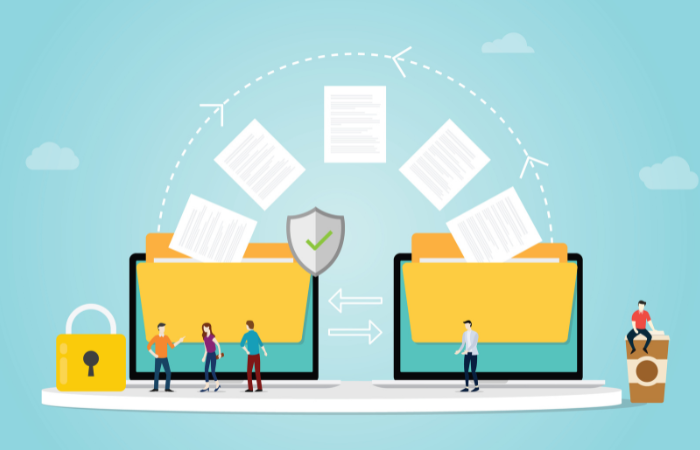

Four things to be aware of when data integration

Large-capacity file transfer software, focusing on ease of use
Three benefits
According to the "Survey Results on Japanese Companies' Internet of Things (IoT) Initiatives" published in 2016 by Gartner, a major IT market research company, over 50% of respondents expressed expectations for IoT, such as "IT will be able to contribute more to business." However, nearly 40% of respondents also stated that they "still don't know where to start," suggesting that many companies are unsure how to incorporate it into their business. In this article, we will introduce examples of IoT use cases, as well as steps to promote IoT and points to note regarding data integration, which is the key to utilizing IoT.
1. IoT Use Cases
1-1 Definition of IoT
First, let's review what IoT (Internet of Things) is. There is no clear definition of IoT, but it is mainly used in the following two senses.
- Narrow definition
- A technology in which sensors embedded in objects read the state and changes of the objects themselves and their surroundings, and send this information to the network.
- Equipment incorporating No. 1 technology
- Communications and data management services to realize the technology in 2
- Broad definition
A system that utilizes data obtained from the technologies, devices, and services described above (1) for the benefit of business and society.
1-2 Examples of IoT use
IoT can be broadly categorized into two ways.
Here we will introduce one easy-to-understand example of each.
(1) Examples of use in the narrow sense
This is an example of how "connecting things to a network expands the possibilities that they have."
In September 2016, Otsuka Pharmaceutical and NEC announced that they would jointly develop an IoT pill case for stroke patients.
This IoT pill case has the following features:
- Automatic notification of medication times
- Send the date and time of taking the medicine to a smartphone or tablet device
These features will prevent you from forgetting to take your medicine and allow your family to keep track of your medication status.
(2) Examples of broad usage
This is an example of how data collected from network-connected objects can be used to benefit business and society.
Disney World has developed the MagicBand, a sensor-equipped wristband that guests can wear to seamlessly check into hotels, purchase lunch, and make reservations for certain attractions.
However, MagicBands can be used for other purposes as well. MagicBands can collect data on how guests move around the park. By analyzing the data collected from MagicBands, Disney World is able to use it to improve the allocation of attraction staff and improve inventory management in shops and restaurants.
2. 4 steps to utilize IoT data
It is predicted that there will be 50 billion devices connected to the Internet by 2020. What specific steps are needed to utilize the vast amount of data collected from these devices to benefit business and society?
2-1 Data visualization
First, let's understand what can be learned from big data collected from IoT. There are publicly available tools that can visualize big data collected from IoT in graphs and maps, so it would be a good idea to introduce these tools as needed.
2-2 Hypothesis formulation
From the visualized data, derive a hypothesis: "If we utilize this data, perhaps we can improve our business in this way?"
To achieve this, it is necessary to analyze the big data collected from IoT, and recently, there have been an increasing number of cases where this data is analyzed using AI (artificial intelligence).
2-3 data integration
Once the policy of "how to use big data collected from IoT to create value for the business" has been decided, the next step is to actually collect the data and link it to other applications.
As IoT data is being input into business sites that operate in real time, various disruptions are expected to occur. More details will be provided in the next section.
2-4 PDCA
By repeatedly conducting test operations, we will explore more effective ways to utilize the system and ways to bring about wider-ranging effects.
3. Four things to be aware of when data integration
As mentioned in 2-3, when collecting IoT data and linking it with other applications, failure to consider several points can lead to confusion in the field. The following four points are particularly important to pay attention to.
Things to be careful of when data integration (1) Missing data
There are areas where missing data during collection, such as data related to equipment monitoring or crime prevention, can lead to serious accidents.
If you want to utilize this kind of IoT data, you need to implement a data integration system that will ensure reliable data collection.
Things to be aware of when data integration (2) Increased management costs
The more devices connected to a network, the greater the likelihood of network errors occurring, which can result in enormous operational and management costs.
When building a system that connects a large number of devices, it is necessary to introduce data integration system that reduces operational management work, such as functions that automatically detect network errors and automatically retry when an error occurs.
Things to be aware of when data integration (3) Increased communication costs
Collecting image and video data through IoT can result in huge communication costs. If you expect the volume of communication data to be large, you will need to introduce a data integration system that reduces communication costs by compressing and transferring the data.
Things to be aware of when data integration (4) System construction load
Even if you want to start IoT demonstration right away, it takes time to build a data collection protocol and a mechanism data integration data integration with other applications.If you want to shorten the time it takes to build the system and spend more time on PDCA, it is a good idea to introduce a data integration system that allows you to collect, process, analyze, and link data with other applications without programming.
summary
According to the Gartner survey mentioned at the beginning, 10.1% of companies responded that they had established a specialized IoT department or group. This percentage is sure to increase in the future.
To promote IoT, it is important to quickly build a system that can collect data without loss from devices connected to the network and smoothly data integration with other applications.
Please refer to the "4 things to be careful of when data integration" introduced in this article to select the optimal system.
File Sharing: A Beginner's Guide Column List
- File Sharing: An Introduction
- The dangers of "shadow IT" that you should be aware of before using data integration services
- File sharing services: 5 things you need to know when selecting one
- Pitfalls of free file transfer services! Information leakage prevention
- Understand the roles and types of protocols used for file transfer
- Is a file sharing service the best option for sending and receiving large files?
- The ever-increasing volume of data is making file transfer a struggle.
- Three benefits of large-capacity file transfer software that prioritizes ease of use
- Four things to be aware of when data integration
- How to data integration?
- file transfer via HTTP? ISDN will end in 2020
- MFT enables file transfer that FTP cannot.
- No more need for USB flash drives? 3 ways to transfer data over LAN
- Improve business efficiency with data integration platform! Three benefits
- Convenient! How to use Bluetooth for file transfer
- How to use file transfer services that you may have thought you knew about
- Key points to consider when choosing data integration middleware
- Recommended file transfer services to improve business efficiency
- A reliable ally for data integration! Efficient conversion and effective utilization through ETL
- How to data integration with Salesforce
- data integration middleware makes your work more efficient
- This is recommended! data integration service that is conscious of security
- Efficient data integration and siloed system integration through EAI
- When integrating systems with overseas bases, improve work efficiency with English-language tools!
- Three benefits of centrally managing system integration
- A DI platform that data integration scattered throughout the company