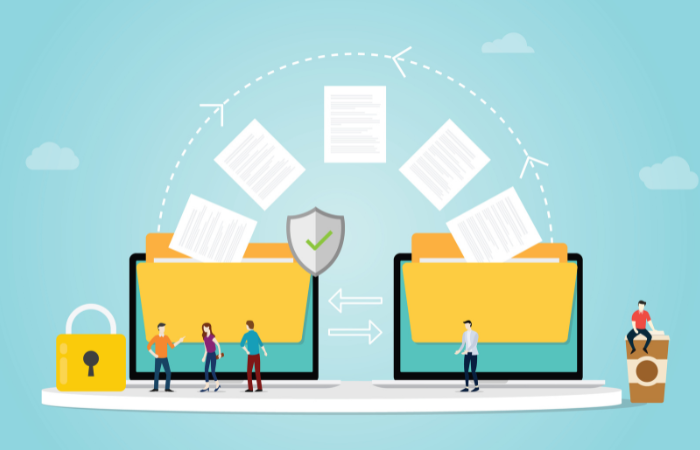

MFT (Managed file transfer) realizes file transfer that cannot be solved with FTP

Is FTP reaching its limits? What is secure and easy file transfer MFT?
FTP file transfer are convenient because they can be transferred regardless of the operating system or other environment, but they are limited to simple transfers and do not allow for detailed processing such as character code conversion or compression/decompression. Furthermore, since the data is not encrypted during transfer, using it for corporate purposes carries a significant risk of information leaks. Therefore, this article introduces MFT file transfer, a secure and easy-to-use alternative to FTP file transfer.
1. Three problems with FTP (file transfer Protocol)
FTP has been used for file transfer since the dawn of Internet protocols. The reason it has remained in use for so long is probably because it allows for easy file transfer without relying on the sender's operating system or worrying about file size. However, there are several issues with using FTP to file transfer in business situations.
(1) Unable to encrypt file transfer
The biggest problem with FTP file transfer is that communications are not encrypted during file transfer. In today's world, where the risk of information leaks from companies has become a social issue, file transfer that cannot be encrypted can lead to companies being seen as having a low level of security awareness, putting them at risk of losing credibility.
There are also advanced versions of FTP, such as SFTP, FTPS, and SCP, which allow file transfer while encrypting the communication channel. However, like FTP, these do not have any other functions besides file transfer, so they are not suitable for business transactions.
(2) Detailed processing is not possible when file transfer
FTP is a protocol dedicated to file transfer and does not have any other features. Therefore, when file transfer via FTP, detailed processing such as character code conversion, data integrity verification, compression/decompression, and history cannot be performed. This leads to inefficiency in business operations.
(3) file transfer becomes personal
Related to (2), because FTP file transfer alone cannot handle detailed processing, in many cases dedicated operation management tools or independently developed tools are used in conjunction with it. FTP file transmission also requires knowledge of FTP itself. This creates a dependency on individuals, such as those who are not familiar with tools and FTP, making file transfer impossible, which is another factor that leads to inefficiencies in business operations.
2. MFT (Managed file transfer) Solves FTP Issues
There is a demand for file transfer systems that overcome the challenges of FTP while maintaining its convenience, and MFT file transfer is one such system that is gaining attention. MFT stands for Managed File Transfer, which literally translates to "managed file transfer." To achieve these tasks, including those that FTP cannot perform, as mentioned above, you have the option of developing the necessary functions yourself or using dedicated tools. The benefits of MFT include solving the three major challenges FTP faces: security measures, increased work efficiency, and elimination of work dependency.
(1) Encryption enables secure file transfer
MFT can automatically encrypt files, which is something that FTP file transfer can only do with other tools. This reduces the risk of files being transferred unencrypted due to linking with other tools or misconfigurations, making file transfer easy and safe.
(2) Improved business efficiency through reduced processing effort
It includes default processing such as character code conversion, data integrity verification, compression/decompression, and history, which are not possible with FTP file transfer, eliminating the need for additional development and improving business efficiency.
(3) Anyone can easily file transfer, eliminating the dependency on individual skills.
MFT is designed to be intuitive and easy to use for anyone. It eliminates the need for process settings that are required with FTP, as well as settings that require knowledge of FTP itself, eliminating the dependency on individual skills.
summary
You might think that simply changing file transfer method won't have much of an impact on your business. However, once an information leak occurs, the time and cost required to resolve the incident can be immeasurable. Switching file transfer to MFT not only reduces security risks, but also improves business efficiency and reduces the costs of securing personnel. From these three aspects, file transfer can be said to be file transfer system that greatly contributes to increasing a company's profits.
»HULFT: An MFT that enables efficient and secure file transfer that anyone can easily use
Related pages
»[Press Release] HULFT Ranks Second in Global Sales Share (Gartner MFT Market Research)
File Sharing: A Beginner's Guide Column List
- File Sharing: An Introduction
- The dangers of "shadow IT" that you should be aware of before using data integration services
- File sharing services: 5 things you need to know when selecting one
- Pitfalls of free file transfer services! Information leakage prevention
- Understand the roles and types of protocols used for file transfer
- Is a file sharing service the best option for sending and receiving large files?
- The ever-increasing volume of data is making file transfer a struggle.
- Three benefits of large-capacity file transfer software that prioritizes ease of use
- Four things to be aware of when data integration
- How to data integration?
- file transfer via HTTP? ISDN will end in 2020
- MFT enables file transfer that FTP cannot.
- No more need for USB flash drives? 3 ways to transfer data over LAN
- Improve business efficiency with data integration platform! Three benefits
- Convenient! How to use Bluetooth for file transfer
- How to use file transfer services that you may have thought you knew about
- Key points to consider when choosing data integration middleware
- Recommended file transfer services to improve business efficiency
- A reliable ally for data integration! Efficient conversion and effective utilization through ETL
- How to data integration with Salesforce
- data integration middleware makes your work more efficient
- This is recommended! data integration service that is conscious of security
- Efficient data integration and siloed system integration through EAI
- When integrating systems with overseas bases, improve work efficiency with English-language tools!
- Three benefits of centrally managing system integration
- A DI platform that data integration scattered throughout the company