
Data transfer middleware makes your work more efficient

Make your work more efficient with "Data Transfer Middleware"!
What method does your company use to link data between different systems?
Until now, common methods have been to "send files in bulk via FTP" or "enter data twice."
However, both of these methods had problems such as lack of immediacy and inefficiency.
Instead, what is currently attracting attention is "data transfer middleware," which can efficiently link data in real time.
In this article, we will explain what "data transfer middleware" is and how data integration using "data transfer middleware" differs from existing data integration.
1. What is "data transfer middleware"?
1-1 What is "middleware"?
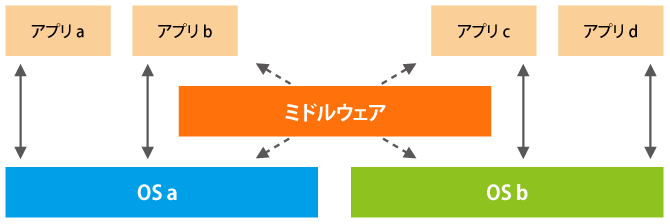
"Middleware" is a type of software that sits between the operating system (OS) and application software.
Typically, functions that are likely to be commonly used by many applications are provided as OS functions.
However, there are certain functions that are not general enough to be included in an OS, but are always commonly used in certain fields.
Since it would be inefficient to develop these functions individually, they are provided in the form of "middleware."
Many types of "middleware" are designed to be compatible with multiple operating systems and hardware, so that applications do not need to worry about differences in operating systems.
1-2 What is "data integration middleware"?
"data integration middleware" refers to middleware provided for the purpose of linking data from various business systems and cloud services running on different operating systems.
2. Differences between "Data Transfer Middleware" and other data integration methods
Before the advent of "data transfer middleware," two main methods were used to data integration between different systems: "file transfer" and "double data entry."
2-1 Difference between "file transfer" and "data transfer middleware"
(1) What is "file transfer"?
"file transfer" refers to sending and receiving files over a network.
A communication procedure called FTP (File Transfer Protocol) is often used for "file transfer."
"file transfer" can be used immediately without installing any special software, so it is used by many companies.
(2) Data processing method for "file transfer " "file transfer" uses a bulk processing method called "batch processing."
"Batch processing" is a method of writing a certain amount of data to a single file and then transferring the data all at once.
(3) Difference between "file transfer" and "Data Transfer Middleware" The "batch processing" used in "file transfer" is suitable for processing that does not require real-time performance, such as sending employee payroll data to a bank at the end of the month.
However, it is not suitable for processes that require immediacy, such as "When one unit of product A is sold in the sales management system" ⇒ "Deduct one unit from the inventory management system."
In contrast, "data transfer middleware" can perform data integration processing as soon as the need arises.
- "file transfer": Good at linking with "batch processing"
- "Data transfer middleware": Good at batch processing as well as real-time integration
2-2 Difference between "double data entry" and "data transfer middleware"
(1) What is "double data entry"? "Double data entry" refers to a person manually entering the same data into multiple systems.
"Double data entry" has been used as an operational method when it is not possible (or difficult) to data integration via "file transfer" due to differences in data formats between systems, such as between an "quotation/billing system" and an "accounting system."
Because it was a manual process, there were no system costs involved, but it was time-consuming, there was a high chance of errors, and it was very inefficient.
(2) Data processing method for "double data entry" Since it is manual entry, it is basically processed one record at a time.
However, processing cannot proceed without human intervention, which creates a time lag.
Although it is possible to handle multiple data formats, as mentioned in (1), the possibility of human error is very high.
(3) The difference between "double data entry" and "data transfer middleware" By utilizing "data transfer middleware," it is possible to link data in different formats and, unlike human processing, it is possible to process data instantly and without error.
- "Double data entry": Highly flexible, but inefficient and prone to errors.
- "Data transfer middleware": Highly flexible, yet also efficient and accurate.
For reasons such as 2-1 and 2-2 above, an increasing number of companies are introducing "data transfer middleware."
summary
Now that multiple databases, file systems, business systems, cloud services, etc. are mixed within a single company, a major challenge is how to efficiently and safely connect the data held by each system.
One solution that is attracting attention is "data transfer middleware."
"Data transfer middleware" not only links data from different systems, but also includes functions for detailed linking processes, such as handling transfer errors and automatically starting applications after files arrive.
Compare the functions, features, track record, etc. to select the one that is best suited to your company.
File Sharing: A Beginner's Guide Column List
- File Sharing: An Introduction
- The dangers of "shadow IT" that you should be aware of before using data integration services
- File sharing services: 5 things you need to know when selecting one
- Pitfalls of free file transfer services! Information leakage prevention
- Understand the roles and types of protocols used for file transfer
- Is a file sharing service the best option for sending and receiving large files?
- The ever-increasing volume of data is making file transfer a struggle.
- Three benefits of large-capacity file transfer software that prioritizes ease of use
- Four things to be aware of when data integration
- How to data integration?
- file transfer via HTTP? ISDN will end in 2020
- MFT enables file transfer that FTP cannot.
- No more need for USB flash drives? 3 ways to transfer data over LAN
- Improve business efficiency with data integration platform! Three benefits
- Convenient! How to use Bluetooth for file transfer
- How to use file transfer services that you may have thought you knew about
- Key points to consider when choosing data integration middleware
- Recommended file transfer services to improve business efficiency
- A reliable ally for data integration! Efficient conversion and effective utilization through ETL
- How to data integration with Salesforce
- data integration middleware makes your work more efficient
- This is recommended! data integration service that is conscious of security
- Efficient data integration and siloed system integration through EAI
- When integrating systems with overseas bases, improve work efficiency with English-language tools!
- Three benefits of centrally managing system integration
- A DI platform that data integration scattered throughout the company