

What are "water breaks" in soccer and "WBGT" (Wet Bulb Globe Temperature), which is used in companies' mandatory heatstroke prevention measures? ~The era of thinking about "heat" with data.

This is Watanabe from the Marketing Department.
This is a column that casually covers a variety of topics related to data, IT, and more.
The term "WBGT" (Wet Bulb Globe Temperature) is heard everywhere.
This time, I'd like to take a look at "WBGT" (Wet Bulb Globe Temperature), a term that has become increasingly common in our increasingly hot world. I'll explain what WBGT is, why it's used in so many fields, and how we can scientifically address the heat.
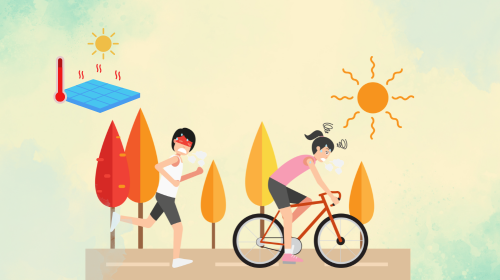
"Water breaks" in soccer
Recently, when I go to watch a soccer match, I've noticed that in addition to halftime, there's sometimes a "water break," which is a short interruption to the game.
Traditionally, matches were temporarily suspended outside of halftime only when something had happened during the game, such as "waiting for a VAR decision" or "waiting for treatment for an injury." So, a temporary suspension during a match seemed like a signal that something had happened. However, my first encounter with a water break while watching a match live was when I didn't know the reason for the suspension and wondered, "What happened?"
Or, the experience of a "drinking break" at a game is like that; the cheerleaders tend to sit down, realize they should drink some water, and drink together.
Not every match has a water break; it varies from match to match. It's not always implemented in summer matches, and sometimes there is a water break even in June. Based on the local climate, the decision to implement a water break seemed reasonable, but I wondered how they decided whether or not to implement one. It turns out that the criterion for deciding whether or not to implement a water break was the "WBGT" (Wet Bulb Globe Temperature) index.
Criteria for determining whether companies should mandate heatstroke prevention measures.
One recent topic of discussion is the revised Industrial Safety and Health Regulations, which came into effect in June 2025, making it mandatory for companies to implement heatstroke prevention measures, with penalties for non-compliance.
While heatstroke is often discussed in the context of Construction, where work is frequently carried out outdoors, it's not a legal obligation limited to a specific industry; all companies are required to implement heatstroke countermeasures. Looking at statistics on serious accidents caused by heatstroke, it becomes clear that accidents are also frequent in industries other than Construction, such as Manufacturing, transportation, security, commerce, and cleaning.
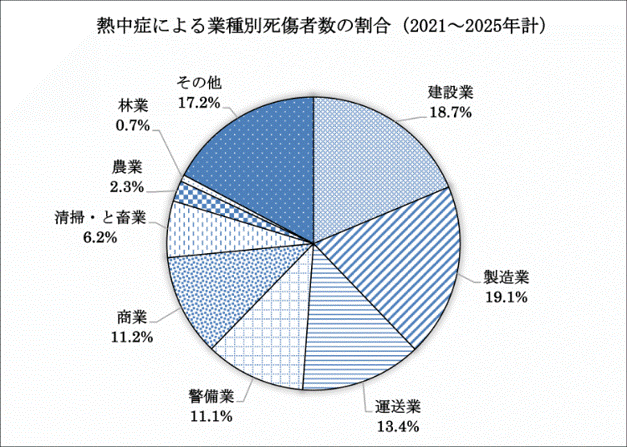
This is not just a request for effort, but a mandatory requirement with penalties, meaning that businesses that fail to take measures will be subject to imprisonment of up to six months (or penal servitude) or a fine of up to 500,000 yen. In other words, companies have no choice but to take measures, which has become a hot topic.
There's a lack of understanding, with some people thinking it's an overreaction to make such a fuss about the heat, and that people should just put up with it. However, heatstroke can cause serious accidents, including death and permanent disabilities. Therefore, in tropical and subtropical countries, working outdoors during the daytime in summer is sometimes considered completely unreasonable. In the Middle East, there are even countries where daytime outdoor work is prohibited by law.
In the first place, "making people work in excessively hot conditions" not only poses a risk to workplace accidents, but also contributes to decreased productivity, increased work errors, and even employee turnover. Therefore, countermeasures were necessary to ensure a successful business.
And here too, the criterion used to determine "under what circumstances is the implementation of countermeasures mandatory" was the value called "WBGT".
The origins of WBGT (Wet-Bulb Globe Temperature)
WBGT (Wet-Bulb Globe Temperature) is a heat index devised by the U.S. Marine Corps in 1954. It originated from an initiative at the recruit training center on Paris Island, South Carolina, as a means of scientifically managing the risk of heatstroke.
Paris Island is a highly humid region, and because it is home to the U.S. Marine Corps, which is known for its rigorous training, serious heatstroke incidents have occurred there, which has become a problem. Therefore, the WBGT (Wet Bulb Globe Temperature) standard was developed to scientifically determine "what level of training is appropriate under what climate conditions."
The U.S. Marine Corps uses "green flags," "yellow flags," "red flags," and "black flags" at training grounds based on the WBGT (Wet Bulb Globe Temperature) value, and manages what types of training are permitted under the current climate conditions accordingly.
In Japan, the prevailing approach to "dealing with the heat" was long based on mental fortitude. Even in the 1980s, it was common practice to deprive athletes of water during outdoor sports activities in the middle of summer, based on the idea that "if you can't endure the heat, you won't develop the patience to withstand it" or "drinking water will only tire you out and prevent you from getting stronger." Compared to that, it's astonishing that such efforts were being made as far back as the 1950s.
Subsequently, WBGT spread throughout the world and came to be used in many fields. In the United States, it came to be used as a criterion for determining whether the temperature was suitable for sports activities, and it even became an international standard by ISO. It is an indicator with a proven track record that is trusted and used all over the world.
In Japan, it wasn't until 1994 that calls for preventing heatstroke in sports based on WBGT values began to be made. In the 2020s, the J.League also adopted it as a standard for implementing "drinking breaks." Recently, we've seen "heatstroke warning alerts" issued in conjunction with weather forecasts, and these are also issued based on WBGT values.
How is WBGT calculated?
Before explaining the concept behind WBGT, let's first look at the formula used to calculate it.
- Outdoor calculation formula
- WBGT = (wet bulb temperature x 0.7) + (black bulb temperature x 0.2) + (dry bulb temperature x 0.1)
- Indoor calculation formula
- WBGT = (wet bulb temperature x 0.7) + (black bulb temperature x 0.3)
It appears that the calculation involves blending three different temperatures. Also, while heatstroke prevention is often associated with outdoor activities, the WBGT calculation formula includes a specific formula for indoor use.
dry-bulb temperature
"Dry-bulb temperature" is what we commonly refer to as "air temperature." In other words, it's the temperature measured using a regular thermometer.
However, in outdoor calculations, this temperature accounts for "only 10%" of the calculation, and in indoor calculations, it is "not considered" at all. We have traditionally tended to judge whether it is hot or not based on "air temperature," but this is insufficient (if judging by air temperature alone was sufficient, then there would have been no need to invent WBGT in the first place).
wet-bulb temperature
"Wet-bulb temperature" is the temperature measured using a thermometer with its bulb wrapped in water-soaked gauze. The difference from dry-bulb temperature is that "the temperature drop due to water evaporation is taken into account." In other words, it is a temperature that takes humidity into account.
The wet-bulb temperature accounts for as much as 70% of the WBGT value, highlighting its importance. In other words, the ability to regulate body temperature through sweating and evaporation is crucial.
High humidity can be dangerous even at low temperatures because the body's ability to lower temperature through sweating is impaired. It's also necessary to "replenish fluids" to ensure proper sweating, and to "replenish fluids containing electrolytes at the appropriate osmotic pressure" to compensate for the loss of electrolytes from the body due to heavy sweating.
globe temperature
"Black globe temperature" is the temperature measured at the center of a thin, hollow copper sphere, 15 cm in diameter, with a matte black surface. It's so strange that it almost seems like magic, making you wonder "why such a peculiar measurement method?", but this is done to take "radiant heat" into account.
Two types of "heat" are involved in how people perceive heat. First, there is the "heat from the air that is in direct contact with the body," that is, the normal temperature. The other is the "heat caused by infrared radiation emitted from the surrounding environment."
For example, with a heated table (kotatsu) or a charcoal fire, you feel the heat "directly" through infrared radiation, not through the air. Also, when you enter a room with a roof that has become extremely hot during a heatwave, you feel the scorching heat "directly" rising from the ceiling. When you enter an underground passage in the middle of summer, even though the temperature of the air itself is roughly the same as outside, it can suddenly feel "cool." This is because the "radiant heat you were receiving from the surroundings" is gone in the underground passage, making it more comfortable.
The black paint is used to effectively receive heat radiation from the surroundings, and the matte finish does not reflect infrared rays. By isolating it from the outside air with a hollow metal sphere, the temperature is measured with "heat radiation taken into account."
The combination of these three "temperatures" gives us the "WBGT" (Wet Bulb Globe Temperature) index.
Hopefully, you now have a general understanding of what WBGT is. The topic of "heat" will undoubtedly become more and more important, but WBGT defines "heat" from the perspective of preventing heatstroke using this approach. It is a calculation formula that makes us think about the importance of considering factors other than temperature, such as humidity (or the decrease in body temperature due to sweating) and radiant heat.
As explained above, measuring WBGT values requires specialized measuring equipment. However, that's a bit too complicated, so instead, you can refer to the "WBGT forecast values" published by the Ministry of the Environment and the Japan Meteorological Association based on the weather conditions of the day.
- ⇒ Ministry of the Environment Heatstroke Prevention Information Site Graph - Today
- ⇒Beware of heatstroke! - Heatstroke information (approximate WBGT value) - Japan Meteorological Association tenki.jp
However, it's important to note that this is merely a "predicted value for general outdoor conditions." The true WBGT value at a given location cannot be determined without measurement. In particular, the correct WBGT value indoors (which is obvious considering the mechanism) cannot be determined without measuring it on-site.
WBGT during a soccer "water break"
The first example we discussed was how WBGT values are actually used in practice, specifically in sports.
Guidelines for preventing heatstroke by the Japan Sport Association (JSPO)
The Japan Sports Association, a public interest incorporated foundation, has compiled guidelines on whether it is safe to play sports in hot weather from the perspective of preventing heatstroke.
⇒ Exercise guidelines for preventing heatstroke - Let's prevent heatstroke – JSPO
- WBGT value of 31 or higher: Exercise should be stopped as a general rule.
- Exercise should be stopped unless there are special circumstances.
- WBGT level of 28 or higher: Avoid strenuous exercise (extreme caution)
- Avoid strenuous exercise and endurance running, or any other activities that easily raise body temperature.
- Take a break every 10-20 minutes and replenish fluids and electrolytes.
- WBGT value of 25 or higher: Take breaks actively (be cautious).
- Take breaks and replenish fluids and electrolytes proactively.
- Take a break every 30 minutes or so during strenuous exercise.
- WBGT value of 21 or higher: Caution
- Be careful as there is a risk of heatstroke.
- Actively replenish fluids and electrolytes.
- WBGT value below 21: Generally safe
- The risk of heatstroke is usually low.
For example, if you're in charge of your child's soccer team, you can use these guidelines to decide whether it's safe for them to exercise today. For instance, if you say, "The WBGT value is above 31, so we're canceling the game," it makes the reasoning behind the decision clear.
However, it's not uncommon these days for WBGT values to exceed 31 during the daytime in summer. If we apply this standard, it will often become impossible to exercise during the daytime in summer, forcing people to exercise in the early morning or evening, or in air-conditioned indoor spaces (or perhaps Japan's climate has simply become like that now).
WBGT values during J.League's "drinking time"
The "water breaks during soccer matches" that I mentioned earlier are implemented according to the following criteria. It seems that some improvements have been made to the water break system, perhaps because it has been in place for a while since it was introduced in the J.League.
- WBGT value of 31 or higher
- A "cooling break" will be implemented.
- WBGT value of 28 or higher
- We will implement a "drinking time"
- WBGT value of 25 or higher
- A "drinking break" will be implemented if either team requests it.
- WBGT value of 22 or higher
- A "water break" will be held if both teams wish.
- WBGT value less than 22
- Not implemented
In addition, it has been decided that "drinking breaks will be implemented as a general rule during matches in August." As far as I remember, when "drinking breaks" were first introduced, they were only implemented during a specified period in the summer, and were mandatory for matches within that period. However, nowadays, even outside of that period, for example, in May, if it is unusually hot, drinking breaks will be implemented depending on the WBGT value.
Since it's a professional sport, it's difficult to implement a policy like, "We measured the WBGT value and it's above 31, so we're canceling the match; everyone who came can go home." Therefore, there are no rules in place to cancel matches, and it seems that matches are played with a "cooling break" in place. However, in the summer, daytime matches are generally not held, and kickoffs are scheduled for 7 PM or later when the temperature has dropped, so it's not that there's no consideration at all; consideration is given at the match scheduling level.
Cooling break
A "cooling break" is a more thorough heatstroke prevention measure than a simple water break. It involves temporarily stopping the game to drink beverages, and instead, like halftime, players return to the air-conditioned bench area to actively cool their bodies. The essence of heatstroke prevention is not fluid intake, but lowering core body temperature, so this measure involves "providing a more effective break to directly cool the body."
Since cooling breaks are primarily used as a countermeasure for WBGT values above 31, which are unsuitable for sporting events, it means that, in general as a measure against heatstroke (for example, as a measure for people working outdoors), measures like drinking breaks are more effective and preferable than measures like water breaks.
The reason it says "if either team wishes" is because
If the sole purpose were accident prevention, mandatory heat-related breaks should be implemented when certain conditions are met. However, given the reality that "taking a break" itself can affect the outcome of the match, it seems that the decision to implement a break is made after consulting with both teams.
When a break is taken, the flow of the game pauses. Since teams can strategize based on the assumption that the flow of the game will stop, the presence or absence of a water break can be advantageous or disadvantageous to some teams.
While drinking breaks are designated as times for rest and tactical communication is prohibited, casual conversation is not forbidden, so in reality, tactical adjustments are often made during drinking breaks (it seems that this is inevitable when any system is put in place). For this reason, I think that they "ask both teams for their intention to implement it" because it is a factor that can affect the outcome of the match.
"We will not be conducting hydration breaks."
Furthermore, the J.League press release also specifically states, "We would like to inform you that we will not be implementing the hydration breaks that were introduced at the FIFA World Cup 2026™." This is a clear statement that they will not be doing that thing that was unpopular with soccer fans.
The fact that water breaks are effectively used as time for tactical adjustments is a form of abuse of the system by the teams, but at the 2026 World Cup, the tournament organizers (of all things) abused the water breaks by using them as "time to insert TV commercials," which was called a "hydration break." It was an excessively long 3-minute water break that was always implemented regardless of WBGT values, even in stadiums where the entire stadium was air-conditioned.
The J.League rules mentioned above state that water breaks should be "approximately 1 minute or less in accordance with the International Football Association Board (IFAB) Laws of the Game," and that cooling breaks involving moving behind the bench should be "3 minutes (to move into the shade, cool the body, and rehydrate)." The fact that they specifically mention it suggests that water breaks should be kept brief (1 minute or less) in accordance with international rules.
In other words, the World Cup hydration break, which is supposed to be a time to drink water, was an excessively long 3 minutes, comparable to a cooling break in the J.League, and did not even respect the rules of the game established by the International Football Association Board.
WBGT in the "Mandatory Heatstroke Prevention Measures" for Companies
Next, let's look at the standards for "heatstroke prevention" that have been the subject of much discussion, which will become mandatory with penalties from June 2025.
⇒ Strengthening measures against heatstroke in the workplace - Ministry of Health, Labour and Welfare
First, it states that "measures should be implemented based on the WBGT value."
The situation in which countermeasures become mandatory is defined as "when working for more than one hour continuously or more than four hours a day in an environment with a WBGT value (heat index) of 28°C or higher or an ambient temperature of 31°C or higher." Perhaps anticipating situations where WBGT values are unavailable (or where people do not understand what WBGT is), a temperature-based condition definition is also included.
While not limited to outdoor work, and therefore encompasses all indoor work, the reality is that there are many days when the WBGT value exceeds 28 during the day. Therefore, this legal obligation broadly applies to hot days in and around summer, as well as during the summer months.
The tasks that need to be addressed include "establishing a system," "creating procedures," and "informing stakeholders." This would involve clearly defining who is in charge and where (establishing a system), deciding what heatstroke prevention measures to take, how to monitor the risk of heatstroke, what procedures to follow to mitigate the risk, and what procedures to follow if someone is suspected of having heatstroke (creating procedures), and then Education employees and stakeholders about heatstroke prevention measures and procedures (informing stakeholders).
Commonly implemented measures and whether they are sufficient.
I am not an expert in this field, so I am not entirely sure what kind of measures are desirable for preventing heatstroke in companies. However, I have heard that currently, "using air-conditioned clothing" and "measuring body temperature rise with wearable devices" are common practices.
Air-conditioned clothing often receives positive feedback after adoption because it keeps people cool. On the other hand, some point out that, as a measure against heatstroke, it can have the opposite effect in situations where high humidity prevents sweat from evaporating, thus limiting its effect in lowering body temperature. Furthermore, in situations where temperatures exceed 35 degrees Celsius, which are now common, it can draw in air hotter than body temperature, potentially having the opposite effect.
Regarding wearable devices, while core body temperature is the key factor in preventing heatstroke, wearable devices can only directly measure surface body temperature. Therefore, they may need to be used cautiously as a basis for judgment in some cases.
If we were to draw inspiration from sports training strategies, we could consider measures such as ensuring adequate fluid and electrolyte intake to induce sweating (drinking time), taking regular breaks, and, in dangerously high WBGT (Wet Bulb Globe Temperature) situations, taking a break in an air-conditioned environment to directly lower body temperature (cooling break).
Let's consider WBGT as a means of scientifically addressing "heat."
Since heatstroke prevention measures are now mandatory and subject to penalties, I suspect that in many cases, measures are being taken to the best of one's ability, even if they are not very invasive. However, it is also possible to consider taking more proactive measures using WBGT values.
Since the WBGT value is now widely used all over the world, it should be possible to use it as a means of quantifying "heat" and dealing with it scientifically.
Project management that takes "heat" into consideration
A work environment that is "too hot" is not only a matter of obligation to take measures against heatstroke, but is also inherently undesirable as a work environment. If excessive heat leads to decreased work efficiency or a decline in work quality, it is certainly not a good thing. If more people are taking time off due to illness or if employee turnover is increasing, it is also undesirable from a human resources perspective.
In this era of severe labor shortages, we can no longer rely on sheer willpower to cope with the heat. Wasting human resources while simultaneously compromising progress and work quality is obviously detrimental to business operations and should be improved as an inefficient way of working.
In undertaking such improvements, numerical analysis using WBGT values should be effective. I'm not an expert on outdoor work sites, but even so, if I think about it for a moment,
- Write down a list of tasks being performed on site.
- Let's analyze the productivity of each task based on the WBGT value.
- Let's analyze the work quality (frequency of errors, etc.) for each task based on the WBGT value.
This approach seems to allow for an objective analysis of how heat is affecting work (some areas will have a greater impact than others), and it should also be possible to investigate the effectiveness of different heat countermeasures.
- We will compare the situation with and without heat countermeasures in place.
- For example, what is the difference in WBGT values between having a cooling vest and not having one when the WBGT value is 28 or higher?
- You can determine whether it's more costly to work in extremely hot conditions or to delay the work without pushing yourself too hard.
- For example, which is more cost-effective overall: investing in countermeasures to harvest crops at the best possible time, or delaying the harvest without taking unnecessary risks, resulting in lower crop quality?
Furthermore, the WBGT value can be measured at the work site, and the Japan Meteorological Association also provides forecast values indicating what the value will be at what time on what date. Therefore, the following should also be possible:
- Analysis has revealed that tasks whose work efficiency drops significantly when WBGT values rise will be scheduled to be completed during cooler hours.
- Since a sudden heatwave is forecast for Friday, we will revise our work plan to complete tasks A, B, and C by Thursday.
- It is possible to create a Gantt chart that takes into account changes in projected work progress based on the WBGT value.
I believe this would allow for the management and optimization of work processes that take heat into consideration. Furthermore,
- If we can quantify the deterioration of work efficiency, the decline in quality, and the negative impact on human resources caused by an increase in WBGT values,
- The effectiveness of investing in heat countermeasures can be measured numerically to determine how beneficial it is.
- This will provide new information to help determine whether or not to introduce unmanned technologies and how much to spend on them.
Furthermore, given the increasing frequency of extremely hot days with temperatures exceeding 40 degrees Celsius, this could prove useful in the future.
- When explaining to a client that "work is delayed due to the extreme heat," it is important to be able to explain with numbers why work is being delayed, what needs to be done to cause the delay, and the rationale behind why it is unavoidable.
- Alternatively, it is possible to pre-determine in the contract with the client how to handle situations where the WBGT value changes.
- We can demonstrate to our clients, with concrete figures, that our company has a competitive advantage due to its well-equipped heat countermeasures.
How to consider "heat" in marketing
Weather data is known to be associated with more things than one might expect, and even seemingly unrelated factors, such as equipment failure rates, can sometimes be found to be correlated with temperature and humidity when examined.
It is naturally assumed that human behavior is greatly influenced by the weather, but the WBGT value may be a more accurate reflection of the impact on people than temperature or humidity. If so, it may be possible to interpret "changes in people's behavior due to heat" from the WBGT value.
I think there are situations where this can be used as a means to predict which products will sell well now, and what kinds of behaviors people are generally exhibiting today (such as how many people are going out and how many are staying at home).
For example, it might be possible to make appropriate decisions about which products to display in the store and which menu items to offer based on the temperature, the WBGT (Wet Bulb Globe Temperature), and the age of the customers.
Connecting technologies to make advanced use of WBGT values a reality
I've given some thought to the possibility of proactive measures using WBGT values, although I'm not an expert and this is just speculation on my part.
Summer heat is only going to become an increasingly serious problem, and in that context, the ability of an organization to effectively cope with the heat will become a key differentiator from its competitors. If a company can utilize data to address heat-related issues, it will likely gain a competitive advantage.
However, in order to actually realize the "possibilities of data analysis" that we have been discussing, it is not enough to simply prepare the WBGT value itself as data; it is necessary to create a situation where a lot of other data can be obtained from various parts of the company and used in combination with the WBGT value.
For example, unless we refer to work record data such as who did what and when on site, and inspection results data of the deliverables after the work is completed, and then pre-process that data into a format that can be used for analysis, we can't even do the initial analysis I had in mind.
data integration is necessary both for performing data analysis and for utilizing the analysis results in business.
The WBGT value itself is a combination of data obtained data integration three measurement methods: dry-bulb temperature, wet-bulb temperature, and black globe temperature. It's likely that there was a lot of trial and error involved in determining which data to use and how to calculate it.
Furthermore, the U.S. Marine Corps used "green flags," "yellow flags," "red flags," and "black flags" in training grounds according to the WBGT value as a means of preventing heatstroke. This can be seen as a type of initiative that "uses conclusions obtained from data analysis to achieve business results by data integration to an external system."
For example, the system can be used to automatically send heat countermeasures instructions to work sites based on the calculated WBGT value, or to automatically notify relevant companies via email of the projected progress of future work based on the WBGT value and the progress of the work. In this way, the analysis results can be used to translate into actions that produce results. The ability to implement such integrated processing is important both for preparing the data necessary to obtain the analysis results and for generating results from the analysis results obtained.
So, how can we create such an environment where data integration?
There is a way to freely "connect" data using only a GUI.
Our company offers products such as "DataSpider" and "HULFT Square" which allow for seamless data integration across a wide variety of data, software, and cloud services using only a graphical user interface (GUI).
To analyze data and achieve results, you first need to gather data from various sources. Furthermore, achieving results through data utilization inevitably requires trial and error. This means that with each trial and error, "the effort of preparing new data necessary for the analysis" is incurred, and in real-world data utilization efforts, the effort involved in such preparation is often more difficult than the analysis itself, hindering progress.
It can be difficult for people to immediately understand the necessity of data integration, or why dedicated tools and cloud services are needed for data integration. However, our product has been supported for many years as a means to "create a situation where sufficient data is available for thorough data analysis" and "to build a system that enables actionable steps that lead to results based on the analysis results obtained" in "such situations."
In this era of increasingly hot weather, in order to stay ahead of the curve by achieving advanced capabilities to cope with the heat, we encourage you to consider using "DataSpider" and "HULFT Square" as means of "connecting" data and systems, and prepare for an era where even "heat" is considered through data.
The person who wrote the article
Related Columns
-
The "free rice" at Iekei ramen restaurants is actually a blessing for the establishments – what constitutes good innovation?
-
The "space AI data center concept," which has been making headlines with companies like SpaceX, is generating intense debate – the reality is not so simple.
-
When we think of spring, we think of cherry blossoms, but there are some surprising facts about the origins of the Somei Yoshino cherry tree, such as the fact that its roots are unknown.
Recommended Articles
-

How can we turn the "tacit knowledge" lying dormant within our company into "AI knowledge" and utilize it?
We will explain the specific process for turning unstructured data scattered throughout your company into an asset and maximizing the potential of AI. -

Automated classification of product masters using generative AI: How to bring a new perspective to your analysis
We will explain the new perspectives that transformation in product master management brings about through the automatic classification mechanism brought about by generative AI and the benefits that can be gained by adopting it. -
How to get the insights you want without changing your master data
This e-book offers a new approach to solutions for companies that have data but are not making use of it.