

The future "moon city" might be a "city made of earth (sand)"—an era where the most advanced things might be the very things that have always existed.

This is Watanabe from the Marketing Department.
This is a column that casually covers a variety of topics related to data, IT, and more.
Today's theme: Surprising facts about the "Age of Lunar Cities"
This time, I'd like to talk about some surprising future possibilities that lie ahead in the rapidly advancing field of "space development," and how this might suggest that the strong essence that can shape the future might lie in "things that have been around for a long time."
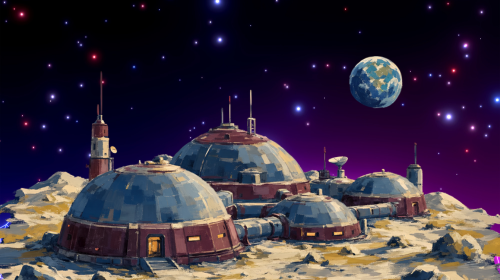
The accelerating "space race"
These days, we hear more about space development than ever before.
During the Cold War, space exploration was a hot topic, but at that time, it was mainly seen as a dream for humanity or a national project, and profitability was often not a major consideration. However, recently, private companies have been launching rockets more frequently, and the situation has changed qualitatively.
As of this writing (October 2026), it seems that private companies worldwide are competing to develop the capability to launch rockets into space. SpaceX, which is even further ahead in this competition, is likely working on the next stage: "What will we do in space using the launch capabilities we have achieved?"
Let's consider what happens next.
Launch capability will gradually become a given, and I think the competition will mainly revolve around "what kind of business can be made in space." What will be done with artificial satellites, or what will be done when a space station is built in orbit? For example, we've heard about plans to build space hotels for a long time, or space factories that utilize zero gravity, or perhaps Elon Musk's grand plan will come to fruition, resulting in an AI data center in space.
The next thing will probably be a "race for the moon's surface."
This time, the topic is predictions for what will happen even further in the future.
With rockets being launched frequently and in-orbit activities becoming increasingly common, what kind of competition will we see next? I believe we will see a "competition to reach the moon" and a "competition to establish bases of operations on the moon."
Even with numerous space stations being launched into orbit, the lunar surface still has "ground, gravity, and resources," making it fundamentally different as a base of operations. A lunar base has the potential to become humanity's first permanent base of operations outside of Earth, and I believe there will be competition for it.
The renewed acceleration of activity surrounding the moon began after it was discovered that there was likely water on the lunar surface.
Humans first reached the moon on July 20, 1969, as part of the American Apollo program. However, after Apollo 17 in 1972, manned landings ceased, and efforts to return to the moon waned. This was because the dream of being the first to reach the moon had already been fulfilled, and there was little economic motivation to continue the pursuit at great expense.
However, since the turn of the 21st century, it has become thought that there may be a sufficient amount of water on the moon, and research efforts by various countries have become active again.
Transporting water from Earth is extremely costly. If it can be secured locally, the possibility of establishing a permanent base of operations increases dramatically. Not only can drinking water be obtained, but by electrolyzing water, oxygen and hydrogen, which can be used as rocket fuel, can also be secured.
The race to reach the moon by rocket and the race to establish a base of operations on the lunar surface will soon begin. Following that, I think there will be a race to make the base of operations larger and more sophisticated, a race to secure and utilize lunar resources such as water to transform them into permanent bases of operations, and finally, a "lunar city development race" to compete on a larger scale, with more functions, more inhabitants, and greater economic power.
A "city on the moon" would likely be a "city made of earth (sand)."
For example, what image comes to mind when you hear "a lunar city inhabited by 5,000 people"?
You might have a classic science fiction image of "vehicles running through transparent glass." Or perhaps you imagine "buildings with white, membrane-like walls" or "silver buildings" resembling space bases or spaceships, shining in the sunlight. If you imagine that many people live on the moon, you might picture "a forest of skyscrapers like those on Earth" or "a city covered by a giant dome."
However, it seems highly likely that a real lunar city would be a "city of buildings made of earth (sand)." This is quite different from the futuristic city image described above. If that's the case, the "lunar city development competition" would become a competition to "build a massive city using lunar sand."
Why is it predicted that the city will be built of earth (sand)?
You might be wondering, "Why soil (sand)?" But if you think about it the following, it seems like there's no other option.
The lunar surface is an extremely harsh environment. Besides the lack of air and extreme temperature differences between day and night, the presence of high levels of cosmic radiation is another major challenge. With radiation exposure simply from being on the lunar surface, long-term stays become difficult.
For the lunar surface to function as a permanent base of operations, it is necessary to protect against strong radiation by some means. The basic measure for this is to attenuate the radiation by "covering it with something massive." You may have heard of "protecting it from radiation by surrounding it with lead." Lead is a very heavy metal, so it is sometimes used for this purpose.
You might think that we could simply use heavy materials on the moon to block radiation in the same way as on Earth, but the cost of launching a rocket increases with weight, so transporting large quantities of extremely heavy building materials from Earth would be prohibitively expensive. In other words, instead of sourcing from Earth, we need to "procure locally."
If we were to try to procure a large quantity of "weight" locally, the only option left would be to utilize the lunar surface's unique sand called "regolith." Because, frankly, we can't think of anything else that would be found in such large quantities on the moon.
This idea is not far-fetched. Since the Apollo program provided detailed information about the Moon, there has been discussion about utilizing regolith as a resource. In 2015, the European Space Agency (ESA) proposed the "Moon Village" concept, which also considered using regolith as building material and shielding material. Currently, the US-led Artemis program is also conducting research on its use as a building material.
Wouldn't the "development competition for lunar cities" essentially become a competition of "how to utilize the sand on the moon"?
In other words, a "lunar city where 5,000 people live" would likely be a living space with heavy walls and ceilings, created using lunar sand in some way, to accommodate 5,000 people. This is quite different from the image that comes to mind when you hear the term "lunar city."
For example, a dwelling might be constructed using a lightweight, membrane-like material that can be brought from Earth, and then covered with lunar sand. In other words, it might be like building a lunar base that looks like the kind everyone imagines, and then burying it in sand.
I imagine early lunar bases might look something like that, but it doesn't seem like a suitable method for building large structures that would accommodate many people, and I think a different approach would be needed for city construction.
It seems that the idea of building cities underground and living in them is already being considered, and there are plans to excavate areas on the moon where large underground cavities are known to exist and create living spaces. Perhaps life in a lunar city will be similar to that of subterranean people.
If you want to build a large-scale lunar city on the surface of the moon, you need to consider how to construct a lunar city with many large structures built primarily from lunar sand.
This may seem like an unlikely prediction, but if the current space race leads to a competition to develop cities on the moon, then the key to that competition might be "how to build structures and create a large city using lunar sand."
I think it's really difficult to anticipate what will happen in the future, or what will be truly necessary in the next competition.
There are settlements made of earth in North Africa.
Next, let's consider the technique of "buildings made of sand or soil."
When you hear "buildings made of earth," you might imagine the simple structures of tens of thousands of years ago, when humankind was still in its primitive stages. However, in North Africa, there are settlements made entirely of earth. I'm not talking about small houses made of earth; I'm talking about entire towns made of earth.
Perhaps the most famous example of a "village made of earth" is Ait Ben Haddou, a UNESCO World Heritage site in Morocco. The entire village, built on a hillside, is constructed entirely of earth, and its beauty is so remarkable that it has earned it a World Heritage designation, making it a popular tourist destination. Its otherworldly and unique landscape has also made it a popular filming location for movies.
⇒Wikipedia: Settlement of Ait Ben Haddou
Ait Ben Haddou is a settlement built by the Berbers, and there are other Berber settlements and dwellings dug in the ground in North Africa. They may be an ethnic group that is not commonly heard of, but they have lived in North Africa since before the time of ancient Rome, and even the famous former French footballer Zinedine Zidane's parents were Berbers who immigrated to France.
This region has historically been attacked by various foreign enemies, including ancient Rome, Islamic dynasties, and France, and its climate is harsh due to its proximity to the Sahara Desert. By constructing entire settlements from earth, they can be fortified as strongholds, and earthen houses also have the effect of moderating temperature fluctuations, making life more comfortable. When you think about it, these advantages are similar to the motivation for using sand on the moon (to protect oneself from harsh cosmic radiation, but sand is the only material available in abundance).
In other words, future lunar cities are not a completely unknown challenge for humanity, but rather something that resembles the diversity that humanity has created throughout history—for example, the earthen settlements that have been built in North Africa for a long time.
In times of change and uncertainty, diversity is often said to be important, and this example also demonstrates the potential of diversity.
What is an "idea" that is inherently superior?
Surprisingly, this is what we're seeing: the traditional earthen architecture of North Africa, which we might think of as something of the past, could potentially serve as inspiration for building a lunar city.
Just like asking "Is it soil (sand)?", you might also be asked "Is it file transfer?".
If I may be so bold, we have a similar experience with our own product. Regarding our file transfer middleware, "HULFT," we sometimes get asked, "Is it really file transfer?" However, there is a strong underlying reason why it *should* be file transfer.
Even considering the incredibly diverse range of IT environments in the world, it's still expected that "files" can be used in almost all environments. They can be used in environments ranging from traditional mainframes to the latest cloud services, smartphones, and IoT devices; in fact, it's harder to imagine an environment where they *cannot* be used.
Furthermore, you'll rarely encounter a situation where you "don't know how to process files." They can be processed using most programming languages, and you can expect that most engineers will be able to implement the process of opening files.
In other words, by being "file-based," it can be expected to function without problems in a wide variety of environments and situations. Furthermore, just as cloud computing has emerged, even if new environments appear in the future, this technology is highly likely to remain usable across both new and traditional environments without any issues.
When you think about it that way, I think you'll understand that there's an essential reason why file transfer should be the way it is. And just like the idea of "building a house with soil and sand," there's an inherently superior quality to the way of thinking itself.
If we're talking about rocky celestial bodies in the solar system (not gas giants like Jupiter), then it's generally likely that their surfaces are rich in rock and sand. In other words, earthen construction may be "a type of construction that functions well in the diverse environments of the solar system," and the fact that "similar stories have emerged both near the Sahara Desert and on the moon" might be an example of this inherent nature.
This could become a highly sustainable building technology on Earth.
Furthermore, we can consider "future possibilities" on Earth as well. Soil and sand are abundant in most places on Earth. Or, if we were to bring the technology that proved successful in lunar cities back to Africa, it might prove to be very useful there too.
For example, imagine a device that, once filled with sand and water, automatically 3D prints a house according to the blueprints. This would allow for the construction of houses cheaply using materials abundant on Earth, making it an unprecedentedly sustainable construction technology.
However, simply enabling file transfer doesn't mean everything is perfect.
Just as there are advantages to building with soil (sand), there are also advantages to file transfer. However, that doesn't mean that everything will go smoothly simply by using file transfer.
While simply sending files might seem easy using existing technologies like FTP, if you're using it as a file transfer platform for an IT system that handles business operations, you actually need to consider many factors to ensure it functions properly.
For example, a logging function is needed to check who transferred what and when. Functions are also required to detect and recover data corruption during transfer, implement security measures such as encryption, and include backup functions. Furthermore, a function to pass received data to subsequent processing is also necessary. If a transfer is interrupted due to a line failure or other issue, a function is needed to determine how far the process has progressed and to safely resume the transfer.
Furthermore, a system is needed to understand and manage the overall status of file transfer ecosystem, which operates on a massive scale every day. It is also necessary to ensure that these numerous functions can be properly utilized in a wide variety of environments.
There's a huge gap between "at least files can be transferred" (the minimum level of "file transfer" as a concept) and "safety, security, and reliability are firmly ensured to a level where tasks can be entrusted to it" (a "file transfer platform" that can be used for business purposes).
Incidentally, if you adopt our file transfer middleware "HULFT," you'll immediately have an environment with well-thought-out solutions to address the practical difficulties of file transfer. As a result, you can immediately enjoy only the excellent aspects of file transfer (which is why it has been supported for so many years).
▼ Want to know more about HULFT Products?
⇒ HULFT 10 | Product Introduction Page
Perhaps the strong essence that can shape the future lies in things that have been around for a long time.
As I mentioned earlier, construction using soil (sand) may be a type of architecture that functions well and reliably in the diverse environments of the solar system. Those who find solutions and become winners on the moon may also become winners when it comes to building cities on Mars and beyond in space colonization.
However, similarly, aside from those excellent inherent qualities, many difficulties will inevitably arise when trying to utilize them as practical technologies, as illustrated by the example of file transfer. I suspect that the competition surrounding the construction of cities on the moon will be a battle to see whether we can properly resolve these "gritty realities" and make it truly practical.
Things you might fall into when trying new technologies in order to take on a new challenge
It's become increasingly common to hear people say that we shouldn't just continue doing things the same way, but that we must also embrace "new technologies" and "new fields." As a result, it's quite common to see people trying out trendy new technologies.
However, even after conducting a Proof of Concept (PoC), you might find that it doesn't yield any further results, or that in order to practically implement your initiatives, you'll face the same "gritty realities," leaving you feeling lost and bewildered.
Furthermore, upon closer examination, it's often the case that the field of trendy new technologies is dominated by incredibly talented individuals worldwide, making it quite challenging for a company to even compete.
Things that have been around for a long time have sometimes already overcome the "gritty realities" of life.
However, even if it seems hopeless to break into the battle for the world's best in generative AI, there might still be room for us to win in an unexpected area, like building a house out of sand. If we examine it carefully, we'll find that there are many fields where "unexpected things" will likely be necessary in the future.
Furthermore, if you choose to fight using time-honored, unchanging principles, there's another advantage: "things that have been used for a long time" mean that the "gritty realities you'll face when actually trying to use them practically" may have already been addressed with solutions developed in the past.
While there are no cities in Japan built entirely of earth, there are many traditional techniques that utilize earth in relation to architecture. Examples include roof tiles made by firing clay, and plastering, which involves applying water-soaked clay to create walls. In fact, there are fields where know-how for utilizing earth has been accumulated over many years.
For example, with plastering, gaps can sometimes form in the corners of walls or where they meet pillars as the wall dries, or walls made with the same materials and in the same way may have uneven coloring, or white powder or stains may appear a few days later. Methods to prevent these kinds of problems, which you only discover when you actually do the work, are already in place. In fact, when you hear these kinds of stories from a master plasterer, you realize how profound and amazing their craft is.
Of course, plasterers have never used lunar regolith to plaster walls, and common sense from Earth is unlikely to apply to construction on the moon. Nevertheless, if we let our imaginations run wild, it's possible that "roof tiles" made by firing lunar regolith with the heat of sunlight, and "traditional plastering techniques" that can transform the difficult lunar sand into beautiful earthen walls, might overwhelm other construction techniques, and that lunar cities could be built using earthen craftsmanship that dates back to the Edo period.
When you think about it that way, it seems like we really need to consider very carefully what is truly "new."
An unexpected "city on the moon made of sand"
So, in this article, I introduced the surprising idea that how we utilize lunar soil might be a key point in the upcoming "lunar development race." And it seems that buildings made of soil (sand) have a more inevitable essence than I initially thought.
We have to do something new, but at the same time the competition is too fierce. Competition in truly cutting-edge technology is usually intense, and in reality, it often comes down to whether we can compete and win at the forefront globally.
On the other hand, situations like "Are you going to build a city out of sand?" or "Are you going to communicate using files?" could actually present opportunities if utilized effectively.
Before reading this, I think many people wouldn't have found the idea of "building houses with earth" particularly appealing. But what about now, after reading this? I think what's important from now on is to re-evaluate the strengths and assets your company already possesses, in combination with the current situation (for example, by effectively data integration if it's IT), and make them sound equally impressive.
And as for the lunar city, I have a feeling it will simply be "living underground on the moon," but I hope a mysterious lunar city will appear that is neither futuristic nor ancient. It would be wonderful if a fantastic lunar architecture conceived by a "master of earth architecture" somewhere in the world becomes a reality.
The person who wrote the article
Related Columns
-

The "free rice" at Iekei ramen restaurants is actually a blessing for the establishments – what constitutes good innovation?
-
What are "water breaks" in soccer and "WBGT" (Wet Bulb Globe Temperature), which is used in companies' mandatory heatstroke prevention measures? ~The era of thinking about "heat" with data.
-
The "space AI data center concept," which has been making headlines with companies like SpaceX, is generating intense debate – the reality is not so simple.
Recommended Articles
-

How can we turn the "tacit knowledge" lying dormant within our company into "AI knowledge" and utilize it?
We will explain the specific process for turning unstructured data scattered throughout your company into an asset and maximizing the potential of AI. -

Automated classification of product masters using generative AI: How to bring a new perspective to your analysis
We will explain the new perspectives that transformation in product master management brings about through the automatic classification mechanism brought about by generative AI and the benefits that can be gained by adopting it. -

How to get the insights you want without changing your master data
This e-book offers a new approach to solutions for companies that have data but are not making use of it.