

Linking legacy systems with SaaS using HULFT


"HULFT" is file transfer tool that has held the top domestic market share for 21 consecutive years*. This program explains the features of HULFT, which is highly useful not only for transferring files but also for improving business efficiency, as well as its file integration mechanisms and case studies. It also introduces how to integrate with other solutions to more efficiently integrate corporate systems, from legacy systems to SaaS.
*Source: Fuji Chimera Research Institute, Inc. "2004-2010 Package Solution Marketing Handbook"
"New Software Business Market 2011-2024 Edition" < file transfer Tools Package, Value-Based, Vendor Share> FY2003 Results to FY2023 Results (Saison Information Systems Results until FY2022)
What is HULFT?
HULFT is used in a wide range of industries as middleware that safely and efficiently shares files between corporate systems. It supports a variety of platforms and can be used in a consistent manner across everything from legacy systems to modern environments such as cloud and containers, making it easy to implement and operate with low learning costs, regardless of the skill level of the engineer.
First, we will explain what kind of tool HULFT is, its features, and how file integration works.
▼I want to know more about legacy systems
⇒ Legacy System / Legacy Integration | Glossary
▼I want to know more about containers
⇒ Container | Glossary
▼I want to know more about file sharing
⇒ File Linkage | Glossary

HULFT Features
Rich features
file transfer protocols includeFTP (File Transfer Protocol)and SFTP (SSH File Transfer Protocol). While these provide basic file transfer functionality, simply transferring files is often insufficient when integrating corporate business systems, as various transfer-related processes occur. HULFT, on the other hand, allows you to immediately use the functions you need simply by configuring them from a dedicated management screen, reducing development time.
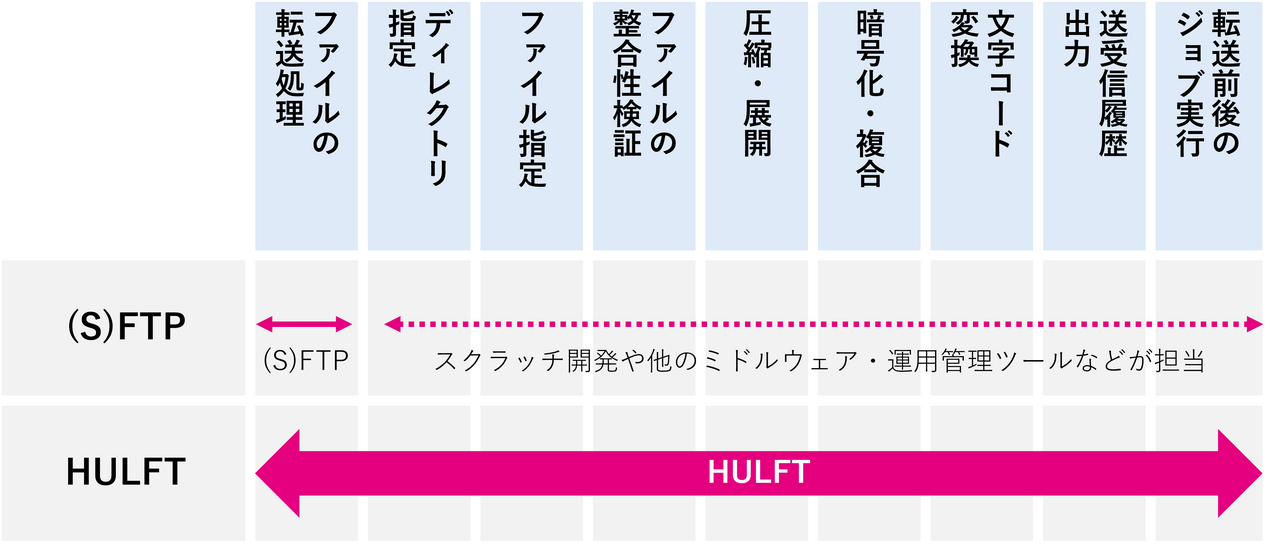
Tracking transfers and handling transfer errors
HULFT can track the results of file transfer and allows you to view and output the transfer history.
If the transfer fails, you can identify the cause by referring to the error code and take appropriate action. Identifying the cause of file transfer between different organizations tends to take time, but HULFT can clarify the demarcation point of responsibility by identifying whether the cause is on the sending or receiving side.
Many companies have cited the use of HULFT as a requirement for file collaboration between different organizations and mission-critical operations because of its high reliability in delivering important data reliably, including a recovery function in the event of network failure.
Easy expansion of partners
It supports a wide range of platforms, from legacy systems to modern environments such as clouds and containers. Specifically, it supports operating systems such as zOS, IBMi, UNIX, Linux, and Windows, as well ascontainer orchestrationservices provided by public clouds. It can be used with any platform using the same procedures, making it possible to expand the scope of collaboration regardless of the skill level of the engineer. It can also be used on platforms connected via public lines, as well as LANs.
Use of HULFT
This section explains the basic mechanisms and operating environment for using HULFT.
How file sharing works
With HULFT, sending a file is called "send" and receiving a file is called "receive." Because transfers are performed peer-to-peer, file transfer can be performed by installing HULFT on both send and receive sides.
Before file transfer, the send and receive sides each define the file name to be transferred, the transfer method, and destination information. With HULFT, a single definition is created from multiple pieces of information, and these are linked by an ID. When using HULFT to integrate files, all that needs to be agreed upon with the partner is a common "file ID." Even if the number of partners increases, there is no need to know the details of the partner's information, allowing for smooth integration without the hassle of adjustments.
Usage environment and lineup
The product lineup (such as "HULFT 10 for zOS," "HULFT 10 for Windows," or "HULFT 10 for Container Services") that best suits the system environment of send and receive sides is selected and implemented.
HULFT is provided as a self-managed package product that users can operate and manage themselves.
▼ I want to know more about HULFT lineup
⇒ HULFT 10 lineup | Product introduction page
HULFT Implementation Case Studies
HULFT has been adopted in a wide variety of industries and business processes, and we will introduce some specific examples by industry.
Banking: Linking mainframes and open systems
In many banking industries, accounting systems that manage account balances and calculate interest are run on mainframes. Meanwhile, information systems related to sales strategies are increasingly becoming open systems, and HULFT is used to data integration between these systems. HULFT can track the results of file transfer and also converts character codes between mainframes and open systems at the same time as file transfer, ensuring reliable and efficient file sharing.
Retail: Linking POS registers with mission-critical system, core system
In the retail industry, sales data broken down by day, product, and customer attribute is collected from store POS registers and sent to mission-critical system, core system. Maintenance data is also sent from mission-critical system, core system to the POS registers. HULFT is used for this data integration, and its built-in retry function in the event of a transfer error makes it easy to resend failed files. This eliminates the need for individual development work and shortens development time.
Manufacturing industry: Standardization of data integration among group companies
In manufacturing companies with numerous subsidiaries and affiliates, including production bases and research laboratories, data integration interface is standardized using HULFT to ensure safe and reliable integration between the ERP system shared by group companies and the different accounting systems owned by each branch and research laboratory. HULFT 's multi-platform support allows data to be integrated across different systems using the same procedures, ensuring data consistency. These functions ensure reliable file integration between various systems, leading to improved business efficiency.
HULFT streamlines on-premise and SaaS integration
In recent years, as part of the drive for digital transformation, an increasing number of companies are migrating systems from on-premise environments to the cloud and using SaaS. However, legacy systems also exist in on-premise environments, creating a need for flexible, mutually adaptable integration between SaaS and legacy systems. Customers who use HULFT are also increasingly migrating peripheral systems to the cloud and using SaaS while maintaining their legacy systems, and we feel that there is a growing need for API integration in addition to file integration with HULFT. In this chapter, we will introduce how to efficiently integrate on-premise systems with SaaS by combining HULFT with other solutions.
▼I want to know more about on-premise
⇒ On-Premises | Glossary
▼I want to know more about SaaS
⇒ SaaS|Glossary
▼I want to know more about the API
⇒ API|Glossary

Integration with HULFT 10 API Gateway
HULFT 10 API Gateway is a system for centrally managing HULFT installed in multiple systems. HULFT 10 API Gateway provides APIs for managing and operating HULFT, and you can manage and operate HULFT from SaaS or external services via HULFT 10 API Gateway.
▼ Want to know more about HULFT 10 API Gateway?
⇒ HULFT 10 API Gateway | Product Introduction Page
Collaboration with HULFT Square
If you have requirements such as "I want to use API to connect data" or "I want to achieve data integration with a managed service," using HULFT Square is effective. HULFT Square is a service provided by Saison Technology, the same company as HULFTiPaaS (Integration Platform as a Service)In addition to the wide range of pre-set connectors and intuitive interface that are common features of iPaaS, it also features a file integration function (HULFT Transfer) that is equivalent to HULFT. This makes it possible to integrate data from HULFT installed in an on-premise environment into a SaaS system via HULFT Square.
▼I want to know more about managed services
⇒ Managed Services | Glossary
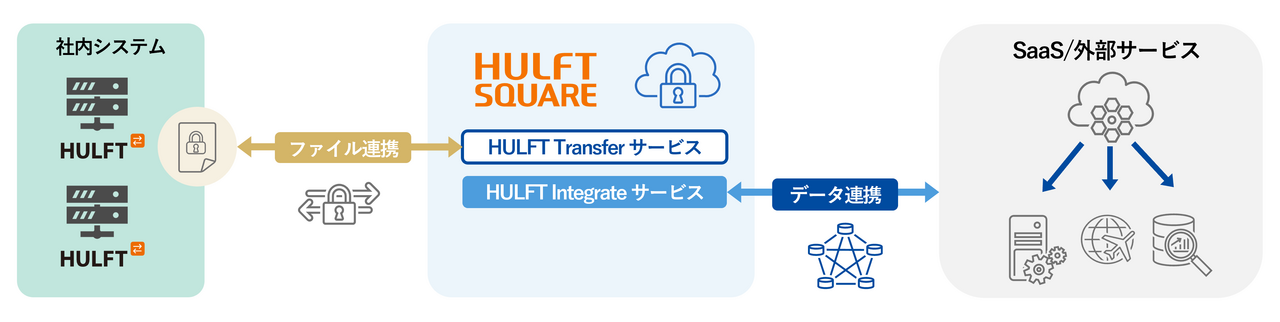
We will introduce some use cases that can be realized by integrating HULFT and HULFT Square.
Reduced management effort for external connection systems
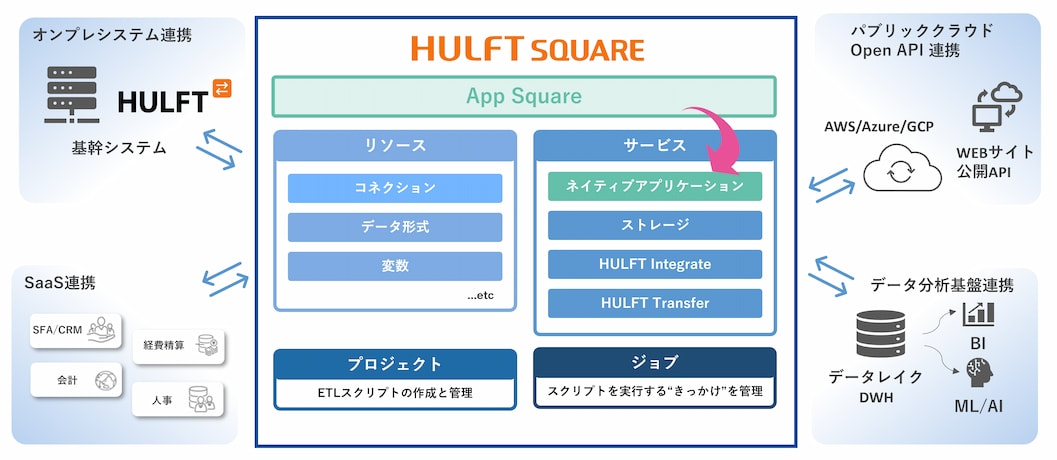
An external connection system is a mechanism that links a company's internal systems with external systems (such as those of other companies or cloud services). Even when using HULFT for file integration, it is common for companies to build their own relay systems. However, building an external connection system in-house increases the operational burden due to configuration, monitoring, and management (software updates, error handling, etc.). By using HULFT Square as an external connection system to solve these issues, you can expect to reduce maintenance workloads through managed services. HULFT 's functions also simplify error handling, resulting in more efficient operations.
Data analysis using internal data
By combining HULFT with HULFT Square, you can consolidate data from various systems, such as your company's mainframe and SaaS, into a data lake or data warehouse. This allows you to centrally manage dispersed data and enable analysis using your own data. Furthermore, by combining it with business intelligence (BI) and generative AI, you can gain insights tailored to your company's business and support rapid decision-making.
summary
HULFT safely and reliably connects all files, including mainframes, UNIX, Linux, and Windows systems coexisting within a company's information systems, as well as log data and CSV files generated by cloud systems, across organizations and systems.The security and easy error handling functions required by companies can be used simply by configuring the settings, shortening development time.
By combining HULFT with compatible solutions, you can make use of your existing assets while flexibly expanding your business to accommodate changes in your business situation, which can lead to a high return on investment even in the long term.
Please use this article as a reference and use HULFT to accelerate your company's digital transformation.
The person who wrote the article
Recommended Content
-

Standardization is the key to successful data integration
Having a mix of data integration tool within a company can lead to a decline in development efficiency and maintainability. We will explain the importance of "standardization" for efficient data integration. -

iPaaS-based data integration platform HULFT Square
iPaaS, data integration platform, is gaining attention in the age of AI. Check out the product details of "HULFT Square," which meets the needs of this era. -

Get an online consultation about data utilization
If you would like to hear more about our data utilization platform, we also offer online consultations.
Related Content
-

The Use of Generative AI in Talent Management: From Intuition to Data-Driven Approaches
-

What is CDC (Change Data Capture)? – A method for securely and reliably transporting data from on-premises systems.
-

data integration techniques for character code conversion—preparing for a mix of SJIS, JEF, and Unicode.