

Japan Airlines Co., Ltd. and JAL Digital Co., Ltd., which are at the core of the JAL Group's DX strategy, have introduced the cloud-based data integration platform (iPaaS) "HULFT Square" as a new dual-wielding tool that can be used separately from the existing data integration platform groups, which are heavy and long, in order to promote in-house production and efficiency of development. As a result, an environment has been created in which even people with no experience in data integration development can perform self-development, and the number of development projects that were difficult to realize in the existing data integration platform group has increased rapidly, such as DX for acquiring flight information data for airline routes and smooth data integration of codeshare flight information with other airlines. data integration platform The company achieved results such as a 50% reduction in development costs and a 50% reduction in the construction period.
Customer Issues
- To promote fast system development, it was necessary to introduce a solution that could be used interchangeably with existing data integration platform which were costly to develop and manage.
Benefits of implementation

Existing data integration platform
It was difficult to realize
Rapid increase in development projects

Related to data integration platform
Development costs reduced by 50%,
Construction time reduced by 50%,
Operating man-hours also reduced by 40%

Even if you have no experience data integration
Self-development through self-study
Establish an environment where
To achieve fast system development, it is essential to introduce a cost-effective data integration platform
The JAL Group is promoting cross-business initiatives, including customer strategies, human resources strategies, and digital transformation strategies, in order to realize its "JAL Vision 2030," which is based on the core principles of "creating a safe and secure society" and "creating a sustainable future," and to become "the most chosen and beloved airline group in the world."
At the core of the group's DX strategy, which centers on AI and data, are Japan Airlines Co., Ltd.'s Digital Technology Headquarters and JAL Digital Co., Ltd. (formerly JAL Infotech), a group company that integrated its organizational structure with the Headquarters in April 2025. The two companies are working together to use IT to improve operational efficiency and service quality, in order to accelerate DX for the group and its customers and contribute to the development of society.
One of the initiatives that both companies have been actively promoting in recent years is "Fast System Development." This is a method of in-house and efficient application development that makes maximum use of no-code and low-code tools available on the cloud in order to adapt to the rapid changes in the business environment. Since around 2022, both companies have been promoting the development of some projects based on this concept, with the aim of responding to small internal needs and ensuring the ability to respond to demand amid limited IT human resources.
However, simply using no-code/low-code tools does not necessarily mean that fast system development is possible, as another requirement for realizing fast system development is to quickly, easily, and cost-effectively data integration between systems.
The JAL Group operates data integration platform for each business area, such as passengers, operations, maintenance, airports, and cargo. However, all of the existing data integration platform were so-called heavy and large platforms that were not suitable for fast system development. Fuminori Fujiwara of the Corporate Group, Digital EX Planning Department, Digital Technology Headquarters, Japan Airlines Co., Ltd., and Yuhi Kaiho, Chief of data integration platform Group, Common Service Platform Department, System Management Headquarters, JAL Digital Co., Ltd., have the following to say:

Digital Technology Headquarters
Digital EX Planning Department
Corporate Group
Mr. Fujiwara Fuminori
"Because our existing data integration platform handled highly important areas such as customer information and flight information, they were quality-oriented and required specialized knowledge, making development, maintenance, and management time-consuming and expensive. They were not suitable for fast system development, and the challenge was that they could not meet internal needs while keeping costs down or quickly implement what we wanted. As a result, we decided to introduce a new data integration platform that prioritized cost-effectiveness, and we wanted to use it in conjunction with our existing data integration platform depending on the content of the development project," said Fujiwara and Kaiho.
HULFT Square was introduced after evaluating its development speed, cost, and customizability.
While searching for a new data integration platform, the two companies chose HULFT Square as one of their candidates and decided to implement it after comparing it with other products. Kaiho explains the key points in their selection:

System Management Headquarters
Common Service Infrastructure Department
Chief of data integration platform Group
Mr. Yuhi Kaiho
"First, we focused on a no-code, low-code tool that specialized in linking SaaS and PaaS, and that allowed for rapid development. Second, it had to have low implementation and operational costs, making it suitable for a small start. This was our first attempt at implementing an iPaaS product, so it was important that we could always back out if things didn't go well. The other factor was that it was highly customizable and could easily data integration with a variety of systems. We chose HULFT Square after evaluating these points," says Kaiho.
The introduction was led by a small team including Kaiho. Kaiho recalls that the team first learned the basics of how to use the system through a lecture by Saison Technology, and then frequently communicated with the support desk to resolve any issues, which made the introduction go smoothly.
"We started out not knowing what iPaaS was, but because it's a no-code, low-code tool, we were able to start using it right away. Also, when we contacted support with questions, they were quick to explain things to us in a thorough manner, which was extremely helpful. Even if we couldn't figure something out no matter how much we thought about it, support was able to solve it immediately, so we rely on them and feel like 'if something happens, we can contact support right away.'" (Kaiho)
Similarly, Fujiwara shared his thoughts on the company's fulfilling customer success:
"One of the HULFT Square is that, unlike other solutions, there is no separate support fee, yet we receive such attentive support and are regularly shared with us useful case studies from other companies. This, along with the fact that it is a no-code/low-code tool, has been extremely helpful in in-house development and speeding it up," says Fujiwara.
The "HULFT Square" that was introduced as a result of this has come to be nicknamed "EPIC LCC" within the department. This is because, if "EPIC," the existing data integration platform used in the maintenance, airport, and cargo business areas, is like a "full service carrier (FSC)" in the aviation industry, then "HULFT Square" is like a more reasonable and convenient "low cost carrier (LCC)." The name is a play on the initials of "LCC," which stands for "Low Cost No Code," and has become a nickname that is more familiar to the department than the product name.
A case study on digitizing flight information data acquisition methods through data integration has received a great response within the company
With the introduction of HULFT Square, the JAL Group has been able to create a succession of development projects that would have been difficult to achieve with existing data integration platform. The first result, which caused a big stir within the company, was data integration data integration platform and saving it in tabular format on Google Drive.
The organization within the group responsible for aircraft maintenance previously used a time-consuming and laborious method of extracting flight information from a host-based system using Excel macros to determine which maintenance personnel to assign to each aircraft. However, with the retirement of this host-based system, it became clear that flight information could no longer be extracted from the previous console screen, so the company decided to develop a system for obtaining flight information using the recently introduced "HULFT Square."
Upon receiving a request from the field, Kaiho's promotion team built a system that took advantage of the advantages of HULFT Square, such as the ability to transfer flight information while strictly managing authentication information, the ability to develop at a much more reasonable and rapid pace than using existing data integration platform, and the ability to format data within the service.
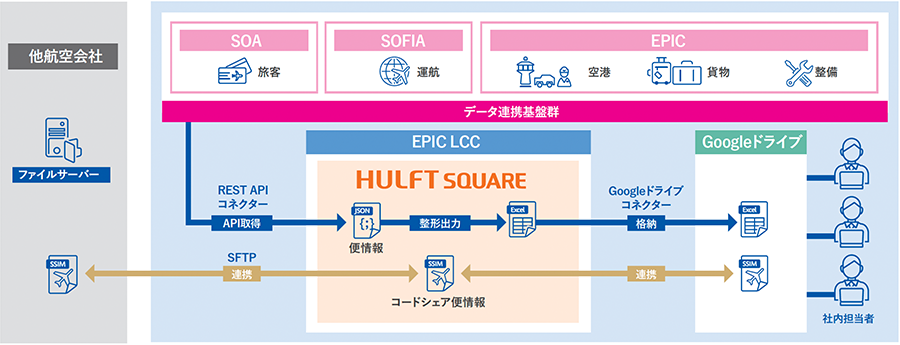
With this new system, flight information obtained from the flight information API is uploaded to Google Drive in spreadsheet format. Using HULFT Square, the latest flight information data is automatically stored in Google Drive every five minutes while ensuring security, making it easy to view and download.
"Using conventional development methods, developing a replacement system to replace the old host-based system would have been a costly and lengthy project. However, with HULFT Square, we were able to complete the construction in just about one month, and about three months including testing. As we had just implemented HULFT Square, and the promotion team was looking for a success story, this was a very good start," says Kaiho.
"HULFT Square" - Inexperienced people build a flight information data integration system in a short period of time
Another success story achieved with HULFT Square is data integration of codeshare flight information with other airlines. A codeshare flight is a flight in which multiple airlines jointly operate a single flight under the flight number of the other airline. To operate this flight, SSIM files (flight information files), a format defined by the International Air Transport Association (IATA), are exchanged between airlines. Previously, employees of the relevant companies directly accessed the FTP site where the SSIM files were stored. However, with the trend toward digital transformation, there was a need to strengthen security and aim for operational efficiency, which led to the need to build a new data integration system.
This is where HULFT Square came into play. In the new system, SSIM files placed on JAL's internal Google Drive by JAL employees are first linked to HULFT Square using a connector, and then placed on the other airline's server via SFTP protocol for sharing. Meanwhile, SSIM files placed on the other airline's server by employees of other airlines are similarly imported into HULFT Square and shared on JAL's internal Google Drive. SSIM files are automatically handed over four times a day and kept up to date.
What is noteworthy here is that this data integration was not built by Kaiho's promotion team, but by the application development team within JAL Digital, which was using HULFT Square for the first time.
"The fact that inexperienced members were able to learn how to use 'HULFT Square' through online manuals and build a data integration system for codeshare flight information in a short period of two to three months is a significant achievement. We are currently facing a shortage of personnel capable of data integration, and a backlog of employees requesting development from our promotion team. Although there are initial Education costs involved, the ability for on-site users who have learned how to use the system to develop and deploy it in their business is a great benefit not only to the promotion team but also to the users themselves," said Fujiwara.
At present, HULFT Square is only collaborating with one overseas airline for codeshare flight information, but the company plans to increase this number in the future based on its success.
Development costs related to data integration platform reduced by 50% and construction time shortened by 50%! Expectations for further expansion of self-development
HULFT Square had a major impact on the development of the JAL Group's fast system. First, the costs required for data integration-related development were reduced by approximately 50% compared to the existing data integration platform. Similarly, the construction period was reduced by approximately 50% and the operational man-hours by approximately 40%.
Furthermore, the fact that even inexperienced people can now learn and develop data integration-related tasks on their own is one of the greatest achievements of Fast System Development, which aims to achieve in-house development and efficiency. Kaiho says he wants to further promote self-development on the ground.
"When we in the IT department develop applications, we first need to understand the rules and procedures of the business that will use the application, so we talk to the people on the front lines. However, it is extremely difficult to understand the business content and translate it into business logic, which ultimately means it takes a long time to launch the service. The greatest advantage of self-development is that it is created by people on the front lines who are familiar with the business, so in a sense it eliminates unnecessary communication with the IT department and saves time. HULFT Square, which can be used with no-code and low-code, will continue to be a powerful tool in promoting self-development, and there is a lot of excitement from the front lines," says Kaiho.
Mr. Kaifū spoke of his vision for increasing the number of "HULFT Square" users by expanding Education content in the future. In response to his words, Mr. Fujiwara concluded with the following.
"There are surely many more ways to use HULFT Square as a relay server, like the two development examples introduced here, so we would like to continue exploring new ways to use it. HULFT Square is reasonably priced, the benefits are easy to see in a short amount of time, and it also has excellent customer success, so we would definitely recommend it to companies considering introducing data integration platform," says Fujiwara.
- The system names in this text (SOFIA, EPIC, etc.) are unique names used within the JAL Group.
Japan Airlines Co., Ltd., JAL Digital Inc.
Japan Airlines Co., Ltd.
- Head office location: Nomura Real Estate Tennozu Building, 2-4-11 Higashi-Shinagawa, Shinagawa-ku, Tokyo
- Established: August 1951
- Capital: 547,442 million yen (as of March 31, 2025)
- Number of employees: 14,431 (as of March 31, 2025)
- Business activities: Scheduled and non-scheduled air transport, aircraft use business, and all other incidental or related businesses
JAL Digital Co., Ltd.
- Head office location: msb Tamachi Tamachi Station Tower N, 12th floor, 3-1-1 Shibaura, Minato-ku, Tokyo
- Established: August 1978
- Capital: 702,452,500 yen
- Number of employees: 1,056 (FY2024)
- Business activities: Collection, processing and provision of information using computer and communication systems; design and development of computer and communication systems; design and development of software; design and manufacturing of facilities, equipment and parts, etc.
- The content of this case study is current as of the time of the interview. The content of this case study may change without notice.