

What is data cleansing? | Explaining its business meaning, necessity, and importance


Maintaining data accuracy and consistency is essential to making the most of data. To maximize the effectiveness of business decision-making and various marketing initiatives, it is necessary to properly organize and manage accumulated data. This is where "data cleansing" becomes important.
In this article, we will introduce the basic concepts and importance of data cleansing, as well as specific techniques, and explain the key points to improving business results.
A basic overview of data cleansing
In business, high-quality data is essential for effective data utilization. If analysis is performed on inaccurate or inconsistent data, there is a risk that decisions and policies will be significantly misguided. Therefore, data cleansing is not a superficial task, but rather a fundamental process for improving data quality across the entire company. It is important to understand the concept of data cleansing and perform it correctly.
What is data cleansing?
Data cleansing is the process of correcting incorrect information, duplicate data, and input errors contained in databases, spreadsheets, etc. to create reliable data. Increasing the accuracy and consistency of data improves the accuracy of analytical results and more reliably supports business decision-making. Leaving dirty data (i.e., "dirty data" that contains errors such as mistakes and omissions) unattended can have a negative impact on customer analysis and marketing initiatives, so it is important to take a proactive approach.
Data organization, cleaning, and name matching
Data organization refers to the process of adjusting folder hierarchy and file naming, primarily to make data easier to manage and view. Data cleansing, on the other hand, focuses on improving quality by correcting erroneous data itself and standardizing variations in spelling. The term "data cleaning" is almost synonymous with data cleansing. Name matching is a type of data cleansing, and refers to the process of matching duplicate data and integrating them into unique records.
What causes dirty data?
Typical causes of dirty data include human input errors and spelling variations. For example, the same company name may be registered as different data due to differences in the presence or absence of spaces, or differences in abbreviations and official names. Furthermore, due to inadequate management systems and a lack of shared operational rules, it is not uncommon for multiple people to enter information in different formats or neglect to update. The accumulation of these factors leads to a decline in the overall quality of the data.
The Importance and Benefits of Data Cleansing
The benefits of data cleansing are wide-ranging, including improving a company's competitiveness and increasing its credibility.
Data cleansing increases the reliability of data, which in turn increases the accuracy of business analysis and dramatically improves the speed of decision-making.It also improves work efficiency and reduces unnecessary costs, bringing great benefits to the entire business.
Furthermore, it is important to note that being able to share correct information in a timely manner will strengthen communication within the organization and customer responsiveness.

Improving speed and accuracy of decision-making
Analysis based on clean data helps to gain a more accurate understanding of a company's current situation and market trends. If the data is full of errors and inconsistencies, the analysis results will be distorted, which may lead to confusion in business strategy. Data cleansing produces accurate results, allowing management and field staff to make decisions with confidence.
Strengthening competitiveness through accurate data analysis
Companies that can quickly analyze highly accurate data can accurately identify market changes and take proactive action, giving them a major advantage in differentiating themselves from their competitors.
On the other hand, analysis based on uncleansed data carries a high risk of making inaccurate hypotheses, which can lead to a loss of direction in your initiatives and the risk of missing out on growth opportunities for your business.
Cost reduction and improved business efficiency and productivity
Handling inquiries and complaints related to inaccurate data can be a significant burden on businesses. Using cleansed data can reduce this hassle, allowing you to focus valuable resources on your core business activities.
Additionally, using cleansed data can help eliminate duplicate work and unnecessary processes, lowering overall operational costs.
The result is increased productivity and agility across the organization, freeing up time for more strategic initiatives.
Increased credibility and brand image
Companies that can consistently provide up-to-date, accurate information are seen as having thorough quality control and are trusted by business partners. Continuously implementing data cleansing also helps to improve the brand image and reputation of the entire company.
On the other hand, incomplete data can damage the trust of business partners and customers.
Enables you to implement measures that lead to business growth
Highly accurate data is essential for accurate customer segmentation and targeting. Improved data quality allows for more effective marketing and sales strategy planning and implementation. For example, with well-organized customer attributes and purchase history, it is more likely that offers tailored to customer needs can be provided. This can improve the efficiency of marketing and sales initiatives and is also expected to increase customer loyalty.
Examples and techniques of data cleansing
This chapter introduces specific examples of data cleansing tasks that are commonly encountered in the field and the corresponding techniques.
Data handled in daily operations is often entered manually, and is prone to various problems such as typos, inconsistencies in spelling, and duplicate entries. If these are left unaddressed, problems will arise later when analysis begins, resulting in extra time and cost required to resolve the issue. In order to avoid such situations, it is important to understand specific cleansing techniques.
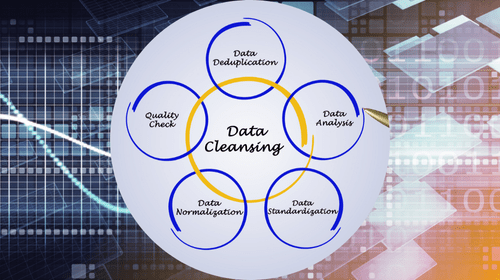
Completing data entry errors and missing values
Correcting typos and missing fields when entering data is a fundamental step in maintaining data quality. By reviewing the input rules of your company's applications, Excel, and forms, you can reduce the risk of errors. If blank fields are unavoidable, it is important to make a reasonable guess based on existing information and fill them in, or to have a system in place for separate verification work.
Unifying duplicate data
Even for the same customer or product, multiple records may exist due to differences in notation or input methods between departments. By merging such duplicate data, you can consolidate the data into one and improve analytical efficiency. Setting integration rules for name merging and standardizing notation as unique records makes searching and extraction easier.
Data standardization and unified formatting
Even small discrepancies, such as variations in date notation (e.g., YYYY/MM/DD vs. YY/MM/DD) or differences in units (e.g., cm vs. mm), can cause major errors if they accumulate in large quantities. It is important to design a unified format in advance and make corrections by checking against the standards. The key to increasing the effectiveness of data cleansing is how well you can define and continuously manage operational rules.
Example of correcting inaccurate data
Inaccurate data, such as incorrect addresses or product codes, often occurs on-site and has a significant impact on downstream processes. Therefore, consider automatic validation and system modifications to create a system that minimizes errors. By regularly auditing and reviewing data and implementing a cycle of immediately correcting incorrect data, you can prevent a decline in quality.
Data cleansing process and procedure
This section provides a step-by-step guide to a typical process for data cleansing.
Data cleansing is not something that can be done once and then finished; it is an ongoing process. First, it is important to understand the quality of the current data and decide which areas to focus on for improvement. By clarifying the specific steps, collaboration between staff and the introduction of tools can proceed smoothly.
Data collection and quality checks
The first thing to do is to clarify the scope and nature of the data in question. Identify where the data is stored in systems and files, and identify any issues such as duplication or variations in notation in advance. Checking the granularity and volume of the data at this stage makes it easier to predict the tools and personnel required in later processes.
Identifying and correcting errors and incorrect data
The standard method for detecting errors is to extract outliers using Excel functions or SQL queries. In addition to being able to detect them mechanically, visualizing them using BI tools makes them easier for the human eye to spot. When correcting errors, having master data to refer to and a means of verifying the correct values will increase the accuracy and speed of the work.
Data organization and consistency
After correcting the errors, we standardize the format and naming conventions to maintain data consistency. Cooperation between the relevant personnel is especially essential for data used by multiple departments and systems. Ensuring consistency here will prevent unnecessary rework during future analysis and system migration.
Process standardization and continuous update management
Once the cleansing process is established, it is important to create a template and spread it throughout the company. By regularly carrying out cleansing and continually updating manuals and guidelines, you can prevent data from becoming contaminated again. To avoid reliance on individual skills, it is a good idea to clearly document the process when handing over responsibility.
Data cleansing challenges and solutions
We will look at the challenges you face when actually carrying out cleansing and ways to overcome them.
While cleansing work is important, it can be time-consuming and costly to carry out. The larger the volume of data, the greater the burden on human labor, and the greater the risk of errors occurring. Furthermore, if operations become dependent on individuals, there is a concern that know-how will be lost when a specific person leaves the position. How to overcome these challenges is key.
Dealing with huge amounts of data
When dealing with large amounts of data, you may need to introduce high-performance infrastructure or a dedicated data processing platform. It is also important to take measures in the work process, such as dividing the data into a processable format. In addition, it is a good idea to consider ways to optimize processing time by scheduling batch processing or using cloud services.
Reduce manual errors and maintain consistency
While manual checking offers great flexibility, it can also be prone to fatigue and misunderstandings. In addition to creating and standardizing manuals and procedures, it is necessary to create a double-checking system to reduce the likelihood of errors. By combining this with automation tools, it is possible to reduce the scope of manual corrections and make it easier to maintain consistency.
Control costs and leverage automation
Data cleansing requires short-term implementation costs and effort, but when you consider the losses caused by inaccurate data, it is likely to provide a return on investment in the long term. It is also realistic to start with partial automation initially, and then gradually expand once the effectiveness is confirmed. This allows you to proceed with optimization while striking a good balance between cost and effectiveness.
Preventing dependency on individuals by systematizing operations
It is dangerous for only certain individuals to be familiar with cleansing techniques. To prevent this from becoming dependent on one individual, it is effective to prepare a work manual, regularly share knowledge, and provide training. By understanding the importance and procedures of data cleansing across the entire organization and creating a common language, the accuracy and continuity of cleansing will be further improved.
summary
Data cleansing is an essential initiative for increasing the reliability of a company's data and improving the accuracy of business decisions and measures. Regular and planned data cleansing can reduce the occurrence of dirty data while also improving a company's competitiveness and customer satisfaction. As data utilization becomes increasingly important in the future, the continuous practice of data cleansing will be a major key to supporting a company's growth.
The person who wrote the article
Recommended Content
-

Key Points for Promoting DX! The Value of Data Integration
We will explain how to eliminate personalization in business, eliminate data silos, and ensure scalability from the perspective of data integration. -

iPaaS-based data integration platform HULFT Square
Once your data cleansing is complete, it's time to put it to good use! Check out the product details for HULFT Square, a data integration platform iPaaS. -

Get an online consultation about data utilization
If you would like to hear more about our data utilization platform, we also offer online consultations.