

Management speed is determined by structure: Reforming the decision-making process of a regional bank through data integration and AI.


The reform at a certain regional bank began with a single question from the bank president: "Can we really trust these numbers?" The differing calculation logics and discrepancies in data across departments were not merely administrative errors, but structural problems that were clouding management decisions.
This column will provide a detailed explanation of a case study that goes beyond partial optimization using RPA and macros, and redesigns the "decision-making process" itself by combining data integration platform and AI.
"Can we really make a judgment based on these numbers?"
At the monthly management meeting of regional bank C (hereinafter referred to as Bank C), the atmosphere in the conference room instantly became tense with a single remark from the president. The heads of the sales management department, loan management department, and risk management department all scrutinized the documents, their eyes falling on the Excel and PDF files laid out on the table. Graphs and tables were neatly arranged on the projector, but when placed side by side, the numbers were slightly misaligned.
Mr. K, head of the Sales Management Department, explains while pointing to the documents.
"These are preliminary figures. They are compiled based on data from last weekend."
Mr. M, the manager of the loan management department, will provide further details shortly.
"We compile our data based on the final figures from the end of the previous month, so there will inevitably be discrepancies."
Mr. T, head of the Risk Management Department, also chimed in.
"The rating breakdown is based on the end of the previous month and does not reflect recent adjustments."
Each explanation was logical and well-reasoned. However, the bank president's eyes remained calm.
"I understand the logic. But which numbers should we trust for business decisions?"
For management, this meeting should have been a forum for discussing strategy. However, in reality, most of the time was spent verifying the consistency of the numbers, and they were unable to keep up with the changes in the external environment. The president quietly closed the minutes and sighed.
"We are not here to verify the numbers."
At that moment, the management's strong sense of crisis was directed at Mr. A, the head of the IT department.
The often invisible structural factors behind the slowdown in business operations
Bank C is by no means an IT-backward bank. Its core banking system is running stably, and it has already implemented dedicated systems for sales management and credit rating management. RPA is also being used, and the efficiency of on-site operations was progressing. However, the quality and speed of discussions in meetings did not improve as much as desired.
After the meeting, Manager A sat by the office window, gazing at the view and pondering.
<...Partial automation is progressing with RPA and macros. However, why hasn't the speed of cross-departmental decision-making changed?...>
The reason was clear. Data extraction timing differed from department to department, processing logic was scattered across Excel spreadsheets, there were subtle differences in KPI definitions, and the final data integration relied on manual processes. While optimization may have been achieved within each department, there was no cross-functional design across the entire bank.
As a result, management was forced to make important decisions without a unified perspective. This was not merely an operational issue, but a serious business risk.
Questions from management to the IT department
Driven by this sense of crisis, the bank president summoned Department Head A to the conference room one day.
"Can't this structure be changed?"
Manager A remained silent for a while. Simply adding RPA wouldn't solve the problem. Improving Excel macros wouldn't be enough either. The core of the problem wasn't a lack of tools, but rather that the information flow and decision-making process itself were poorly designed.
After several weeks of deliberation, Department Head A returned to the management conference room with the proposal in hand.
"It's difficult to change the accounting system immediately. However, the decision-making process can be redesigned. By building data integration platform and combining it with generative AI, we should be able to immediately provide the 'integrated perspective' required in management meetings."
The bank president nodded quietly. He explained that while overhauling the accounting system would require enormous investment and many years, improving the decision-making process could be tackled with a sense of urgency.

▼I want to know more about data integration platform
⇒ data integration / data integration platform | Glossary
Obstacles to realization: Gritty adjustments and the challenge of "standardization"
However, the project was far from smooth sailing. Soon after we began providing support, we encountered the "high hurdles" inherent in the banking world.
The first obstacle they faced was "the way each department does things." The Sales Management Department, the Loan Management Department, the Risk Management Department—each department had its own calculation logic that it had maintained for many years. Faced with resistance such as "Why do we need to conform to the standards of other departments?", Manager A persistently visited each department and continued to persuade them, saying, "This is not a rejection of the departments, but rather the creation of a common language to prevent errors in management decisions."
The key here was "interface standardization." By establishing rules for how data is connected between each system and standardizing the format, we created a mechanism to physically eliminate data discrepancies between departments. Furthermore, in order to meet the bank's stringent security standards, we meticulously negotiated with the compliance department step by step, including data masking and building a secure environment for using AI.
Another major hurdle was "operation after construction." Even if a new infrastructure is built, if it can't be fixed without relying entirely on external help, it won't be able to keep up with the speed of the bank.
Therefore, instead of simply building the system, we adopted a collaborative approach that emphasized "support for in-house development." From the early stages of development, we teamed up with the person in charge of row C, sharing the design philosophy for data integration and methods for controlling AI. We focused on "skill transfer" so that the people on the ground could expand and maintain the infrastructure themselves.
There are no magic solutions. It requires painstaking interdepartmental coordination, a relentless commitment to standardization, and the creation of a system that allows the frontline staff to operate autonomously. Only when all of these elements are in place does a new "decision-making foundation" begin to take shape.
Data integration architecture supporting generative AI analysis
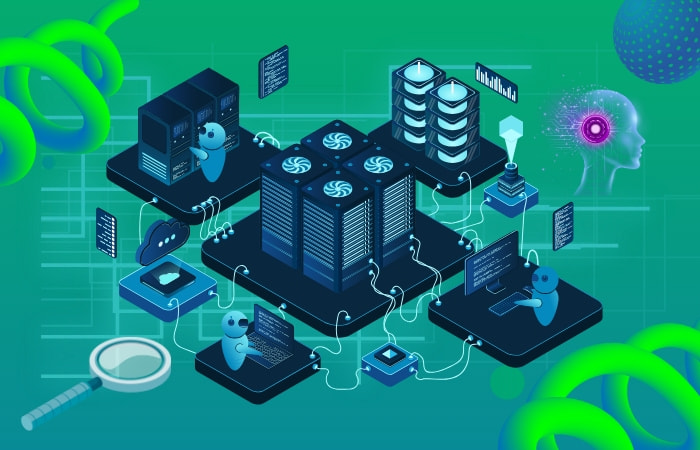
As the technical framework supporting this reform, we built a "hub-and-spoke" type data integration platform.
- Ensuring flexibility through loose coupling: We connected the accounting system and various business systems to data integration platform using APIs and file transfer for "loose coupling." This made it possible to extract and integrate only the necessary data at the necessary time without modifying existing systems.
- Metadata Management and Standardization: We linked items with different names across systems (e.g., customer number and client ID) using the underlying metadata management function, standardizing them as a logical data model. This provides the technical foundation for discussions on the "same map."
- Intelligent Reporting with Generative AI: Integrated, clean data is transmitted to Generative AI (LLM) via a secure closed network. The AI not only summarizes the data, but also analyzes and reports in natural language from multiple perspectives, identifying the factors behind month-on-month deviations and budget achievement rates, based on predefined "anomaly detection logic."
The key point is that instead of forcibly changing on-site operations, this infrastructure has automated the process of absorbing "discrepancies in interpretation" and communicating them to management.
▼I want to learn more about loose coupling.
⇒ Loose coupling | Glossary
Changes and outcomes of the meeting
At the first monthly management meeting after the system's implementation, the figures presented by the sales manager, loan management team, and risk management team were, for the first time, perfectly aligned. A calm yet focused atmosphere, unlike anything before, permeated the meeting room.
The bank president glanced at the documents and said quietly:
"Finally, we can look at the same map and have a discussion."
Time spent questioning the accuracy of the numbers disappeared, and discussions shifted to portfolio restructuring and the development of proactive growth strategies. Meeting times were shortened, but the value of the time available for strategic discussion effectively doubled, and above all, the ability to make decisions with solid evidence, is immeasurable.
[Main Achievements]
- Time spent creating meeting materials: Reduced by 100 hours.
- Data confirmation lead time: Reduced by 50 hours
- Strategy discussion time: effectively doubled.
- Autonomous operation system: Allows on-site configuration changes.
Towards an organization where everyone can discuss using the same map: The changes brought about by reforming the decision-making process.
This initiative is not merely a system overhaul; it's a redesign of the very foundation of management—decision-making. The IT department has expanded its role beyond the "defensive" role of daily system operation to become "engineers who design the structure of management."
Manager A reflected on the situation and said the following:
"What we changed wasn't the system itself. We redesigned the information structure of our management using data integration platform and AI. And most importantly, we gained the confidence that we can nurture this platform ourselves."
The speed of business operations cannot be increased solely through individual effort. It is determined by the "structure." And that structure can be redesigned with intention, and protected and nurtured by one's own hands.

Saison Technology Online Consultation
If you would like to hear more about our data utilization platform, we also offer online consultations. Please feel free to contact us!
The person who wrote the article
Related Columns


Recommended Articles
-

Standardization is the key to successful data integration
I would like to talk about "standardization of data integration." -
In-house data utilization strategies to strengthen bank fraud detection: The key to shifting to predictive and preventative methods
We will explain the strategy for banks to combine their in-house data utilization platform with generative AI to improve their fraud detection capabilities. -
Optimize banking operations with AI-driven insights
The integration of business data and generated AI visualizes previously unseen possibilities and clues in real time, leading to faster and more reliable decision-making.