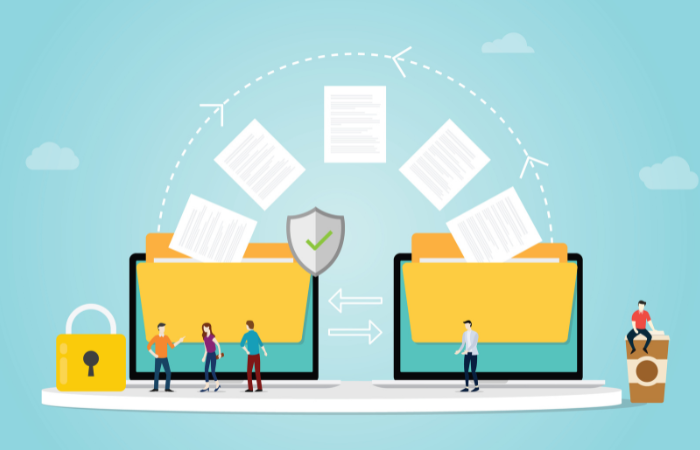

The dangers of "shadow IT" that you should be aware of before using data transfer services

file transfer is an important and essential part of various systems, and it is also something that you yourself use every day.
Let's start by explaining the basics: how does it relate to you? What exactly is it?
Sending and receiving data files is now a common part of business. Many people use free data transfer services to send and receive large files that cannot be sent by email. These services are widely used because they are easy and convenient, but behind this convenience, "shadow IT" is now a major problem. Let's learn about the relationship between "shadow IT" that is rampant in companies and data transfer services, and the dangers involved.
1. The relationship between data transfer services and shadow IT
Nowadays, everyone handles data on a daily basis, and there are more and more opportunities to send and receive data that is too large to send by email. For example, many people have experienced situations like the following where the file size was too large to attach to an email.
- I want to send a proposal or presentation document that uses a lot of images to my boss who is on a business trip.
- I want to send scanned PDF files and blueprints to my customers.
- I want to share the audio and video data of the meeting with partner companies.
- I want to send business data and error logs extracted from the system to the contracted support center.
In the course of daily work, when you need to transfer large files, you need an online large-capacity data transfer service. Some services are offered free of charge, making them easy and convenient to use. However, did you know that behind the popularity of these data transfer services, "shadow IT" is becoming a serious problem for companies?
"Shadow IT" refers to the use of IT services not permitted by the company or personal devices for work. For example, the following actions are all considered "shadow IT" if they are not permitted by the company.
- Use a free data transfer service on the Internet to send data to a business partner or to your boss on a business trip.
- Putting work files in the cloud storage you use with your personal account
- Copying data onto a personal USB and giving it to someone else or taking it home
- Analyze business data using an app on your smartphone
In recent years, along with the widespread use of convenient personal services and high-performance smartphones, this "shadow IT" has been spreading rapidly. The danger of users unknowingly and unconsciously posing a risk to corporate activities has been pointed out.
2. The dangers of shadow IT
There are three major problems with "shadow IT."
2-1. Risk of information leakage
The first is the risk of confidential information being leaked. Uploading data to a data transfer service's server means creating a copy of the data in a location that you cannot control. Users cannot check who can view the copied data, where it is stored, or whether it has been deleted.
In today's world where protecting personal information is important, if a customer's personal information were to be leaked, it would instantly damage a company's image. Furthermore, if confidential information were to be leaked to a rival company, it could result in significant damage. Therefore, using a data transfer service that is not authorized by the company poses a serious security risk.
2-2. Risk of virus infection
The second risk is the risk of being infected with a computer virus. Some data transfer services are equipped with virus checks, but the risk cannot be reduced to zero. Computer viruses are evolving and becoming more sophisticated every day, so there is a possibility that the pattern files to detect the virus may not be ready in time and the virus may slip through the checks.
2-3.Lack of IT governance
The third issue is a lack of IT governance. Governance means control, and companies are required to systematically manage their own information systems as part of their internal controls.
However, the rampant existence of "shadow IT" means that business operations are being carried out using IT services that the company cannot control. The fact that a company is unable to control IT services necessary for business activities is itself a problem. If a problem occurs due to a free data transfer service, not only will the user be held responsible, but the company's management system will also be called into question.
3. What to do to ensure safe data transfer
One of the reasons why problematic "shadow IT" is rampant is the lack of a system for transferring large amounts of data within a company.
In today's world where sending and receiving large amounts of data has become commonplace, business efficiency can drop significantly if data cannot be transferred quickly. Even if you are aware of the risks of "shadow IT," if you have no other means of transferring data, you have no choice but to use a free data transfer service.
Before any incidents occur, it's time to stop relying on free services and adopt a reliable business data transfer service.
summary
In this article, we've explained the relationship between "shadow IT," which poses a significant risk to companies, and data transfer services, as well as the dangers involved. Free data transfer services are convenient and easy to use for personal purposes. However, using them for business purposes without company permission poses significant security issues. In many cases, the lack of other means of data transfer is the driving force behind using free data transfer services. To prevent the rampant spread of "shadow IT," it's important to consider and implement corporate data transfer services as part of your internal infrastructure.
File Sharing: A Beginner's Guide Column List
- File Sharing: An Introduction
- The dangers of "shadow IT" that you should be aware of before using data integration services
- File sharing services: 5 things you need to know when selecting one
- Pitfalls of free file transfer services! Information leakage prevention
- Understand the roles and types of protocols used for file transfer
- Is a file sharing service the best option for sending and receiving large files?
- The ever-increasing volume of data is making file transfer a struggle.
- Three benefits of large-capacity file transfer software that prioritizes ease of use
- Four things to be aware of when data integration
- How to data integration?
- file transfer via HTTP? ISDN will end in 2020
- MFT enables file transfer that FTP cannot.
- No more need for USB flash drives? 3 ways to transfer data over LAN
- Improve business efficiency with data integration platform! Three benefits
- Convenient! How to use Bluetooth for file transfer
- How to use file transfer services that you may have thought you knew about
- Key points to consider when choosing data integration middleware
- Recommended file transfer services to improve business efficiency
- A reliable ally for data integration! Efficient conversion and effective utilization through ETL
- How to data integration with Salesforce
- data integration middleware makes your work more efficient
- This is recommended! data integration service that is conscious of security
- Efficient data integration and siloed system integration through EAI
- When integrating systems with overseas bases, improve work efficiency with English-language tools!
- Three benefits of centrally managing system integration
- A DI platform that data integration scattered throughout the company