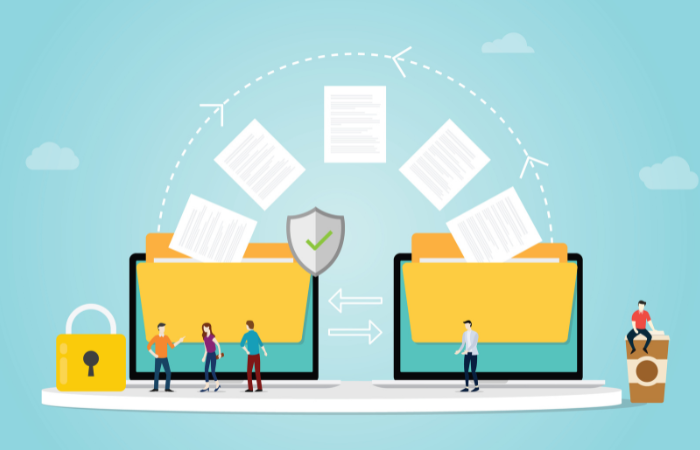

file transfer Services: 5 Things to Know When Choosing a Service

file transfer is an important and essential part of various systems, and it is also something that you yourself use every day.
Let's start by explaining the basics: how does it relate to you? What exactly is it?
Five things you need to know when selecting file transfer service
"Home File Delivery," "Data Delivery," "Firestorage"...
Which file transfer service do you use when sending or receiving large files that cannot be attached to emails, or files containing confidential information that you do not want to send as an email attachment?
"I'm familiar with the service and I'm using it, but it's a bit difficult to use."
Many of you may have had the experience of being asked by a client to use file transfer service you've never heard of.
With so many file transfer services available, which one is best to use?
In this article, we will introduce five selection points for those who use file transfer services for business purposes.
1: Key points for selecting file transfer service (1) Capacity
One of the purposes of using file transfer service is to send and receive files that are too large to attach to an email.
Check the maximum file size you will be exchanging for work, and then choose file transfer service that can send and receive files of that size.
- For free file transfer services: Depending on the service, you can send and receive files up to 100MB to 300GB.
- For paid file transfer services (for businesses): Depending on the service, you can send and receive files up to 100GB to 10TB (1TB = 1,024GB).
2: Key points for selecting file transfer service (2) Security
Another purpose of using file transfer service is to avoid the risks associated with email attachments, such as sending emails to the wrong person or leaking information.
Free file transfer services offer varying levels of security:
- Just a longer and more complicated download URL
- Limit the number of downloads
- A file can be protected by a password
- A device that can encrypt communication when sending and receiving files
- When transferring a file, it has a function to confirm with the recipient before transferring the file.
Additionally, even with free file transfer services, you can increase the security level by registering as a member or using paid options, as follows:
- You can delete the files yourself
- You can change your password
- You can receive a notification when it is downloaded.
Furthermore, with paid (corporate) file transfer services, you can expect a strong level of security, such as the following:
- You can limit the IP address of the connection source.
- Access rights can be set on a cabinet-by-cabinet basis
- You can track the file operation history of each user.
- You can choose from multiple encryption methods when sending and receiving files.
- By verifying the consistency between the transmitted data and the received data, it is possible to detect missing or tampered data.
If you are using it for business purposes, be sure to check the level of security required before choosing file transfer service.
3: Key points for selecting file transfer service (3) Speed
Even if you can send and receive large files, if it takes too much time, it will reduce your work efficiency.
If you frequently exchange large files, you should also check the sending and receiving speeds.
According to a website that compares the speeds of several free services, it takes about the following time to upload a 1GB ZIP file:
- Fastest file transfer service, 1 minute 30 seconds
- Fastest file transfer service: 27 minutes and 30 seconds
It was.
Here too, you may be able to increase the speed by registering as a member or using paid options.
It depends on the environment in which you send and receive data, so we recommend testing it in the same environment as your normal work environment.
Most paid file transfer services (for businesses) also offer a "trial version" or "free trial period," so be sure to test out any potential products.
4: Key points for selecting file transfer service (4) Storage period
The length of time file transfer service requires you to store it will vary depending on the purpose of sending and receiving the file.
From a security standpoint, it is best to keep the storage period as short as possible.
- The recipient cannot check the email immediately
- The recipient cannot download the file immediately
- There are multiple recipients
In such cases, you will need to keep the file for as long as the other party will be able to download it.
In the case of free file transfer services, the storage period is usually around 3 to 7 days.
Here too, the storage period may be extended or changed by registering as a member or using a paid option.
Paid file transfer services (for businesses) often offer longer storage periods than free services, such as 30 days by default.
5: Key points for selecting file transfer service (5) Cost
When considering various aspects such as capacity and security, you will often come to the conclusion that you should use a paid file transfer service (for businesses).
So, the question is, how much does it cost? This also varies greatly.
- Cloud-based services range from a few tens of yen to several tens of thousands of yen per month per account.
- For software-based systems, the cost can range from hundreds of thousands of yen to millions of yen.
We recommend that you first fully consider how you want to use file transfer service, such as "I want to integrate with other systems via API," and then select a product based on the features you need.
6: Other useful features to consider when selecting file transfer service
In addition, paid file transfer services (for businesses) may allow you to realize the features you wish were available.
for example···
- Explorer-like interface makes it easy to use
- Can send to multiple recipients at once
- file transfer can be used as a trigger to automatically execute other applications or automatically send email notifications to designated users.
- Before overwriting a file, the old file is automatically backed up.
- It will continue to send regular reminder emails until the recipient downloads the file.
If you're dissatisfied with the free service you're currently using and think, "If only it could do this much, it would be even more helpful...", why not stop putting up with it and consider a paid file transfer service (for businesses)?
summary
As the number of companies exchanging large files increases, there is a growing demand for file transfer services to be more functional, safer, and more efficient.
As the market changes, the number of companies providing these services is rapidly increasing, so there may already be file transfer service released that is better suited to your needs than the one you're currently using.
Why not take another look at free and paid (for businesses) file transfer services by following the five (plus a few more) checkpoints we've introduced here?
File Sharing: A Beginner's Guide Column List
- File Sharing: An Introduction
- The dangers of "shadow IT" that you should be aware of before using data integration services
- File sharing services: 5 things you need to know when selecting one
- Pitfalls of free file transfer services! Information leakage prevention
- Understand the roles and types of protocols used for file transfer
- Is a file sharing service the best option for sending and receiving large files?
- The ever-increasing volume of data is making file transfer a struggle.
- Three benefits of large-capacity file transfer software that prioritizes ease of use
- Four things to be aware of when data integration
- How to data integration?
- file transfer via HTTP? ISDN will end in 2020
- MFT enables file transfer that FTP cannot.
- No more need for USB flash drives? 3 ways to transfer data over LAN
- Improve business efficiency with data integration platform! Three benefits
- Convenient! How to use Bluetooth for file transfer
- How to use file transfer services that you may have thought you knew about
- Key points to consider when choosing data integration middleware
- Recommended file transfer services to improve business efficiency
- A reliable ally for data integration! Efficient conversion and effective utilization through ETL
- How to data integration with Salesforce
- data integration middleware makes your work more efficient
- This is recommended! data integration service that is conscious of security
- Efficient data integration and siloed system integration through EAI
- When integrating systems with overseas bases, improve work efficiency with English-language tools!
- Three benefits of centrally managing system integration
- A DI platform that data integration scattered throughout the company