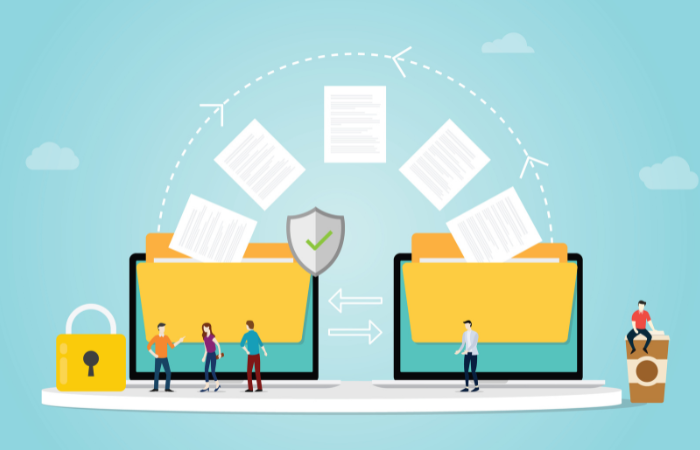

Pitfalls of free file transfer services! Information leakage prevention

Things to consider when using file transfer service
What are the measures to prevent information leaks?
Competition between companies is intensifying in many industries today, with the entry of overseas companies and companies from other sectors. This makes the speed of information transmission crucial. Secure and speedy information sharing between branch offices has become an urgent issue for companies. Previously, file transfer were mainly via email attachments, but due to limitations on the amount of data that can be sent, more and more companies are now using online storage and free file transfer services. However, with free services, concerns remain about information leaks. Here, we summarize the measures needed to ensure secure and speedy file transfer.
1. Current status of file transfer service usage in business situations
According to the results of a survey on corporate data transfer conducted by a company in March 2014 (※), the most common method of transferring business data was "email attachment" at 50.3%, followed by "sharing via online storage" at 23.6%, and "free file transfer services" at 8.7%.
»ITmedia Inc. "Survey on data transfer in companies"
Although the survey was conducted a while ago, it seems that email attachments are still widely used for everyday file transfer. However, in the same survey, 61.1% of respondents cited "size restrictions making it impossible to send or receive files" as a "challenge or problem with data transfer." 32.8% cited "splitting files reduces work efficiency," indicating that file transfer is both time-consuming and difficult. Many companies are now using online storage and free file transfer services as an alternative to email.
2. Risks of using free file transfer services run by companies
Both online storage and free file transfer services are essentially free, allowing large files to be transferred at no cost, making them popular with many companies. However, these services carry risks such as information leaks, and are not a recommended method for companies to use when exchanging confidential information.
There are some possible risks associated with using online storage or free file transfer services:
- You cannot control the security level yourself
Files are exchanged by storing them on a third-party server. Naturally, the server used in this case is a shared server with other users, so the company cannot control the security level of the files itself and has no choice but to leave it up to the service provider. - You cannot manage file transfer usage history in-house.
It is extremely difficult for a company to manage all usage history for online storage and free file transfer services. This means that if information is leaked, it will be impossible to determine who used the service, when, and how the information was leaked.
3. Measures to prevent information leaks in file transfer services
According to the "2015 Information Security Incident Survey Report" published in June 2016 by JNSA (Japan Network Security Association, a non-profit organization), the total estimated damages in 2015 were 254,136,630,000 yen (the average estimated damages per incident was 337,050,000 yen).
Of course, not all of these cases involve information leaks due to file transfer. However, you can see that the damage caused by potential security threats can be significant. In that sense, it is absolutely necessary to avoid neglecting information leak prevention measures when file transfer.
A relatively quick way to prevent information leaks from file transfer services is to use the paid version of each service. While this varies depending on the service provider, there is a significant difference in security level compared to the free version. It also offers improved functionality, such as increased sendable capacity, destinations, and sending history, and extended storage periods.
However, even if you switch from a free service to a paid service, you will still be using a shared server, and you will not be able to manage it in-house. As a company, you will need to consider more fundamental measures to prevent information leaks.
4. How to use file transfer services more safely
To eliminate the disadvantages of file transfer services we have explained so far and use them safely, you must pay attention to the following points.
- Use dedicated servers instead of shared servers
- The ability to fully manage sending and receiving history in-house
- Equipped with functions to prevent eavesdropping, leakage, loss, and tampering of transferred data
File Sharing: A Beginner's Guide Column List
- File Sharing: An Introduction
- The dangers of "shadow IT" that you should be aware of before using data integration services
- File sharing services: 5 things you need to know when selecting one
- Pitfalls of free file transfer services! Information leakage prevention
- Understand the roles and types of protocols used for file transfer
- Is a file sharing service the best option for sending and receiving large files?
- The ever-increasing volume of data is making file transfer a struggle.
- Three benefits of large-capacity file transfer software that prioritizes ease of use
- Four things to be aware of when data integration
- How to data integration?
- file transfer via HTTP? ISDN will end in 2020
- MFT enables file transfer that FTP cannot.
- No more need for USB flash drives? 3 ways to transfer data over LAN
- Improve business efficiency with data integration platform! Three benefits
- Convenient! How to use Bluetooth for file transfer
- How to use file transfer services that you may have thought you knew about
- Key points to consider when choosing data integration middleware
- Recommended file transfer services to improve business efficiency
- A reliable ally for data integration! Efficient conversion and effective utilization through ETL
- How to data integration with Salesforce
- data integration middleware makes your work more efficient
- This is recommended! data integration service that is conscious of security
- Efficient data integration and siloed system integration through EAI
- When integrating systems with overseas bases, improve work efficiency with English-language tools!
- Three benefits of centrally managing system integration
- A DI platform that data integration scattered throughout the company