
Recommended file transfer services to improve business efficiency

Recommended file transfer services to improve business efficiency
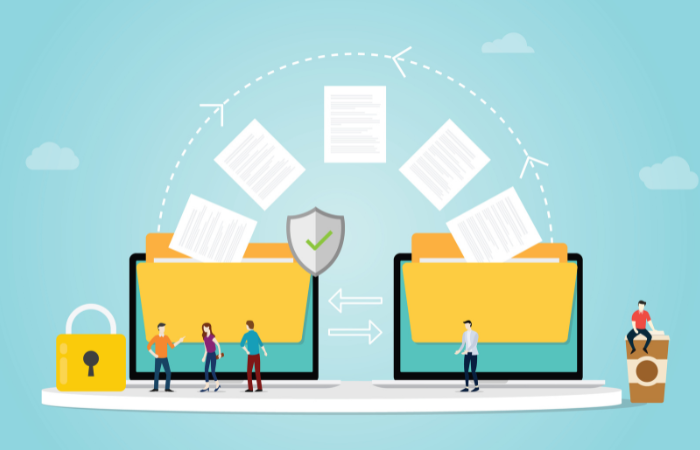
Many companies are considering introducing enterprise file transfer services to improve business efficiency and reduce the risk of information leaks. While enterprise file transfer services offer significant benefits in terms of capacity, transfer speed, and security, they cannot, on their own, handle detailed file transfer related data processing, such as send settings, post-processing, and operations. In many cases, programming using batch files or shell scripts is required. Therefore, this article introduces recommended services that, when used in conjunction with enterprise file transfer services, can handle complex pre- and post-processing processes without the need for additional engineers or programming.
1. file transfer requires various data processing
There are various ways to file transfer. Of these, the safest and fastest way to file transfer is through file transfer service for businesses. For companies that regularly exchange large files, this service is recommended for improving business efficiency.
However, simply being able to file transfer is not enough. To safely transfer large files, various processes are required before and after the transfer depending on the situation, such as deciding which files in the transfer folder to transfer, whether to transfer everything, what to do if an error occurs during file transfer, retransferring files that could not be transferred, deleting files after transfer, etc.
The reason we don't recommend FTP, free file transfer services, online storage, etc. for companies to file transfer is because they cannot process this data. There are services that meet certain requirements, such as security and speed, but if a service cannot solve all of the issues, it must be said that it is not suitable for use by companies.
2. Issues with data processing in file transfer services
However, that doesn't mean that using a corporate file transfer service will solve everything. Of course, there is no doubt that in terms of basic functionality, such as security features like encryption and integrity verification of communications, scheduled transmissions based on the recipient's business hours, and data compression and high-speed transmission of large files, these services offer many advantages over general free services.
However, even with file transfer services for businesses, most services cannot process data before and after file transfer on their own. For the data processing before and after file transfers, rather than file transfer itself, you will need to program it yourself using batch files, shell scripts, etc.
Despite being clearly superior to free file transfer services and online storage services, companies are hesitant to introduce file transfer services for businesses... In addition to the hassle of programming, many of these companies are likely keen to avoid the increased burden (cost) on engineers and the risk of work becoming too dependent on individual skills.
3. Recommended services to prevent work from becoming dependent on individuals
What we recommend is a combination of a corporate file transfer service and a service that allows you to implement data processing before and after file transfer without the need for programming.
There are many file transfer services for businesses, but it is difficult to solve problems with stand-alone services that lack scalability. Even if a service is scalable, if it cannot intuitively automate the processes before and after file transfer without programming, new problems will arise, such as work becoming dependent on individual skills.
Only when these two benefits - scalability and ease of use that anyone can use - can it be possible to solve problems at low cost.
summary
file transfer service for businesses improves business efficiency and reduces the risk of information leaks. However, it does not handle data processing before and after file transfer, and sometimes requires the creation of a separate program.
Therefore, we recommend combining a corporate file transfer service with a service that allows you to easily create the processes that occur before and after file transfer using a GUI.By eliminating the need for programming and preventing work from becoming dependent on individual skills, and by realizing file transfer system that companies originally needed, you can achieve stronger security measures and improved business efficiency.
File Sharing: A Beginner's Guide Column List
- File Sharing: An Introduction
- The dangers of "shadow IT" that you should be aware of before using data integration services
- File sharing services: 5 things you need to know when selecting one
- Pitfalls of free file transfer services! Information leakage prevention
- Understand the roles and types of protocols used for file transfer
- Is a file sharing service the best option for sending and receiving large files?
- The ever-increasing volume of data is making file transfer a struggle.
- Three benefits of large-capacity file transfer software that prioritizes ease of use
- Four things to be aware of when data integration
- How to data integration?
- file transfer via HTTP? ISDN will end in 2020
- MFT enables file transfer that FTP cannot.
- No more need for USB flash drives? 3 ways to transfer data over LAN
- Improve business efficiency with data integration platform! Three benefits
- Convenient! How to use Bluetooth for file transfer
- How to use file transfer services that you may have thought you knew about
- Key points to consider when choosing data integration middleware
- Recommended file transfer services to improve business efficiency
- A reliable ally for data integration! Efficient conversion and effective utilization through ETL
- How to data integration with Salesforce
- data integration middleware makes your work more efficient
- This is recommended! data integration service that is conscious of security
- Efficient data integration and siloed system integration through EAI
- When integrating systems with overseas bases, improve work efficiency with English-language tools!
- Three benefits of centrally managing system integration
- A DI platform that data integration scattered throughout the company