

Despite the history and foundation, data utilization in the financial industry has not progressed. Aiming to raise the level of the entire industry by sharing case studies and know-how.

Financial institutions hold large amounts of important data not found in other industries, including information on customer deposits and withdrawals. However, the reality is that the utilization of this data has not progressed very far. This is said to be due to industry-specific circumstances, such as weak horizontal connections between financial institutions and an inability to share know-how.
In this context, the Financial Data Utilization Association (FDUA), a general incorporated association, was established by a group of financial institutions, startups, and other companies with the aim of raising the level of data utilization across the entire financial industry. With Saison Information Systems joining the association in November 2022, we spoke with Takuro Okada, representative director of the association, Ichio Sato, director, and Mikio Ogawa, vice-chairman of the Planning and Publication Committee, about the background to the association's establishment, its activities, and the challenges and outlook for the financial industry.
▼Profile (from left in photo)
Ichio Sato, Deputy General Manager, Big Data Division, President's Office, SBI Holdings, Inc.
Takuro Okada, Director-General of the Digital Society Common Function Group, Digital Agency, Representative Director of the Financial Data Utilization Promotion Association
Mikio Ogawa, Director of Data Science, DataRobot Japan
*Titles and affiliations are those at the time of interview.
- Financial Data Promotion Association website
- About the Financial Data Promotion Association (YouTube video)
The financial industry possesses vast amounts of accurate data, and has a long history and foundation for utilizing it more than any other industry.
First, please tell us about the background and philosophy behind the establishment of FDUA.
- Ogawa
-
Originally, as various financial institutions began using DataRobot, an AI Cloud platform provided by my company, a sort of financial users' group was formed, and I developed a relationship with Sato-san, Okada-san, and others here that transcended corporate boundaries. However, with only those members, the relationship would have been limited to introducing the tool, so in December 2020, Okada-san established the "Financial Business x Artificial Intelligence Community," the predecessor to FDUA. The purpose of this organization was to bring together volunteers from financial institutions and vendors to discuss cutting-edge data utilization, organization, human resource development, and more.
- Sato
-
For about two years, due to the COVID-19 pandemic, most of our activities were carried out remotely, but when we saw that we could resume full-scale face-to-face activities, we wondered whether it was okay to continue our activities with only members in Tokyo who were knowledgeable about cutting-edge data utilization.We felt that unless we got more people involved, shared case studies and know-how, and raised the bar for data utilization across the industry, the industry itself would decline.
At that time, Okada, who was a driving force behind the digital division of Mitsubishi UFJ Trust and Banking Corporation, began working at the Digital Agency as a private sector specialist. This was one of the reasons why we decided to expand our efforts, leading to the establishment of FDUA in June 2022. The membership started with 31 and has now grown to over 80 organizations, including financial institutions and startups.

Data Science Director Mikio Ogawa
Please explain FDUA's current activities.
- Ogawa
-
Our activities are centered around several committees. The Planning and Publication Committee, chaired by Sato and with me as vice-chair, is planning to compile and publish a book of success stories together with various financial institutions, with the aim of formalizing know-how on data utilization.
The Standardization Committee is creating a checklist that can objectively assess the progress of data utilization at each financial institution. Financial institutions are, of course, concerned about the state of their own data utilization. To what extent has their data utilization progressed, and where are their weaknesses? To enable them to make their own judgments, we hold honest discussions and open up about each other's situations, and establish evaluation criteria that are in line with the actual situation in the financial industry.
The Data Competition Committee is also working to develop and discover DX talent. In order to attract talented DX talent to the financial industry, they must be convinced that financial institutions' data utilization is interesting. Therefore, we are planning a program that will allow students, as well as working adults, to experience the utilization of financial data in the form of a competition. - Sato
-
However, that alone makes it difficult for members to participate, so we also hold regular events, etc. At the biweekly study sessions, we invite financial institutions and partner companies to share relatively simple knowledge and case studies that will serve as a gateway for members to utilize data.
On the other hand, at meetups held with the aim of expanding horizontal connections within the industry, we not only bring together people from city banks, which are central players in the industry, but also people from relatively new industries such as leasing companies and card companies. - Ogawa
-
Many people at leasing and card companies say, "I can't arrogantly say in front of the bankers, who are senior figures in the industry, 'We use data like this...'" However, due to the nature of their business, they are well-suited to data, and there is a lot of competition, so they are actually very advanced in terms of data utilization.
- Sato
-
That's right. When people from the same industry get together, a lot of interesting conversations like that come up, and even within the same financial industry, there's a wide range of different topics, and you can see the differences in the themes of data utilization. If you only focus on the center of the industry, you won't understand these things, so I try to plan meetups from various angles.
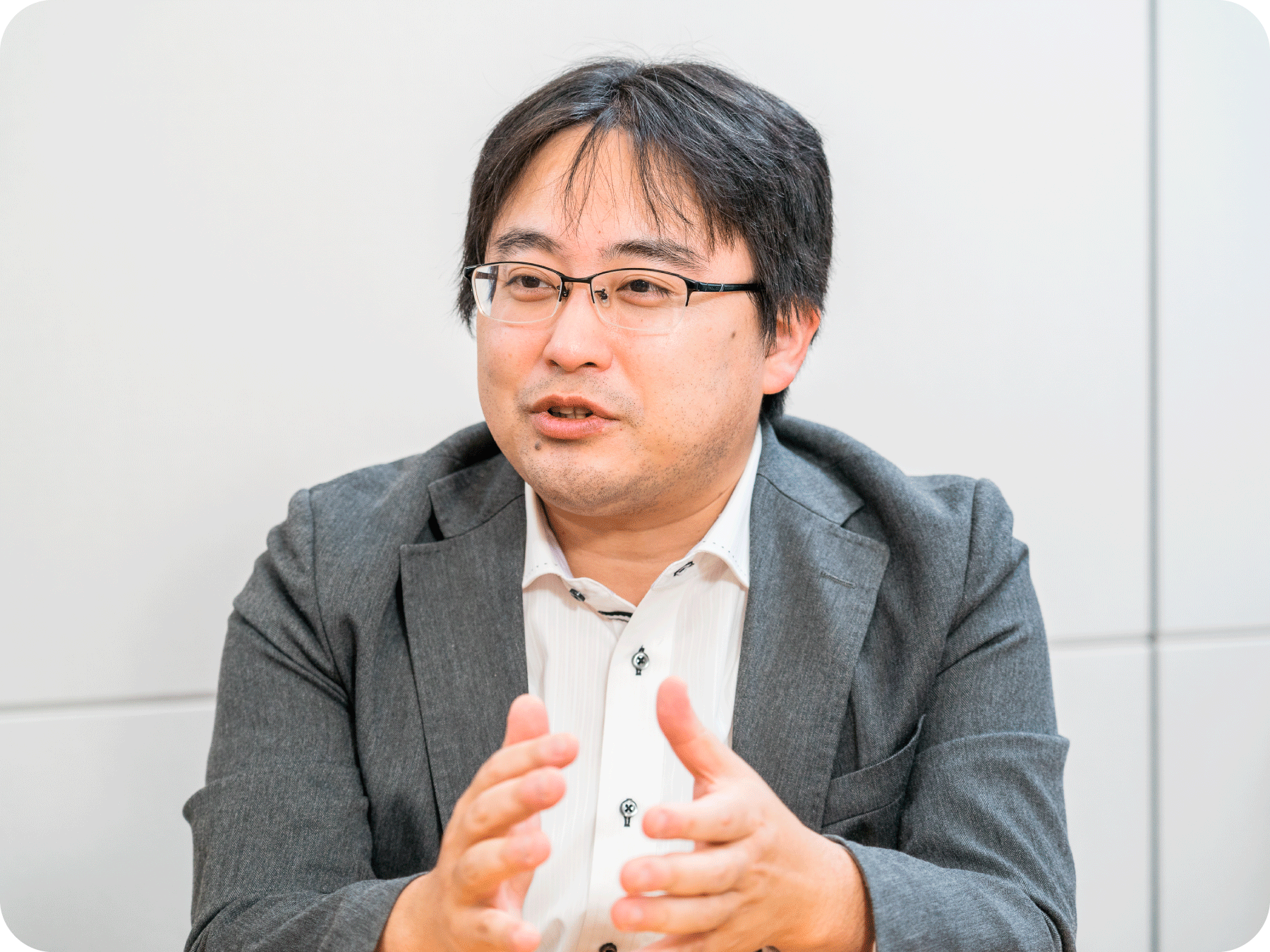
Ichio Sato, Deputy Director of Big Data, President's Office
What kind of data exists in the financial industry, and how is it currently being used?
- Ogawa
-
What we have is mainly deposit and withdrawal data and customer attribute information. The greatest feature of this data is that it is "data that cannot lie." For example, when it comes to salary survey data in other industries, it is easy to write in arbitrary numbers or round down decimals. However, in the case of financial institutions, data such as when and how much was deposited into whose account is fact and can never be altered. Therefore, analysis can very clearly show who is currently having financial problems and what kind of services they are looking for.
On the other hand, the downside is that the data is coarse-grained. For example, credit card data only tells you the store where the purchase was made and the amount, so it's difficult to use on its own and needs to be combined with other data. In this regard, corporate groups with a wide range of businesses, like Sato's SBI Holdings, can analyze not only deposit and withdrawal data but also data on family structure, occupation, and other data obtained from other industries, allowing them to understand when people are likely to take out insurance or buy a house and make optimal proposals. - Sato
-
Finance is, to begin with, a world of data. Naturally, highly accurate data has been accumulated over many years, and what is considered cutting-edge data utilization today has already been done throughout history. However, what's interesting is that when talking to people from financial institutions, they almost always respond, "We don't have any data, and we don't know how to utilize it." This means that in many cases, people are not aware that they are utilizing data, even though they have been doing it unconsciously in their work.
Regional banks and other financial institutions have an overwhelming amount of data, with accuracy comparable to that of any other company in their respective prefectures. Furthermore, compared to other industries, financial institutions are likely to have the systems, internal structures, and personnel necessary to utilize various types of data. They have the potential to rapidly incorporate new data, such as artificial data generated by AI. Therefore, it's important to be conscious of storing and utilizing non-monetary data as well, and if they do, I believe they could become a model for other industries.
The key to raising the level of data utilization across the industry is "down-to-earth, real-life examples"
What are the hurdles to utilizing data in the current financial industry?
- Ogawa
-
One is the culture that Sato-san mentioned earlier: "We can't do it, it's too early." In this climate, even if one person comes along who wants to utilize data, it's difficult to gain the understanding of those around them, and they end up like the "ugly duckling." Everyone is essentially a swan with the ability to fly, but they don't realize this; this is a common problem in many financial institutions.
- Sato
-
A typical example that is often talked about is a competition held by a certain company. The company had no in-house personnel who could utilize data, so they held a competition to recruit talent from outside. As a result, all of the top winners were employees of the company's own group. The talent was right there within the group, but they hadn't realized it.
- Okada
-
Recently, a major financial group has been holding a data competition for its employees in an effort to discover data talent within the company.
When trying to hire data scientists, banks have traditionally considered hiring mid-career candidates from outside the company, but the unique culture and working style of finance makes it difficult for people from other industries to fit in, resulting in a tendency for them to quit without settling down. In contrast, internal data competitions are an attempt to discover and develop talent who already fit the unique culture of finance and understand the company's operations, and there have been many successful examples. In fact, a broad look at banks has revealed that talent with the potential to become data scientists is buried among new hires in their 20s and in sales offices!
While large financial groups can host such data competitions independently, it is difficult for regional financial institutions to do so. Therefore, the Association plans to hold a data competition from around December 2022, open to participants across the financial industry free of charge, and work to discover and develop regional financial data talent.

- Sato
-
It's true that there are many cases where motivated people who want to "change financial institutions through data utilization" are forced to give up due to regular internal transfers and reorganizations. FDUA hopes to discover such talent through the activities of the Standardization Committee and Data Competition Committee, and provide a place where they can continue their efforts to utilize data, which will help them maintain their positions within their respective financial institutions.
In this situation, what kind of achievements do you expect from Saison Information Systems, which has joined FDUA?
- Sato
-
You are actually the only company that provides a solution that is implemented in all financial institutions. That is truly amazing, and I think it is very significant in terms of comprehensiveness. I believe you have many examples and know-how that can be used as reference for financial institutions, such as how you are using this function, and I would like you to spread this information together with us.
- Ogawa
-
From my experience, your company's HULFT is a unique and useful solution when it comes to "connecting data," so I would love to see examples of companies that have truly achieved data integration shared across the board. When I asked an insurance company why they were so slow to utilize data, they said, "We're currently running an ID integration project, and we plan to start data analysis after two years of that." No, no, that situation hasn't progressed at all for years. In other words, there is a deep chasm when it comes to "connecting data."
- Sato
-
One common reason data utilization doesn't progress is when the decision to connect is made first without deciding how to utilize the data. Every company and every department has your company's solution installed, and they can connect whenever they want. However, they can't connect because they haven't decided what to use the connected data for.
- Ogawa
-
In this situation, even if you tell us about some amazing examples of data integration and utilization, like "We've created this giant battleship!", we don't know how to get there. If you could share examples specific to financial institutions, where you first connect this data for this purpose, and then in the next step connect it like this, even if it's just a more compact and simple use case, we hope that we'll be much closer to a state where data is easier to utilize.
- Okada
-
That's right. No matter what kind of company it is, it's impossible for them to easily learn to utilize data. That's why I'd like your company to share real stories about the challenges and difficulties you've faced. I feel that the financial industry as a whole has a culture of hiding negative information rather than disclosing it. While this may be unavoidable to some extent in competitive areas, in non-competitive areas such as basic data integration and human resource development, it would be beneficial for both parties to share know-how.
In particular, in recent years, the number of companies from other industries entering the financial industry has increased, and the era of competition within narrow sectors is coming to an end. In this context, I believe it is of great significance that your company, which has the most down-to-earth, real-life examples of data integration, is disseminating them.
Saison Technology Official YouTube Channel "SIS☆STA"
Saison Technology's official YouTube channel "Sys☆Star"
We are introducing an interview video with the Financial Data Promotion Association. Please take a look.
Related Content
-

Survival Strategy in an AI-driven Society: How will humans live in an artificial super-intelligence society?
-
Applicable AI that can quantitatively judge and evaluate core credit operations of banks - Tips for developing credit screening AI -
-

Grasp insights that cannot be grasped through numbers from text and qualitative information! ~ Characteristics of text classification AI ~