

Making real estate investment more convenient and high-quality. The key is to create a model that is easy for people to interpret - Focus of value calculation AI -
Many people and companies have high hopes for AI, saying things like, "I want to incorporate AI into my work," and "I have high hopes for AI as a management team." What are the perspectives of people and companies that are actually using AI, and how are they building and utilizing it?
This series introduces the use of AI and success stories. In this third installment, we spoke with Yusuke Horie, chief analyst at MFS, Inc., a company founded in 2009 that provides online mortgage and real estate investment services, about examples of AI use at MFS and how they have achieved success with it.
▼Profile
Financial Data Utilization Promotion Association, Planning and Publication Committee
MFS Co., Ltd. Product Development Department Research & Analytics Team
Yusuke Horie
*Titles and affiliations are those at the time of interview.
Aiming for a more user-friendly service, focusing on value calculation AI
First, could you introduce yourself?
After graduating from university, I worked in the markets department of a regional bank, managing domestic and international bonds and other securities, before moving to MFS. Currently, in the research and analytics team, I develop services that utilize AI, analyze the financial and real estate markets, conduct research on mortgages, and write various books, including the book I was asked to write about, "Patterns for Success with Financial AI."
Could you tell us about MFS Co., Ltd.?
Our company's original business was providing mortgage refinancing offline, but we later moved online. We currently operate two businesses: the online mortgage service "Mogecheck" and the real estate investment service "INVASE."
Our management team comes from investment banks and securities companies both in Japan and overseas, and our CEO and COO have pioneered and led new initiatives for the industry, such as mortgage securitization. Many of our other members also have backgrounds in the financial industry, and we are developing a business that combines financial knowledge with technology.
Could you tell us about the background behind MFS's start to use AI?
Mogecheck has been promoting the use of data for some time. To put it simply, we have developed a predictive model for the "probability of passing a mortgage loan screening," or in other words, the probability of a loan being approved, by utilizing the know-how we have cultivated since our founding as a mortgage intermediary and a large amount of screening result data from major banks. This model is already in service, and is provided as "Mogereco," a service that recommends the perfect mortgage for each individual based on the loan approval probability, user attribute information, and desired conditions.
We wondered whether we could use AI not only at Mogecheck but also at INVASE to provide better services to users, and so we developed the "value calculation AI pattern" that I will talk about today.
What is "value calculation AI"?
Value calculation AI is a machine learning model that calculates monetary value. INVASE predicts real estate prices, but it can also be used to calculate all kinds of "values," such as predicting insurance payment amounts, residual values of leased products, and loan limits.
Normally, such value calculations are often carried out by experts in the field after conducting research and calculations from various perspectives, but a common feature of financial services is that "those who make decisions faster are often the ones who get the contract."
In other words, if you spend too much time calculating value, you run the risk of losing the contract to a competitor. There's also the risk that you won't be able to gather the experts and personnel in that field in the first place, and that different people will have different standards for calculating value. Value calculation AI can solve these problems.
Before using AI, first identify the characteristics of real estate investment
Could you tell us about "INVASE" that you will be talking about today?
INVASE is an online service that handles all the procedures for borrowing, refinancing, and purchasing real estate investment loans, from application to completion of screening. It offers a voucher service that determines the loan amount available for real estate investment loans, as well as a real estate investment loan refinancing service, and can also assist users in selling properties they own. Last year, INVASE acquired Condominium Asset Management Co., Ltd., a real estate sales brokerage company that provides asset-focused consulting, as a subsidiary, and is now also able to sell investment properties in-house.
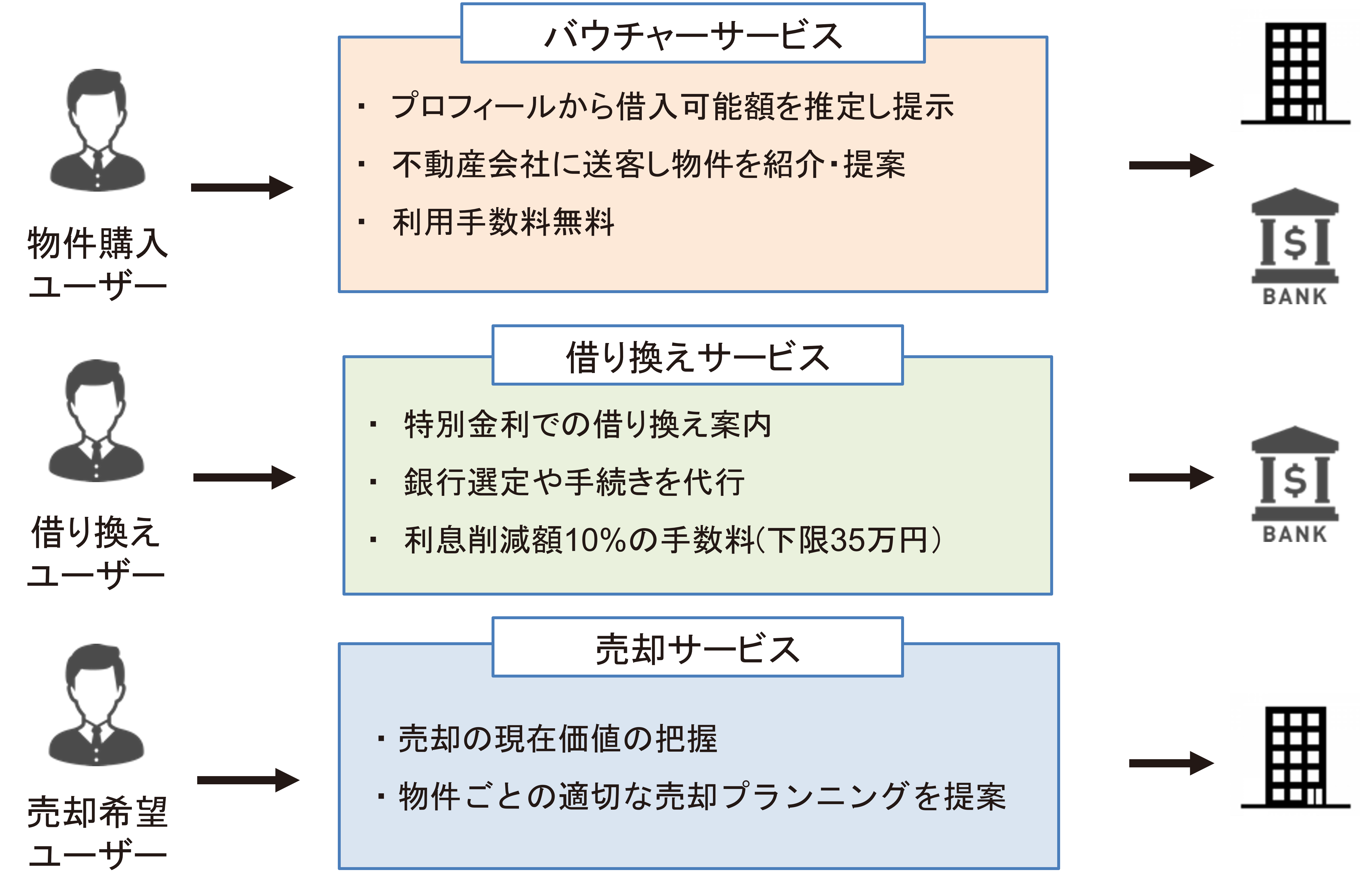
INVASE's conventional services
*An explanatory video is provided at the end of the article.
Can you tell me more about real estate investment?
In real estate investment, it is common to borrow a loan from a financial institution to purchase a property and then rent it out to earn rental income. However, if you buy a property at an overpriced price, you will be far from achieving success in real estate investment, such as income gains and capital gains, so it is important to "be able to purchase the property at a fair price."
Real estate is a unique asset, with no two pieces alike in the world, so unlike stock prices, there is no value that can be determined by anyone. Calculation methods such as the income capitalization method and comparable transaction method leave room for subjectivity on the part of the appraiser, and there is no centralized data source in Japan that manages past transactions. This is why we turned our attention to value calculation AI that can statistically evaluate real estate prices.
INVASE is developing a model that uses AI to predict property prices for condominiums for single people in urban areas, which are the most popular type of real estate for many people, including office workers.
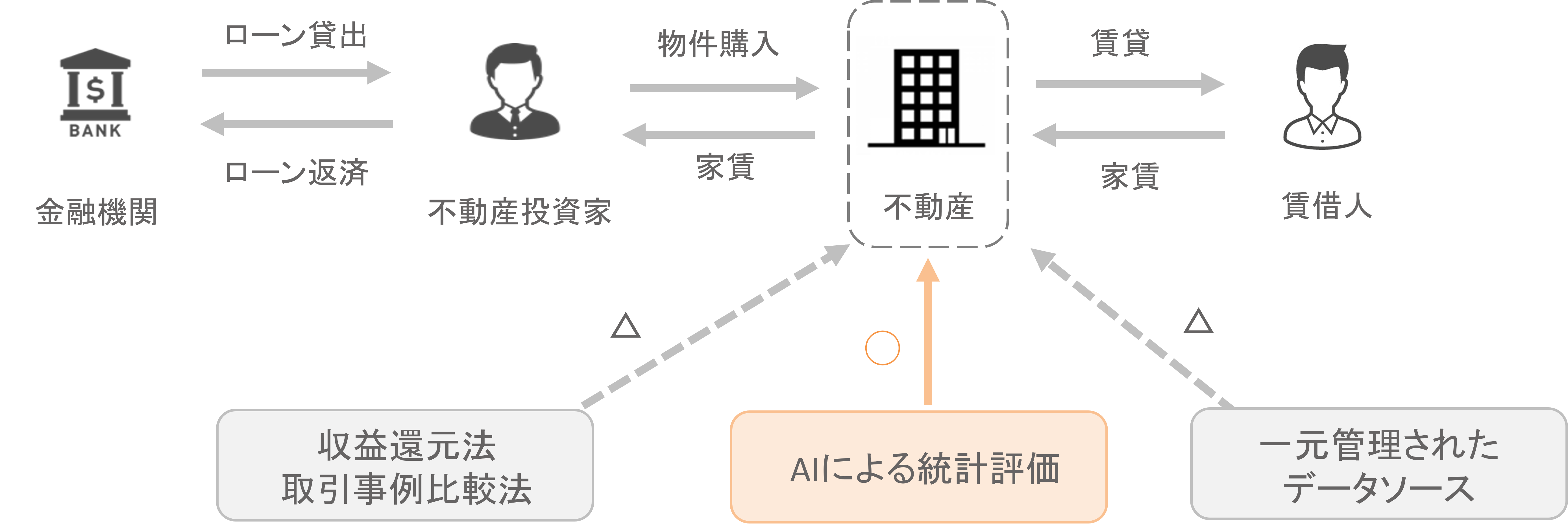
Asset management method through real estate rental
There are few evaluation scales for real estate, so statistical evaluation using machine learning is effective
*An explanatory video is provided at the end of the article.
Preparing the data source, notation variations, and examining the destination
Can you tell us more about INVASE's value calculation AI?
To build INVASE's value calculation AI, or "a model for predicting property prices," we use property data stored in our own database as learning data. However, we also use external data such as property information sites in addition to property data registered by INVASE users.
It's important to note that, unlike in-house databases, external data often has variations and inconsistencies in notation. For example, data posted on property websites is often not formatted to be processed as data, so preprocessing is important, such as converting it into a data type that's easy for AI to evaluate and standardizing notation. Addresses might be "1-1-1 Chiyoda, Chiyoda-ku" or "1-1-1 Chiyoda, Chiyoda-ku," and property names might be "Maison, MAISON, Maison." Room numbers are also sometimes written as "201" or "2-1," which are variations. Preprocessing is needed to convert these notations into postal codes for addresses, or to list only the floor number.
By the way, the image below shows an image of the dataset used for this value calculation AI.
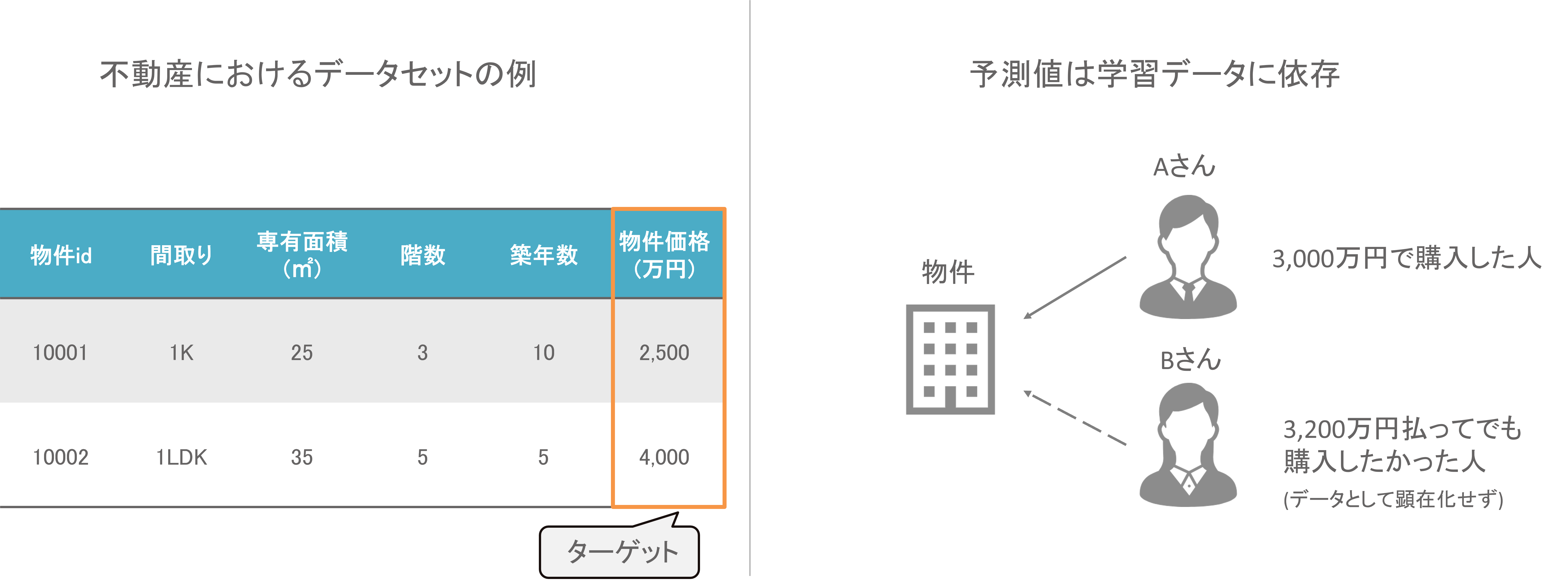
Value calculation AI datasets and points to note
Prepare the target data and attribute information of the product
Since the predictions are based solely on the data used for learning, it is necessary to consider what value you really want to calculate.
*An explanatory video is provided at the end of the article.
The key to creating a value calculation AI is to determine what value you really want to calculate. For example, in the diagram above, let's say there are two buyers, A and B, for the same property. A concludes the deal for 30 million yen, but B was actually considering purchasing it for 32 million yen. In this case, only the data for A, who concluded the deal, remains, and the data for B, who was considering 2 million yen more, does not remain. In other words, the property's true value may have been 32 million yen, but the 30 million yen price tag, which was the actual successful sale, becomes the AI's learning data.
As in this example, the AI's predicted value will change depending on the data collected, so you need to think about what value you really want to calculate and what data you need to prepare for that.
Fluctuations in notation, "What value do we really want to calculate?"...there's a lot to think about.
"Floor plans" are also a good example of data processing. For example, a human would recognize that "one-room" and "1R" are the same thing, but AI may not understand that they refer to the same thing. In addition to standardizing such notations to 1R, 1DK, etc. and using them as categorical values (Method A), another method is to break down the elements of the floor plan and express them numerically (Method B). For example, a 1K apartment has one room and one kitchen, so you could separate the data columns into "number of rooms, living room, dining room, kitchen, other" and use "1,0,0,1,0".
There are many ways to preprocess this kind of data, but it's best to choose one based on the accuracy of the predictions. We also used data organized using methods A and B to create AI learning patterns. As a result, method A proved to be more accurate, so we decided to go with it.
Does this mean that Method A is the best for AI to calculate the value of real estate investments?
It depends on the product and the customer. We believe that the reason why Method A was more accurate with INVASE is because it is a model targeted at "condominiums for single people." This is because there are not many floor plan options for single people. In the case of family-type apartments, there is more information on the floor plan, so Method B may be more accurate.
You can start by preparing the data and making adjustments depending on the product and customer preferences.
The ways in which AI can be used can be expanded depending on your ideas. Once you become familiar with it, it's a good idea to consider not only your customers and products, but also your own company's "particulars." Our company's motto is to have an "AI model that reflects the latest real estate market conditions," so we built the model by collecting data on a monthly basis.
The challenge here was that the amount of data that could be collected varied from month to month. This meant that the accuracy of the model varied from month to month, causing the prediction results to fluctuate. To ensure a consistent amount of data, we decided to use data from the most recent three months and assign weights, or in other words, importance, to newer data. Specifically, we weighted the data by copying the most recent rows, allowing the AI to learn more from more recent data. In this way, we were able to reduce fluctuations caused by a lack of data while also achieving the concept of "reflecting the latest market conditions."
Additionally, in the cross-validation partitioning performed when building a model, rows of the same data must be in the same partition, so we also add a column to identify that the data is the same.
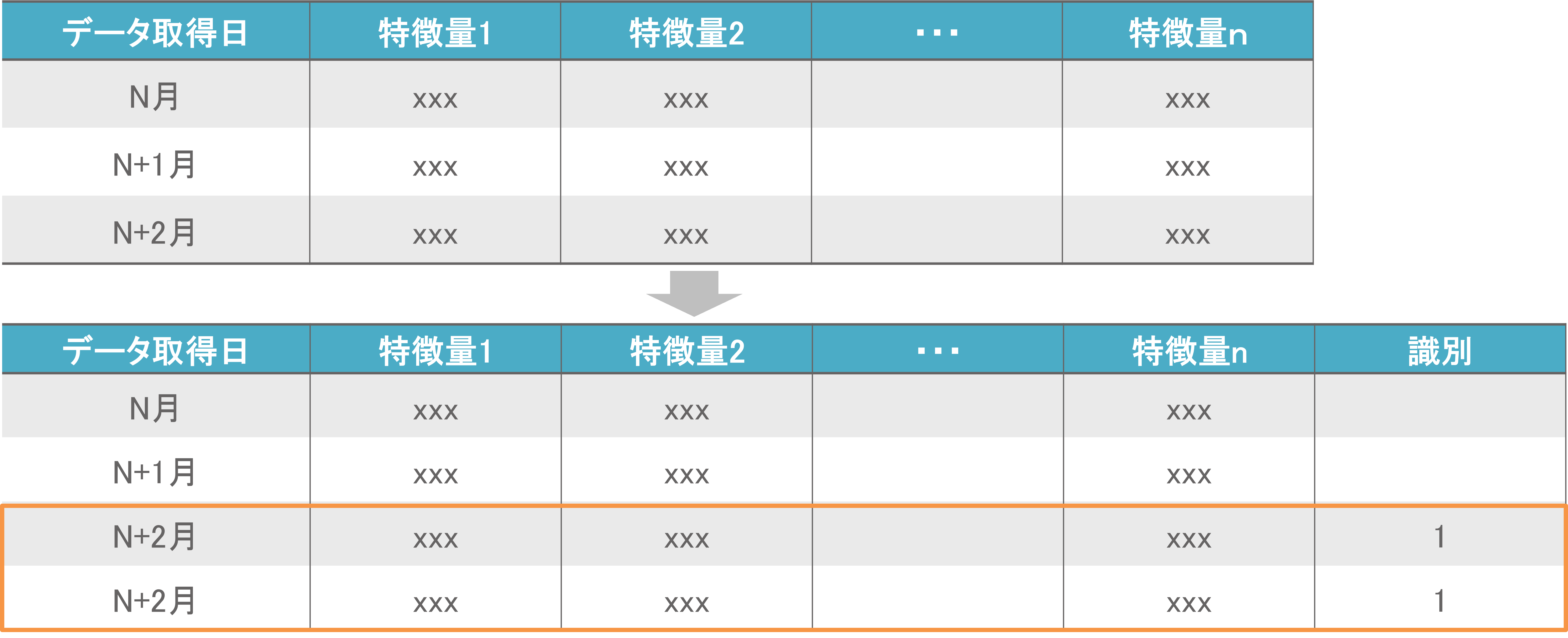
Weighted using acquisition date data to take into account the latest real estate market conditions
Adding columns for partitioning in cross-validation
*An explanatory video is provided at the end of the article.
We will make adjustments to ensure there are no major discrepancies with human perception and business reality.
Next comes modeling. As with Nabekura (link to explanatory article) and Hashizume (link to explanatory article), we will use AutoML to build this model. While AutoML tools can create a model to a certain extent without detailed settings, we made some detailed settings, such as monotonicity constraints. Monotonicity constraints are constraints that clarify the direction of features and targets based on domain knowledge, such as business hypotheses and on-site experience.
To explain more specifically, I think we all intuitively understand that the larger the floor area of a property, the higher the price (monotonically increasing), and the older the building, the lower the price (monotonically decreasing). Monotonicity constraints clarify the relationship between such features and the target. Because AI may not be able to express such relationships well due to bias in the training data or a lack of localized data, we corrected the model by applying monotonicity constraints to several features. This means that humans support and control AI learning to prevent large deviations from domain knowledge and human intuition.
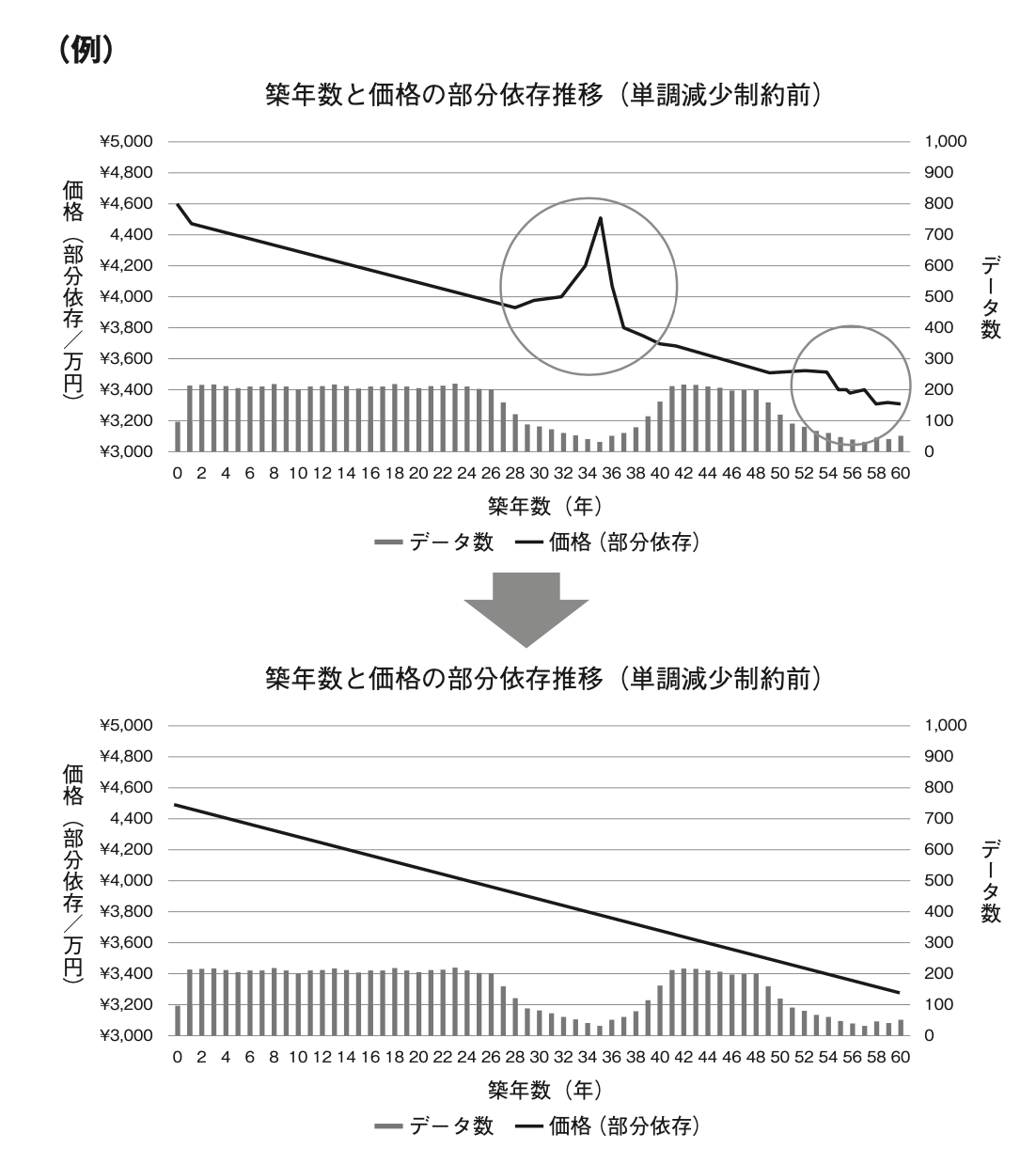
For features such as floor area and age of building, the relationship between the feature and the predicted value showed a trend that went against the trend (top figure), so if necessary, applying monotonicity constraints can be applied to reduce the variability of the training data (bottom figure).
Value calculation AI is not meant to surpass humans, but to support them.
In the case of real estate, no matter how accurate an AI model can be created to assess and calculate value, there will inevitably be some degree of price adjustment based on human judgment in areas that are difficult to digitize, such as the degree of deterioration of home appliances.
Therefore, we aim to avoid large discrepancies with the actual buying and selling prices, and have adopted MAPE, or mean absolute percentage error, as our evaluation indicator. MAPE calculates the "error" by subtracting the correct value from the predicted value, and then calculates the "absolute percentage error" by dividing the error by the correct value. This allows us to check and adjust how close the predictions are to the correct value. After reaching a consensus with the business side within the company, we set a target of MAPE of 10% or less.
Thank you very much. This time, I got a different impression from the cases by Mr. Nabekura (link to explanatory article) and Mr. Hashizume (link to explanatory article).
In the book "Financial AI Patterns," leading companies in the financial industry introduce their own AI success patterns and case studies. Among them, our company is unique in that we are using AI for general consumers, rather than for the purpose of streamlining business processes. Going forward, both INVASE and Mogecheck will continue to utilize data to provide user-oriented services. We hope that this case study will be helpful to companies and personnel who are also considering using AI for end users.
Written by Financial Data Utilization Promotion Association
"Success Patterns for Financial AI"
Now on sale and a big hit!
"FDUA Financial Data Utilization Promotion Association Tie-up Project" video
On Saison Technology's official YouTube channel,
We would like to introduce an explanatory video by Yusuke Horie of MFS Co., Ltd., who was in charge of writing Chapter 3.
Please see also.
Related Content
-

Survival Strategy in an AI-driven Society: How will humans live in an artificial super-intelligence society?
-

Applicable AI that can quantitatively judge and evaluate core credit operations of banks - Tips for developing credit screening AI -
-

Grasp insights that cannot be grasped through numbers from text and qualitative information! ~ Characteristics of text classification AI ~