

The key is to combine a variety of data, including meteorological data, to increase productivity across society.
When you hear the term "weather data," how many people imagine it being connected to business? However, meteorological data, which is rich in variety and has a wide range of uses, including not only weather, temperature, and humidity, but also ocean currents and solar radiation, is actually being used in businesses in a variety of fields. The Weather Business Promotion Consortium (hereinafter referred to as WXBC) is working to promote businesses that utilize meteorological data (weather business). We spoke to Mr. Murakami, who chairs the WXBC's New Weather Business Creation Working Group and is active in a wide range of roles, including as an open data evangelist for the Cabinet Secretariat, a regional information advisor for the Ministry of Internal Affairs and Communications, a digital strategy advisor for Shizuoka Prefecture, and a senior researcher at the Mitsubishi Research Institute, about the use of meteorological data.
*Titles and affiliations are those at the time of interview.
Why is it necessary to utilize meteorological data?
First of all, please tell us about WXBC's initiatives.
Simply put, WXBC was founded with the desire to "make greater use of weather data." Despite the fact that the Japan Meteorological Agency and other organizations make a lot of weather data publicly available, not many people are able to utilize it. Weather data is familiar information that has long been useful in people's daily lives, whether in agriculture or fishing, and with the advances in technology, it should be even more useful. I joined as one of the founders with the desire to spread the word that data utilization has the potential to increase convenience and improve efficiency. But why is it necessary to use data to improve efficiency in the first place? It's easy to say that efficiency is important, but have you ever thought about why it's so important?

- I certainly thought that using data was important for efficiency, but I had never thought about why that was.
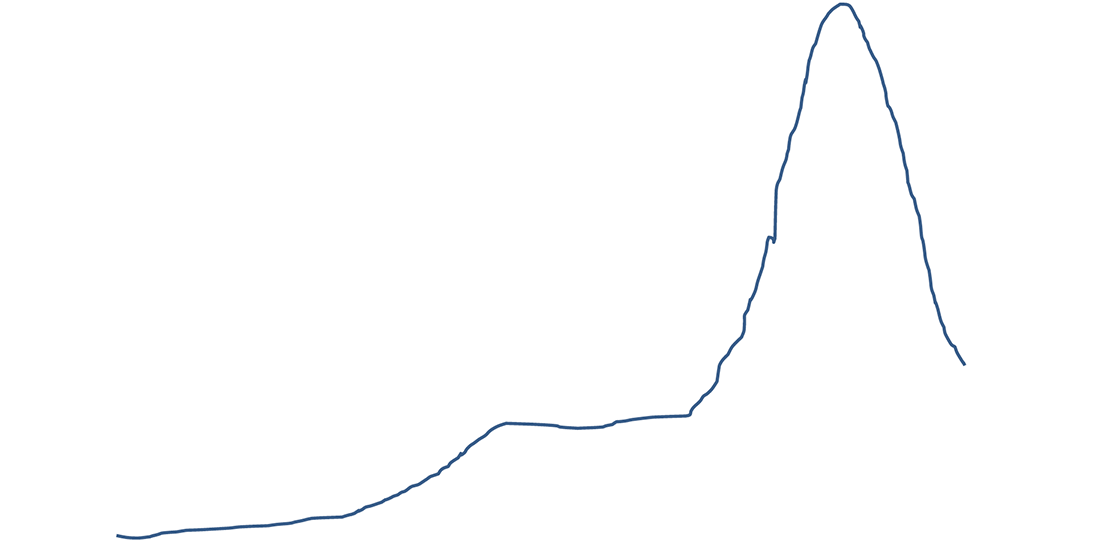
This curve is closely related to the reason for this. Do you know what this curve represents?
1. Bitcoin
②Crude oil prices
3. Japan's population
- That's difficult... Maybe number 1, Bitcoin?
1) Bitcoin 2) Crude oil prices are also pretty close, but the correct answer is 3) Japan's population. I'm sure you're all aware of the issue of population decline, but when you look at it over a 1,000-year span like this, it's clear that the population will decline rapidly in the future.
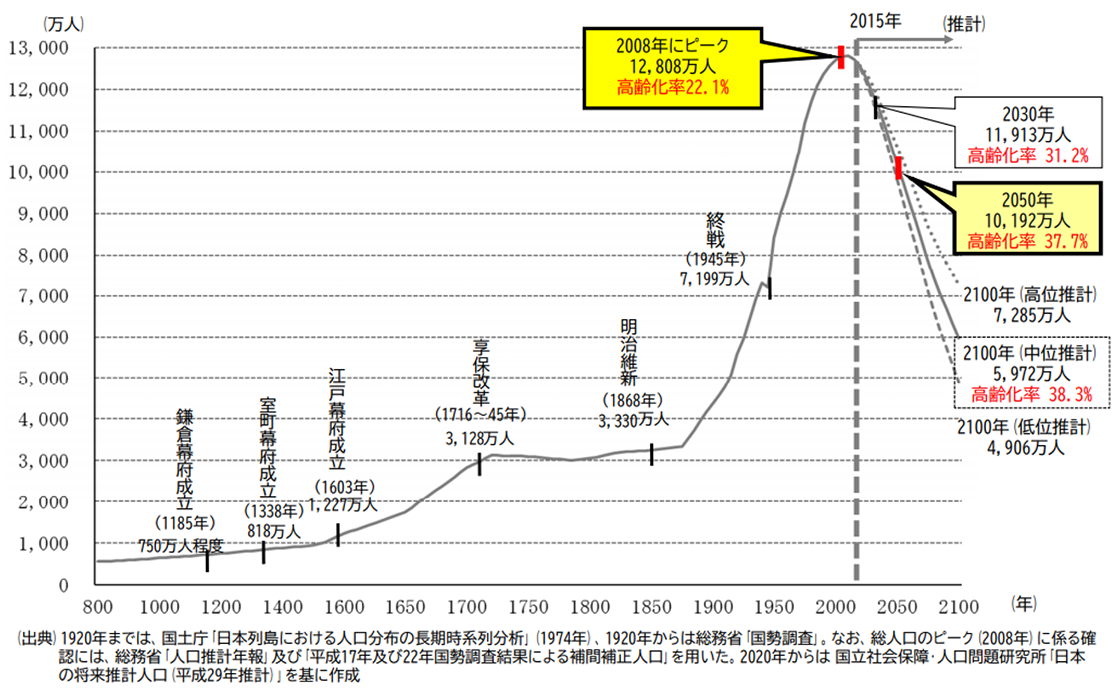
https://www.mlit.go.jp/policy/shingikai/kokudo03_sg_000214.html (Accessed November 17, 2020)
The cause of this decline is a decline in the number of children, or the total fertility rate (hereafter referred to as the birth rate). Japan's population will continue to decline, making it increasingly difficult to secure workers. According to estimates by the National Institute of Population and Social Security Research, Japan's working population will decrease by approximately 30 million over the next 40 years. While some experts say a slight population decline is not a problem, if things continue as they are, Japan's population will eventually reach zero. And before that happens, society will no longer be sustainable. This challenge applies not only to private companies but also to local governments. The Ministry of Internal Affairs and Communications has recommended that local governments be able to maintain their functions with half the current number of employees within 20 years (Municipal Strategy 2040 Concept Study Group). With a declining workforce and declining tax revenues, society will have to be supported with half the current number of staff. If we become complacent and think we're still safe, Japan will no longer be able to sustain itself as a nation.
So what should we do? We must raise the birth rate and halt population decline. The birth rate in 2019 was 1.36, and we need to raise this to 2.07, which will allow us to maintain the population. However, even if the birth rate were to reach 2.07 immediately, the number of women of childbearing age is declining, so the population will continue to decline for some time. In order to address this, it is essential to significantly increase productivity across society through digitalization. This applies to both the private sector and the government. By increasing productivity through digitalization, we can support society with fewer people and buy time. In the meantime, we can advance measures to address the declining birthrate and halt population decline.
Data is the key to advancing the digitalization of society as a whole. There is a saying that "data is the new oil." This means that just as oil is useless if it remains underground, data cannot remain dormant, but only becomes useful when it is collected, analyzed, and utilized in services. Like oil, data is a "resource" that can have an enormous impact.
In other words, the answer to the first question, "Why do we need to improve efficiency through data utilization?" is, "To increase productivity throughout society as a way to buy time for measures to combat the declining birthrate." That is why we at WXBC continue to work on our mission of promoting the use of various data, including meteorological data. Meteorological data in particular is extremely diverse, with a wide range of uses, including weather, temperature, humidity, ocean currents, wind direction and speed, and solar radiation. Another feature is that it allows for objective, rather than subjective, predictions.
The potential of weather data to solve problems
How is weather data actually used?
It has a wide range of uses, so it's not possible to introduce them all at once, but here are a few examples.
For example, there's a crime prediction service called "pledpol." Two scholars studying earthquake prediction in the United States wondered whether earthquake prediction algorithms could be applied to crime forecasting. They collaborated with local police to create a crime prediction system using seven years of crime data. The system analyzes historical crime data by type, analyzing characteristics such as the time, location, and weather and temperature at the time of the crime. Based on these results, the system predicts when, where, and what type of crime is likely to occur in the future. By focusing patrols in these areas, the system can prevent crime before it happens. Similar services have already been introduced in Europe and Asia, and in Japan, they have been introduced by the Kyoto Prefectural Police, and Kanagawa Prefectural Police are also conducting research. While crime prevention measures until now have mainly relied on educational campaigns such as posting posters, data is now being used to predict and prevent crime.
Another Finnish service called "Enevo" uses data to streamline garbage collection. While garbage collection typically follows set days and routes, the amount of garbage varies depending on the season and weather. Therefore, sensors are attached to each collection bin (container) to monitor the amount of garbage in real time. This is then combined with various data, such as the past garbage accumulation in each bin, the day of the week, weather, and information on nearby events, to predict when each bin will be full. By changing the collection route each day based on these results, garbage collection becomes more efficient, reducing labor costs and CO2 emissions. Furthermore, since garbage does not overflow from bins, this also has benefits in terms of aesthetics and hygiene.
In Japan, for example, AI is used to predict demand for taxis. There is a difference in experience between veteran and new taxi drivers, and the difference in sales depends on whether or not the driver has empirical knowledge of when and where to go to pick up passengers. Therefore, by using data such as mobile phone base station information, taxi operation data, facility information, event information, and weather data, AI can predict demand, thereby increasing taxi utilization rates.
An era where data can be utilized regardless of the size of the company
Are there any other examples of Japanese companies using weather data?
For example, Lawson uses over 100 parameters, including store location characteristics, customer characteristics, sales performance, day of the week, time, event information, and weather information, to predict the next day's sales and decide on ordering and staff deployment based on that. This reduces food waste and opportunity losses due to stockouts, and by accurately allocating staff, the company is able to increase profits while keeping labor costs down. Hearing this, some might think, "Lawson is a large company, so they can make such use of it thanks to huge investments," but that's not necessarily the case.
- Are there any examples of small companies using weather data?
Ebiya, a small shop in Ise City, Mie Prefecture, also combines data to forecast demand and allocate staff. This combined souvenir shop and restaurant originally ordered goods based on intuition and experience. However, by predicting customer demand from data and using that information to purchase goods and allocate staff, they were able to reduce employee working hours, increase profits, and raise salaries. They collected data likely related to sales, narrowed it down to useful data (past sales, day of the week, weather, temperature, etc.), created an algorithm, and provided repeated feedback to improve accuracy. As you can see, with just a little knowledge and without a huge investment, various cloud services can be used to perform data analysis and sales forecasts at low cost.
What's important to note is that in all of the examples given here, the problem is solved not by using meteorological data alone, but by combining it with other data.
Don't just use weather data, use weather data too
Indeed, in all of these examples, efficiency is achieved by combining multiple data sets.
I often say, "Don't make weather data the subject." People who are knowledgeable about weather data often say, "Using weather data...", but using weather data alone won't do much. Weather data is just one type of data among many, and the most important thing is to work with a variety of data.
- Is there anything important to remember when combining various types of data?
The key to using data is to value on-site insight. As the Ebiya example shows, rather than simply outsourcing sales forecasts to an external company, it's important for the people involved, who have a firsthand understanding of the situation on-site, to identify what data will affect sales and compare the forecasts with actual results to improve forecast accuracy.
The data used may be collected in-store, such as sales by day of the week, time of day, or product, purchases, or staff working hours, but may also be external information, such as event information. Weather data is also one example of data obtained from external sources.
- What are your thoughts on how data will be used in the future?
First of all, you need to be aware of the effectiveness and necessity of using data. Currently, many companies and local governments are not making much progress in using data, but it is expected that more will start to do so in the future. As a result, there will be big differences in various aspects, such as productivity and profit margins, between those who are able to use data and those who are not. Even if it's just a small initiative, I would be happy if people would start by formulating a hypothesis and verifying it with data.
I believe there are many companies that compile actual results and set targets for sales and costs. However, there are still few that properly analyze, based on past data, why sales increased (decreased) or why costs increased (decreased). Furthermore, it is expected that only a minority of companies make future predictions based on past data. However, in the future, management that bases sales plans and local government financial plans on data and then adjusts the plan's course by comparing it with actual results will likely become mainstream. The important thing is to not miss out on this trend. Furthermore, the data released by local governments and other organizations currently has different items and formats depending on the local government. It is necessary to standardize this and make it easier to use.
Even small shops like Ebiya can take advantage of cloud services to manage their businesses in a new way. We live in an age where anyone can utilize data with just a little knowledge. Why not start by visualizing the issues and hypotheses you're experiencing on the ground with data? For example, simply visualizing data on meals and steps taken over the past week can reveal issues such as nutritional imbalances or the need for more exercise. Before making predictions, start by visualizing the current situation. I believe this will be a step towards making the future brighter, even if only a little, in Japan, where the birthrate is declining.
- * "Personal Data: The Emergence of a New Asset Category" (World Economic Forum, 2011)
- Click here for information on how to obtain weather data and weather data.
- For an overview of weather data and an introduction to each weather data item, click here.
Related Content
-

Survival Strategy in an AI-driven Society: How will humans live in an artificial super-intelligence society?
-

Applicable AI that can quantitatively judge and evaluate core credit operations of banks - Tips for developing credit screening AI -
-

Grasp insights that cannot be grasped through numbers from text and qualitative information! ~ Characteristics of text classification AI ~