

What is the valuable data that can provide personalized learning and bring about behavioral change? The unique superintendent's strong sense of crisis and the new shape of education
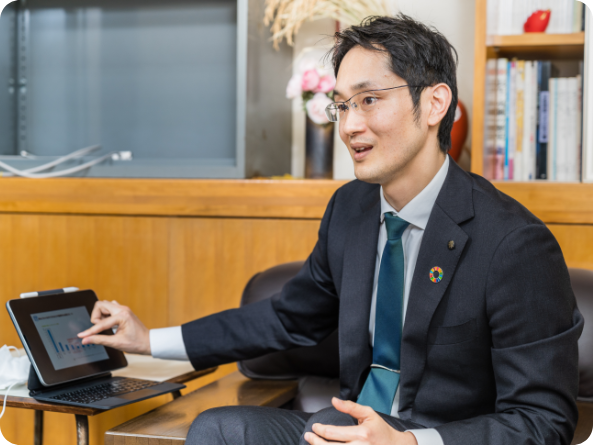
Hiroto Iwaoka was offered the position by the mayor while still employed at the Ministry of Education, Culture, Sports, Science and Technology, and was appointed superintendent of education for Kamakura City in August 2020 at the young age of 35. As the position is often filled after the retirement of school principals, the average age of superintendents nationwide is around 64, but Iwaoka is one of only four superintendents under 40 in the approximately 1,700 municipalities nationwide. What is more, Iwaoka, who lives in Tokyo, is working daily on educational reform in Kamakura, a place he has no connection to. What is the future of children that this unique superintendent of education envisions?
*Titles and affiliations are those at the time of interview.
Background to becoming Superintendent of Education
Please tell us how you came to be appointed as the Superintendent of Education for Kamakura City.
Prior to becoming Superintendent of Education, I worked in early childhood education at the Ministry of Education, Culture, Sports, Science and Technology, and was involved in numerous educational administration projects related to elementary and junior high schools. Since then, I have always valued the importance of educational administration that reaches the last mile. Education in schools is inherently something that only occurs through the interaction between teachers and students. While the central government fulfills its responsibilities by creating laws and issuing notices, this alone does not create an educational impact for children. This is why I have worked with many people, focusing on methods for collecting data, creating manuals, setting guidelines, and issuing notices that will lead to behavioral change on the ground. It was at this time that I received an offer to become Superintendent of Education, and I decided to take on the role of Superintendent of Education for Kamakura City.
You were offered the position of superintendent of education in Kamakura, a city you have no connection to. What were your thoughts when you first heard about it?
My fundamental philosophy in educational administration, which is also the goal of the new curriculum guidelines, is to realize a school education that is open to society. Rather than simply teaching subject content, I want to realize a school education that builds a better society, incorporating various resources not only within the school but also in society, and empower children with the skills they need to live happily in this rapidly changing era. Kamakura is the perfect place to embody this philosophy. As a historic area, it is a city that values tradition, but its attractive living environment and unique cultural story have also attracted entrepreneurs, artists, and other creative people to Kamakura in recent years, making it one of the cities truly rich in social resources compared to other municipalities. When I heard about the appointment as Superintendent of Education, I strongly felt that I wanted to take on the role.
Kamakura is a city where tradition and modernity coexist, so I heard that the mayor had a strong desire to explore ways to combine tradition and modernity in the field of education as well. I believe that I was chosen as the candidate for this role when they were looking for new personnel to lead such efforts.
Issues in the educational field
As you have been involved in educational administration, you have had experience with various data that serve as the basis for policymaking. Please tell us about your experiences with data in the educational field.
I have been involved in the creation of a nine-year compulsory education system that combines the elementary and junior high school systems, the creation of guidelines for optimizing school size through consolidation and closure, and the creation of policies for promoting the establishment of night junior high schools, but facts are important for creating each policy. For this reason, I have worked on a number of projects, including the design and implementation of various surveys and the analysis of their results, and in a sense, I recognize the importance of data.
He also has experience studying educational economics, which uses econometric methods to build evidence in the field of education, while obtaining a master's degree from the Graduate School of Public Policy at UCLA (University of California, Los Angeles). The United States is a country at the forefront of data-driven thinking, and each state is required to administer standardized tests that allow for comparisons over time. This means there are many opportunities to come into contact with vast amounts of data, making it a heavenly environment for an educational economist.
However, conversely, we were caught in a dilemma where we couldn't make policies without data, and I witnessed a situation where each school worked hard on the mandatory standardized tests in Japanese and math, and as a result, time for art, food education, ethics, physical education, etc. was gradually cut back. Evidence-based data is of course important, but I believe that my experience at the time formed within me the value that it is not enough on its own.
Many systems have been introduced in the educational field, and a great deal of data has been accumulated. From the perspective of data, what do you think are the challenges facing the education industry today?
I believe there are various dimensions to data utilization. One is the use of data in policymaking. This is the use of data for evidence-based policymaking (EBPM), which involves considering what kind of initiatives should be implemented based on data such as each school's grades, physical fitness test information, and questionnaire surveys of children.
The other is the use of data to improve daily instruction. This is not about the government formulating policies, but about using data to help teachers in the field use it as a hint for their daily instruction planning. In this area, it cannot be said that there is an environment in place where data can be used not only in Kamakura City, but nationwide.
Although there is data for policy formulation, there is currently no data from the field that would be useful for improving instruction.
In fact, the use of data in policymaking is also insufficient. Unlike the United States, Japan lacks sufficient data in an analyzable format. As you may know, Japan has a National Academic Achievement Test, a national academic achievement and learning status survey that fully reflects the intent of the national curriculum. This test is useful for formulating strategies that allow teachers and students to understand the educational goals of the country. However, because the variation in mean scores and standard deviations is not standardized and the population changes every year, comparisons over time are not possible. The reality is that the data does not allow for analysis of whether children's academic abilities have improved, whether the difficulty of the test is related, or whether there are differences in the population. The reality is that, with an insufficient data environment, we are not at the stage for data-driven policymaking.
I also believe that reform of academic achievement tests is necessary to formulate evidence-based policies, but tests themselves are only conducted once a year, once per semester, and while it is certainly possible to conduct fixed-point observations, it is not possible to grasp fluctuations in children's performance over a week due to changes in their living environment or social environment, or stress, etc. Even if academic achievement surveys are conducted with a well-designed system, the nature of tests makes it extremely difficult to apply the results to daily instruction.
Some advanced local governments select teachers who have successfully developed children's abilities over the course of a year through academic achievement tests, extract their teaching techniques based on interviews rather than data, and use them to infer teaching methods that will lead to improved academic ability, which can then be used for training, etc. However, since these are merely standardized "tips" for teaching techniques, they are not flexible enough to respond to the daily changes in children.
In this way, the current state of data utilization in the education sector is that we have not yet reached Stage 1, where data is utilized to create policies, and we have not yet reached Stage 2, where data is utilized to help improve daily instruction.
Initiatives for the GIGA School Initiative
The GIGA School Initiative is currently being promoted by various local governments. How do you feel about the potential for this initiative to become a promising initiative when looking at data on daily changes in children?
We believe that this will allow us to take advantage of the strength of having one device per student. Even if we carefully design an academic achievement test, the reason for an improvement in academic ability may be due to the child's living environment, or it may also be influenced by whether or not the child attends a cram school, so it is not possible to determine the cause of an improvement in academic ability from an achievement test alone. In reality, causal relationships become apparent when various data are combined. The GIGA School Initiative, which generates a lot of data in everyday life outside of tests and links it to individuals, is extremely useful for data analysis, and we believe this is one of the points we are looking forward to.
What is the progress of the GIGA School Initiative in Kamakura City?
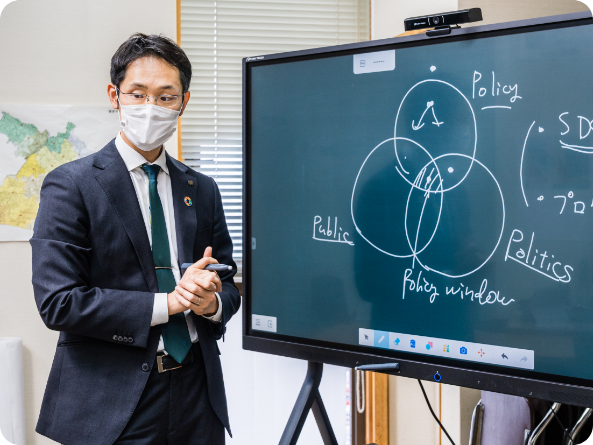
Our progress is not significantly different from that of other municipalities. Kamakura City distributes iPads to all students from first grade of elementary school to third grade of junior high school. However, we believe that learning is isolated with just a device. Therefore, in order to promote interactive and proactive learning, we are installing large electronic whiteboards (it's easier to imagine them as iPads with 65-inch touchscreens) in each classroom to transform individual learning on the device into shared learning and to make learning collaborative. However, since installing large electronic whiteboards requires financial resources from the municipality, it is natural that some municipalities will find it difficult to do so. Kamakura City has provided all three of these: iPads, the Wi-Fi environment required for communication, and large electronic whiteboards.
The environment has already been prepared, but what do you expect it to be used for in the field?
We believe that the progress made in improving the environment can be utilized in a variety of ways. Specifically, we express this as "deepen, communicate, connect, and combine."
By making full use of digital devices, children can independently investigate what they want to know, what they want to compile, and what is valuable from the vast ocean of information. In other words, "deepening" means that children can deepen their learning in line with their own curiosity.
When students put together something and write it on a large piece of paper to present, it can take a long time to create it in the first place, and there may not be enough time for everyone to present. By using digital devices, students can quickly put their ideas into shape and create presentation materials, which can then be shared not only within the school but also outside. This is what we call "communicating."
Furthermore, the collaborative aspect of learning will be greatly enhanced, as students will be able to instantly share researched information using AirDrop and other methods, connect ideas by sharing information with each other before presenting, and co-edit presentation materials. Furthermore, by utilizing video conferencing software such as Zoom, it will be possible to carry out educational activities with a variety of people both inside and outside the school, turning home, the community, and school into learning spaces. This is what "connecting" means.
"Adjusting" allows us to provide individually optimized learning for each child. Until now, lessons were taught using the teacher's mouth, blackboard, and textbook, meaning only one unit could be covered per lesson. For example, some children who don't understand the graph of a quadratic function don't understand graphs at all, while others don't understand factorization or arithmetic operations. The causes vary from child to child. Addressing these diverse causes is difficult through teacher's mouth and textbook lessons alone. By leveraging the power of digital technology, for example, using software called AI Drill, if a student gives an incorrect answer, the cause can be analyzed from vast amounts of past data and presented to the teacher. We believe that by being able to identify the cause to a certain extent for each child, we will be able to provide individually optimized learning.
The importance of data integration
I think there are certainly high expectations that the new data obtained through the GIGA School Initiative will lead to individually optimized learning. However, what about the use of data that has already been obtained?
It's true that various software programs are being deployed in schools, but each program holds its own individual data, making it impossible to perform meta-analysis. From the perspective of information security, it is necessary to manage and operate each of the following software programs separately: learning software such as AI drills and presentation software, school administrative software that manages students' personal information such as grades and attendance, and external software that handles email communications with external parties. As a result, schools are faced with the fundamental issue of difficulty in analyzing this data. I believe that one solution could be to not only reconsider the design of academic achievement tests and the like, but also to create an environment in which the various data collected daily can be treated as a large dataset and meta-analyzed.
By combining academic ability data with consultation history, attendance status, and number of instructional sessions, it may become possible to see things that were previously difficult to notice, such as a child being at high risk of not attending school. Furthermore, if a trend improves when a specific action is taken and this can be quickly identified, it should be possible to use this information to improve daily instruction, and it may even be possible to obtain Stage 2 data from a Stage 1 situation all at once. By linking existing data with information that will be obtained in the future, various hints that will be useful in the field of education should be available.
In fact, Kamakura City conducts an ongoing "Kamakura Children's Awareness and Reality Survey," which provides survey data on children's lifestyle habits. While each data may not be meaningful on its own, combining it with academic achievement data and attendance data could potentially reveal trends in anxiety about home life. This could lead to changes in teachers' involvement, rather than simply scolding students for not completing their homework. This should lead to an approach that leads to behavioral change that cannot be achieved through one-off academic achievement surveys or questionnaires, no matter how well designed. Indeed, the truth can only be seen by linking the data. In that sense, we look forward to future efforts by Saison Information Systems, which aims to contribute to fields such as safe and effective educational data analysis and programming learning based on real problems.
How is the concept of data utilization and data integration perceived in the educational field?
Kamakura City, which has enacted the "Kamakura City Ordinance Aiming to Realize a Cohesive Society" and been selected as an SDGs Future City, is promoting urban development centered on the idea of leaving no one behind, such as by clearly stating the direction of a "cohesive society" where everyone respects each other's personality, individuality, diverse ways of life, and an environment where they can support each other.In terms of education, in addition to promoting a change in mindset through educational training, there is also a movement to establish a support system for children by placing educational consultation coordinators in each school and consolidating knowledge among these members.
Rather than using evidence-based data to implement special educational activities, we believe that fostering a better environment through daily improvements to instruction for the sake of children's well-being will gain understanding. For example, if a child has cognitive characteristics that make them good at reading books but have difficulty listening and cannot sit still during class, it will be possible to provide support based on an understanding of that child's characteristics. We believe that this will also help create an environment where teachers, who struggle daily in the field of education, can provide support using a different approach than before.
Some municipalities, such as Shibuya Ward and Osaka City, are already working on new approaches by linking data, but creating such an environment from scratch requires a great deal of energy and cost. It is expected that software will continue to evolve through the GIGA School Initiative, and the turnover of environments will likely become more frequent. It is unrealistic for all 1,700 municipalities to prepare custom-made data integration platform. In that sense, the education industry will likely also need general-purpose cloud services that can flexibly utilize data integration platform.
For the children of the future
In this rapidly changing social climate, what do you think people in the education industry need to be aware of?
When thinking about education, the most important thing to remember is that children will not become adults based on the current society. Children will become adults and work in the society of 20 years from now, so those of us involved in education need to imagine the society that will exist in 20 years' time and promote our daily educational activities with an eye toward the skills that will be required there. We must have a strong sense of crisis that if we educate people based on the values of the past, we will, in a sense, be robbing our children of their future.
For example, while Toyota has built an ecosystem centered on internal combustion engines, startups like Tesla are creating disruptive innovations by adding autonomous driving features via wireless updates, much like upgrading iOS. Considering the number of startups emerging in fields like social media, smartphones, and even space development that have generated market capitalizations exceeding $1 billion in just a few years, we can bet that the world will be completely different in 20 years. This kind of society is called Society 5.0, but skills like memorizing, following instructions, and completing drills by repeating simple tasks are areas where AI and robots excel. My fundamental thinking is that everyone involved in education needs to consider what skills people will need to acquire in 20 years' time.
What specific efforts are you making to support the children of Kamakura City, who will be responsible for the future?
It is important to anticipate the demands of society 20 years from now and then incorporate them into school education. Toward the goals of Society 5.0, including the skills and attitudes toward learning, and the SDGs, we need to realize proactive and interactive lessons in which each child can play a leading role, and we believe that learning should be optimized to suit each individual's abilities and interests. However, because it is difficult for schools to quickly adapt their resources to keep up with the speed of change, we believe it is necessary to work with many people, including society, to create a diverse educational environment. To achieve this, there are bottlenecks in the areas of tools, experience, and environment, and these must be removed.
Among these, the one I am currently positioning as the core is an initiative called the "Kamakura School Collaboration Fund." By collaborating with universities, educational ventures, NPOs, and other organizations with ties to Kamakura, we have created an environment where we can obtain learning resources such as SDG education, entrepreneurship, and programming. However, because schools lack the connections or funds to collaborate with external parties, some local governments have asked them to cooperate as volunteers during the daytime on weekdays. In such cases, while participating companies can help solve their problems, it cannot be said to be a sustainable environment that can help solve the problems of schools.
Therefore, by establishing a financial foundation for collaboration with society through the "Kamakura School Collaboration Fund," we aim to create an environment in which we can collaborate with society when conducting educational activities that meet societal needs, such as education that allows children to explore their own ideas and provide value to society, or programming education. Initially, we considered securing funding through general revenue, but the current COVID-19 pandemic has caused Kamakura City's tax revenue to plummet, making it difficult to consistently secure stable funding. In order to create school educational activities that are open to society, we are also working to secure funding through crowdfunding, utilizing mechanisms such as hometown tax donations. Improving the educational environment through education built together with society is exactly what Kamakura City envisions for the future of education.
Related Content
-
Survival Strategy in an AI-driven Society: How will humans live in an artificial super-intelligence society?
-
Applicable AI that can quantitatively judge and evaluate core credit operations of banks - Tips for developing credit screening AI -
-
Grasp insights that cannot be grasped through numbers from text and qualitative information! ~ Characteristics of text classification AI ~