
The end of the ISDN service "INS Net" is fast approaching! Are you ready?
Did you know that in 2024, the ISDN service "INS Net Digital Communication Mode" offered by NTT East and West will be discontinued as fixed-line telephone networks are converted to IP? According to the schedule announced by NTT East and West in October 2017, the switchover is expected to begin in January 2024 and be completed in 2025.
Many companies use ISDN, and the majority of them use it for "important data transfer" such as "order placement and receipt" and "payment."
You've never heard of INS, and it doesn't concern your company? The truth is, it's dangerous. In fact, there are many cases where people are using ISDN lines without realizing it, and there are concerns that countermeasures are being delayed. Rather than assuming that your company is safe, why not check the entire company's systems?
What is the end of INS? What is an ISDN line?
First of all, there may be some people who don't know what an INS line is, or who have a vague idea of what it is but wonder why it's causing such a fuss now.
There may also be some people in charge who understand the issue themselves but have trouble explaining why.
▼Even if you don't know what "INS termination" or "ISDN" are, this is a 5-minute video that will clearly explain the related information, so please take a look.
[Kumo Radio] It's about time to take measures against INS - YouTube
ISDN lines are still in use
ISDN lines have been used for EDI (Electronic Data Interchange), which transfers order data between companies, and EB (Electronic Banking), which transfers transfer data from companies to banks. ISDN lines are still used for a wide range of data communications, including POS and CAT terminals (credit card readers) and building security devices, so their discontinuation will have a major impact on companies.
Many of these were introduced between 1988, when ISDN first became available, and the 1990s, so a long time has passed since then. There are cases where the person in charge has changed and people are using the line without realizing it is an ISDN line, or the system department is not fully aware of the situation, as the line is being used at some locations other than the head office.
What if you were using an ISDN line without knowing it? If the service is terminated, communications will stop and your business will come to a halt, so you need to check and migrate before that happens. Building a new system and migrating will cost money and take time, so it's important to take action early. First, we recommend that you check your company's current situation.
What are the alternatives to the end of ISDN (INS)? Data transfer speed and cost are issues
If you are using ISDN, you will need an alternative solution, but what are the options?
NTT East and West are offering "metal IP telephones" as an alternative to ISDN (INS), but they are not suitable for data communications and are said to increase communication times by up to 10 times. Delays in EDI and EB, which are used for close data integration between companies, can have serious repercussions such as production line shutdowns and delays in bank payments, making them a difficult alternative.
Other methods of external connection include "dedicated lines," "VPN," and "IP-VPN," but these require the installation and construction of new equipment, which tends to increase the implementation costs. Furthermore, they often require an operator who is knowledgeable about the technology, which tends to increase running costs.
Additionally, if security considerations are required and a high level of safety and security is required, it is possible to have highly skilled network engineers spend time and money to build the infrastructure and then operate it (which would be the best option if cost and time are not a consideration), but this would be difficult to secure the engineers and, above all, very expensive.
Case study: Company A switched to "HULFT-WebConnect" after ISDN (INS) was discontinued
Company A, a manufacturer of business machines, was also struggling to come up with a replacement plan after ISDN (INS) was discontinued. Company A used EDI to order parts from suppliers.
It was difficult to find a good alternative to ISDN lines. We considered IP-VPN and Internet VPN, but not only was the cost of installing dedicated equipment high, but the monthly running costs of installing them at multiple locations would have been several million yen.
Company A introduced HULFT-WebConnect after it was using HULFT in another internal system. Because no dedicated equipment was required, there were no initial costs, and running costs were also low, the company started small with only a few suppliers and completed the introduction in a short period of time.
Data transfer can be easily automated, allowing for a smooth switchover with minimal modifications to existing systems, and transfer speeds after implementation are significantly faster than before.
Recommended as a replacement for discontinued ISDN (INS)!
“HULFT-WebConnect” “HULFT-WebFileTransfer”
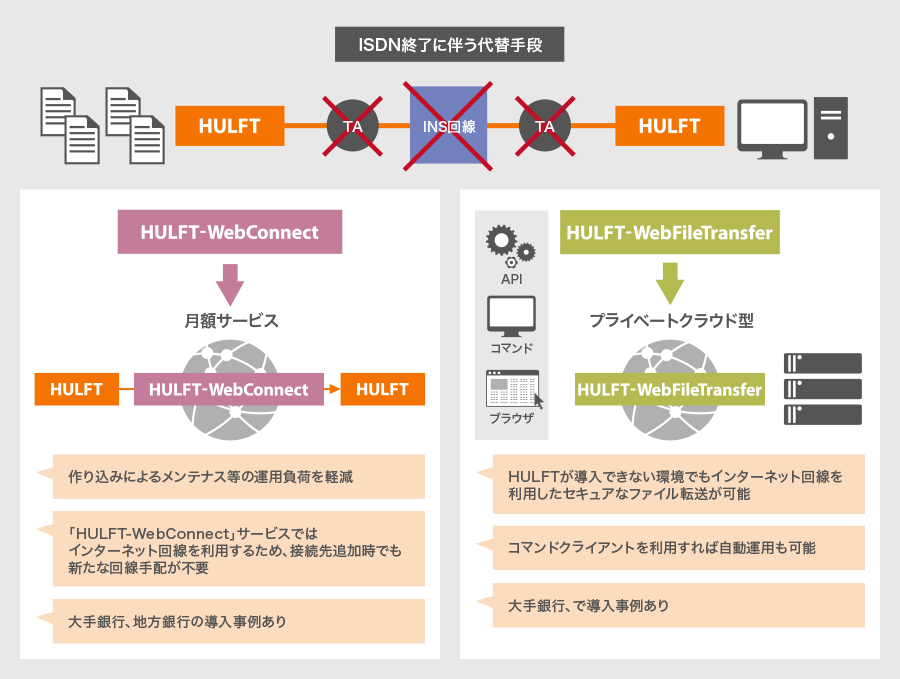
"HULFT-WebConnect" is a service that allows you to easily and securely transmit data over the Internet using "HULFT," a file integration middleware with over 20 years of experience and high reliability in business.
Another feature of HULFT-WebConnect is that if you have an existing system that uses file transfer middleware HULFT, you can simply change the settings slightly, with almost no modifications required.
Advantages as an INS alternative
1. Easy to implement
No new equipment is required. All you need to do is sign a contract and do some simple setup.
2. Inexpensive
For 30,000 yen per month, you can transfer up to 100GB of data to 10 connection destinations. Any excess data is charged on a pay-as-you-go basis, and additional connection destinations can be added starting from 2,000 yen, so no data goes to waste.
3. Safety
Although the data is sent over the Internet, to enhance security, the data is not stored on an intermediary server and communication is encrypted using TLS.
"HULFT-WebConnect" can be used as long as the file transfer middleware "HULFT" is installed on either the data sender or receiver. "HULFT" is the file transfer middleware product with the largest market share in Japan, and has been adopted by more than 10,000 companies in over 40 countries, mainly in the manufacturing and financial industries, so there are probably many companies that have already adopted it.
In addition to "HULFT-WebConnect," which is provided as a cloud service, we also offer "HULFT-WebFileTransfer," a model that allows you to operate and manage your own server. Please consider which option best suits your needs.
An alternative to INS, which requires high security requirements for card information, etc.
"HULFT Multi Connect Service"
The tricky thing about replacing INS is when you are transferring data that requires highly sensitive handling. ISDN is a technology based on the telephone line network tightly managed by NTT East and West, so it is more secure than the Internet, and is safer and more secure than the Internet, where communication failures and hacking must be assumed.
For example, if you are transferring a credit card number, you will no longer be able to simply replace it with a transfer via the Internet. New communication paths replacing ISDN will have to ensure the same level of safety and security as before, and (in cases such as transferring card numbers) you may have to prove to third parties that the alternative to ISDN is "safe and secure."
When using IT in a company, it is common to transfer "important data." If you check your company's systems, you may find that there are many cases where you wonder, "Is it okay to switch to communication via the Internet?" In such cases, it becomes even more difficult to respond.
"HULFT Multi Connect Service" also meets PCI DSS requirements
Therefore, if you have high security requirements, such as when you are looking for an alternative to an INS line but are having trouble with the complexity of having to comply with PCI DSS, we recommend that you consider our INS alternative service, "HULFT Multi Connect Service."
The service has also met the PCI DSS requirements for handling card information over the Internet and has received "PCI DSS certification." It also comes standard with connectivity to "Connecure Connection," a next-generation means of connecting to financial institutions.
We have also taken various measures to minimize the operational burden on customers after the transition to ISDN, such as implementing an integrated user interface to minimize the operational burden of complex protocol settings and network settings.
PCI DSS? Network operation? Are the explanations in the links above too difficult to understand? Don't worry if that's the case. Even if you don't understand, we can provide advice on the very first step in ISDN migration, "clarifying your INS usage status."
summary
This time, we have introduced a data communication method that will replace the ISDN service "INS Net," which is scheduled to end in 2024. If you are interested, please feel free to request a brochure.
Please also see the following materials and hands-on seminars:
I want to know more about "HULFT-WebConnect" and "HULFT"!
This is a free hands-on seminar where you can actually try out WebConnect.
- Seminars, HULFT-WebConnect product introductions, hands-on seminars (free seminars)
- Internet file transfer service "HULFT-WebConnect "(product introduction page)
- HULFT Multi Connect Service | Introducing alternative solutions following the termination of INS Net's "Digital Communication Mode" (Product Introduction Page)