

There are actually more solar eclipses than lunar eclipses - or thinking about "reading data"

This is Watanabe from the marketing department.
This is a column that casually writes about various topics related to data, IT, etc.
Interesting news: There was a total lunar eclipse
Today I'd like to talk about current events that are happening all over the world.
The other day (September 8, 2025), early in the morning, there was a total lunar eclipse for the first time in several years, which became a hot topic. I would like to write a little about lunar eclipses. I will share some anecdotes that will make you think, "Oh, that's true," and some points about how it is difficult to draw necessary conclusions from data alone.
In fact, the next lunar eclipse is coming up soon (the evening of March 3, 2026), so if you read this and gain knowledge and wisdom, I think you'll be able to give some clever advice to those around you at the time of the next lunar eclipse.
Reference: News reporting on the lunar eclipse
⇒ Total Lunar Eclipse 2025: Mysterious Copper-Colored Full Moon Across Japan <Photo Gallery> - Weather News
Which is more common: a lunar eclipse or a solar eclipse?
First, let's start with a story that might make you think, "Oh, I see." Solar eclipses are a celestial spectacle similar to lunar eclipses, but which do you think happens more frequently, lunar eclipses or solar eclipses?
Lunar eclipses happen about once every few years, so people tend to think of them as something that happens every now and then, while solar eclipses are something you might only see once in your lifetime. However, there are actually more solar eclipses than lunar eclipses. Let's take a look at the actual data from 2020 to 2025.
Solar Eclipses ☼ (11) from 2020 to 2025
- June 21, 2020 Annular solar eclipse
- Total solar eclipse on December 15, 2020
- June 10, 2021 Annular solar eclipse
- Total solar eclipse on December 4, 2021
- May 1, 2022 Partial solar eclipse
- October 25, 2022 Partial solar eclipse
- April 20, 2023 Annular Solar Eclipse
- October 15, 2023 Annular solar eclipse
- Total solar eclipse on April 9, 2024
- October 3, 2024 Annular solar eclipse
- March 29, 2025 Partial solar eclipse
Lunar Eclipses ☽ (8 times) from 2020 to 2025
- May 26, 2021 Total Lunar Eclipse*
- November 19, 2021 Partial Lunar Eclipse *
- Total lunar eclipse on May 16, 2022
- November 8, 2022 Total lunar eclipse*
- October 29, 2023 Partial Lunar Eclipse*
- September 18, 2024 Partial Lunar Eclipse
- March 14, 2025 Total lunar eclipse*
- September 8, 2025 Total lunar eclipse*
As you can see, there are more solar eclipses than solar eclipses. This is completely counterintuitive.
While lunar eclipses are often visible all over the world (as long as it's not daytime at that time), solar eclipses, although occurring frequently, can only be seen in limited areas, which creates a discrepancy with intuition. Lunar eclipses marked with an "*" can be seen in Japan (6 times), while solar eclipses, which occur more frequently, cannot be seen in Japan even once (0 times). This is sometimes said to be due to globalization, but it also shows that we don't usually see things from a global perspective.
How lunar and solar eclipses work
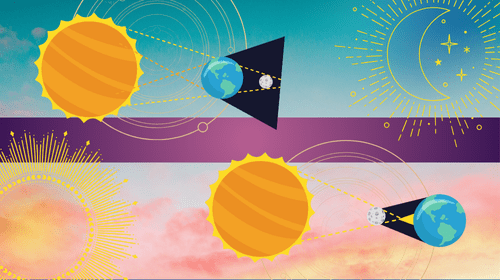
For those who already know, this may be a bit old news, but why do lunar and solar eclipses occur? They occur when the relative positions of the three celestial bodies, the Sun, the Moon, and the Earth, are as follows:
- Lunar eclipse: The Earth blocks the light from the Sun to the Moon
- Sun → (Earth) → Moon
- Solar eclipse: The moon blocks the light from the sun reaching the earth
- Sun → (Moon) → Earth
Since the Earth is larger than the Moon, the Earth's shadow on the Moon often covers the entire Moon, but the Moon's shadow on the Earth only covers a portion of the Earth, so a solar eclipse can only be seen in a limited area.
Why the moon turns red during a total lunar eclipse
During a total lunar eclipse, the moon appears red, which is due to the Earth's atmosphere. Red light, which has a long wavelength, is refracted by the atmosphere and tends to bend around into the Earth's shadow, resulting in the surface of the moon appearing red. The phenomenon of long wavelengths bending around is similar to the phenomenon where light creates a shadow, but sound waves can be heard because they bend around to the back, or where a low-frequency (long wavelength) 800MHz mobile phone is less likely to be out of range because its radio waves can bend around. The reason the moon is red is actually due to a similar mechanism.
The reason we can see a beautiful total solar eclipse is because "now is the miraculous timing"
Also, during a total solar eclipse, we can see the beautiful solar corona, a phenomenon that can only be observed due to the "miraculous timing" when the Moon and the Sun appear to be "almost the same size" as seen from Earth. As the Moon is gradually moving away from Earth, its apparent size will gradually decrease, and in a little while the Moon will no longer be able to completely obscure the Sun, and "only annular solar eclipses will be observable." We are currently living in a "miraculous age" in terms of Earth's solar eclipse.
Please use this as a topic of conversation the next time a lunar eclipse occurs.
Again: Are there really "more eclipses"?
So, I've said that there are actually more solar eclipses than solar eclipses, but some of you may be feeling a bit confused. Next, I'll address that confusion.
I started writing this text with the intention of telling a funny little story, and the story that I expected was "Actually, there are more solar eclipses than lunar eclipses." However, if you ask, "But lunar eclipses are visible in Japan, but solar eclipses aren't, right? If they're not visible, then what's the point?", then you're right.
For example, if your boss asks you, "I think it would be fun to plan a company trip to see a lunar eclipse or a solar eclipse, but which one is more likely to happen in terms of number of people?" and you answer, "A solar eclipse would happen more often," he'll probably get angry and say, "It's pointless if we can't actually see it."
Difficulty in interpreting data (there is more than one way to read data)
This is also a kind of "difficulty in interpreting data" story.
- Prepare data: data on when lunar eclipses will occur, data on when solar eclipses will occur
- Q: Which is more common, lunar eclipses or solar eclipses?
In other words, there is no single answer to this question. The same data can be interpreted differently depending on the context and needs.
If you have been reading this without any sense of discomfort, then you have in fact "read the air and guessed what I am trying to say." In some cases, this "ability to read the air" can lead to assumptions that lead to mistakes. Also, if both "those who see many lunar eclipses" and "those who see many solar eclipses" insist that "we are right," this assumption could lead to arguments.
Or if your boss simply asks you, "Which is more common, lunar eclipses or solar eclipses?", you'll need to confirm the intent behind the question. Or, if you're the boss, asking such a question will turn your subordinate into a "guessing game" for your boss. You can't just tell them to read the mood or figure it out without being told, but you need to clearly explain "why you're asking."
Interpreting the data is actually more difficult
So, if you want to plan a company trip, is it enough to just get data on solar and lunar eclipses that are observable in Japan, copy and paste it, and report it? Actually, that's not the case.
Think about it, even if an observatory says that an eclipse is "observable in Japan," that only means that there is at least one place on Japanese territory where it can be seen. For example, if the solar eclipse could only be seen on an isolated island in the Pacific Ocean, it would be a bit too difficult to "go and see it on a company trip."
You must ask about the "intent of the question." For example, if the question is, "Is it realistic to take a company trip from Tokyo within a few days?", then you lack the data necessary to make a decision, and new data will be needed.
- Additional data required
- The latitude and longitude of the area where the solar eclipse can be seen
- Data necessary for making decisions, such as travel time, transportation costs, and expenses from Tokyo to the area
However, it is unlikely that you will think this far from the beginning. In most cases, while analyzing the data and thinking about what you need to report, you will realize, "Maybe I should check whether it is actually possible to move?"
This means that data analysis may require additional data that you didn't initially think you needed.
- When analyzing and utilizing data, it is easy to realize later that "that data is also necessary," so an environment is needed that allows for the acquisition and use of a wide variety of data as needed.
- Please use our "connecting" technology, which allows you to freely connect to a wide variety of data, IT systems, and cloud services without coding.
It is necessary to check whether there are any oversights, and oversights are common.
For this reason, we also analyzed whether it would be realistic to move the vehicle. But is that really sufficient? People are prone to making mistakes and overlooking things. Taking this into consideration, we need to carefully check whether the plan is "okay."
So I decided to ask other people for their opinions. As I thought, I had overlooked something. Anyone who has actually been looking forward to a lunar eclipse will know that sometimes, "even though it's a wonderful celestial spectacle, you can't see it because the weather is bad." In other words, I realized that I have to be mindful of the weather.
- When analyzing and utilizing data, it is easy to realize later that "that data is also necessary," so an environment is needed that allows for the acquisition and use of a wide variety of data as needed.
- Please use our "connecting" technology.
Although there is no weather forecast for the future, we can at least determine whether a month will have a lot of sunny weather. However, to do this, we need additional data.
If you think about it further, even if the weather is fine at your location, the route may not be suitable. For example, if you were planning to watch the solar eclipse from a remote island, it would be no good if the sea was rough and the route was likely to be blocked.
Just as software testing is essential in software development, it's necessary to check for gaps and omissions, and each time you do, additional data is required. Furthermore, you might also need to consider things like whether you can secure accommodation for the number of people, or if you're traveling abroad, whether the local situation is politically unstable.
- When analyzing and utilizing data, it is easy to realize later that "that data is also necessary," so an environment is needed that allows for the acquisition and use of a wide variety of data as needed.
- Please use our "connecting" technology
"A completely different perspective"
If you answer without thinking, "There are more solar eclipses," it would be inconsiderate, but if you take this much consideration into account when submitting your report, it would be a very thoughtful report.
However, even with this, there are still things that have not been taken into consideration. And what is generally considered an innovative initiative is something that goes beyond the scope of normal consideration. In this case, even in bad weather, you can observe it "as long as you are flying in the sky by plane," so if you take a "tour to watch the solar and lunar eclipse from an airplane," you will no longer have to worry about the weather or location.
People often say things like, "I want new businesses to be created through data analysis," but unless you think about it this much, it may not be possible to say, "A new business has been discovered as a result of the analysis."
- Please use our "connecting" technology to discover unexpected new businesses from unexpected combinations of data and cloud.
Self-service BI
If you have to ask someone or write a request to an engineer to re-collect data or redo the data analysis every time you realize you've overlooked something, notice a related issue that concerns you, or come up with an idea, it will take time and effort and will not go smoothly.
- Can you do this quickly? Come up with an idea → Get the necessary data yourself → Re-analyze the data yourself and quickly understand something new?
In other words, the age of data utilization is an age where you have to do it yourself. That's why people who make decisions, such as managers, are now expected to be able to handle data themselves if possible.
Of course, it is often not realistic for managers to master Python and develop and implement a data analysis system themselves, so it is desirable to create an environment where people on the front lines can do what they need with something they can use themselves.
⇒ Self-service BI (IT self-service) | Glossary
Developing such an environment requires more than just providing a self-service BI tool. This is because the data used for analysis also needs to be prepared. This means that companies need a way to "prepare" the data needed for analysis themselves. Our "connecting" technology, which allows you to connect and bring together a wide variety of data without coding, is essential in such situations.
▼Click here for more information about our "connecting" technology
⇒ HULFT Square a Japanese iPaaS (data integration platform)
⇒ data integration platform DataSpider International
The person who wrote the article