
How the "Four Great Ramen of Niigata" were born ~ "New things" are born from "trial and error"

This is Watanabe from the marketing department.
This is a column that casually writes about various topics related to data, IT, etc.
How "new things" are born
This time, since it's getting cold (it's December as I write this), I thought I'd talk about a topic that will really touch your heart during the cold season: "Niigata's Four Great Ramen."
These days, people often say that we live in an age of uncertainty and change. They also say that we need to take on new challenges and create new things. They also say that it's no good just doing what we're doing now.
So how do successful new things actually come about in the world? That's where the topic of Niigata's four great ramen comes in. They're delicious when eaten during the cold season.
Thinking of new things
When people hear the phrase "thinking about a new business," I feel like there's an image somewhere in the world of a workshop where everyone gets together to come up with creative ideas, or writing a proposal, making a PowerPoint presentation, and somehow managing to explain it while being asked if there are numbers or evidence.
So, what I'm going to write about is whether the majority of new things that have actually appeared in the world are the result of gathering young people together and having them hold workshops using their free ideas, or whether there are many cases where this is not the case (and perhaps this is actually a big hint for us?).
Niigata's "Four Great Ramen"
I'm not an expert on ramen at all, and I don't have much expertise in the subject. Therefore, I've written what I know below (please forgive me). However, even someone like me who isn't that knowledgeable knows that "Niigata has four major ramens," which is a widely known fact in Japan.
If your company wants to come up with a new product, and your new creation becomes widely known in Japan and is called "one of Japan's four great products," I think you can be proud of that as a great success. In other words, for us who want to create something new, I think the "Four Great Ramen of Niigata" can be called a pioneering success story.
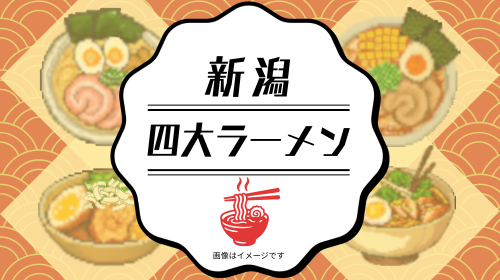
The "Four Great Ramen" specifically refer to local ramen that developed in the following areas of Niigata Prefecture.
- Niigata's "Niigata Light Soy Sauce Ramen"
- Niigata's "Niigata Rich Miso Ramen"
- Tsubame-Sanjo's "Tsubame Back Fat Ramen"
- Nagaoka's "Nagaoka Ginger Soy Sauce Ramen"
"Niigata Light Soy Sauce Ramen"
This ramen is said to have originated in Niigata's old entertainment district, located north of Niigata Station. It is a mild soy sauce ramen with a hint of seafood, and when combined with the thin noodles, it creates a wonderful ramen with a gentle umami flavor.
If I go to Niigata, I always make sure to try this ramen, and in the sense that it is popular with everyone, it could even be said to be the ramen that represents Niigata.
So, how did this mega hit ramen come about? There are various theories, but it seems that it wasn't designed in this way with the intention of making it a big hit.
The reason for the "light and simple flavor" is that, since it was originally a ramen stall, the kitchen was not professional and there was a limit to the amount of heat used, which resulted in the light flavor. Furthermore, the thin noodles were also due to the fact that there was a limit to the amount of heat used, and since it was outdoors, they could not keep customers waiting for a long time.
In other words, the circumstances surrounding the ramen being served at the food stall in Furumachi, Niigata, came first, and the restrictions that forced the business to expand within those restrictions came first. The reality on the ground was that "it is technically difficult to create a rich flavor by cooking noodles thoroughly," and "it's difficult to keep the business going with medium-sized noodles, let alone thick noodles," so it seems that the idea was born out of necessity.
In other words, it seems that this masterpiece ramen was born not from "freely coming up with new business ideas," but from "sincerely struggling with various circumstances" in a "workplace full of realistic constraints and hardships" that is familiar to many of us.
Innovation may not be some far-off idealistic idea, but rather it may be found in the difficult and down-to-earth reality that we struggle with every day.
"Niigata Rich Miso Ramen"
This is also as far as I know, but I've heard that it is a miso ramen that was originally created in a hot spring area in Niigata, inspired by Sapporo ramen. It seems that this was "created as an attempt to create a new product."
It seems that it was created after the chef was impressed by Sapporo ramen, but rather than learning how to make it in Sapporo and trying to recreate the delicious taste, it was created with the desire to create something unique and different by increasing the "richness of the miso."
(Actually, I noticed this after eating this) In Tokyo, when you say rich miso, you probably think of soup that is thick, high in fat, or has a strong flavor or seasoning, but I got the impression that this is what happens when you really "add a lot of miso itself."
For those who find it too salty (I did too), or "to ensure that the richness is strong enough to overwhelm anyone who eats it, even if there are people who think so," a "diluted soup" is served with the dish, which can be added to adjust the strength. Of course, I used the diluted soup.
This is a new product that was "thoughtfully created," but perhaps it became so distinctive that it became a celebrity by being too bold and rejected by some people as being too much. Perhaps this is a lesson that a safe plan that everyone agrees with is no good, and that it has to be something that some people will oppose (this may be the type of initiative that Japanese companies are not good at).
"Tsubame back fat ramen"
This ramen originated in the Tsubame-Sanjo area, which is known nationwide (and perhaps even worldwide) for its advanced metalworking techniques.
It is a unique, rich-tasting ramen with a soy sauce-flavored soup with a strong niboshi (dried sardine) flavor, thick noodles that are sometimes said to be as thick as udon noodles, and most notably, a large amount of back fat that covers the surface. This ramen was apparently developed as a delivery ramen for factory workers in Tsubame-Sanjo.
The soup is thick enough for the factory workers to enjoy, and the custom of eating rice with ramen has become established. The thick noodles are apparently designed to prevent thin noodles from getting soggy when delivered. The large amount of back fat is used to ensure a strong flavor that stands up to the thick noodles, and also helps keep the ramen hot during delivery in the cold Niigata winter. This, too, feels like a result of various circumstances rather than a free pursuit of flavor.
Furthermore, it is standard to have chopped onions (or rock seaweed) on top, but originally it was topped with green onions, but there was a period when prices rose sharply, so they tried using onions as a substitute, and it was so well received that they ended up sticking with onions. This too feels like it happened due to various circumstances on the ground and by chance.
This flavor was born out of various local circumstances, but it is also a ramen that seems to fit the modern era, as more and more restaurants in Tokyo are now serving this ramen. However, this too seems to be a "unique flavor that was born as a result of various local circumstances."
"Nagaoka Ginger Soy Sauce Ramen"
This ramen also originated in Nagaoka city in central Niigata prefecture. It is basically a soy sauce flavored ramen, but it is characterized by its strong ginger taste.
As for why ginger was added, it seems that this was also due to "various circumstances." During the postwar food shortage, ramen using pork bones (tonkotsu) discarded at ham factories and other places appeared all over the country, but when the broth was made from the pork bones, it had a strong porky smell, so "ginger was added to deal with this," and this is how ramen was born.
Ginger was originally a desperate measure to combat the odor, but ginger itself became popular in the area, and people began to add it more willingly, which is how this local flavor was created.
It wasn't just a question of whether adding ginger would make it tasty and give it character, but rather, due to "various circumstances," they decided to add ginger, and what was born became so famous that it is now said that "when you think of ginger-flavored ramen, you think of Nagaoka."
rearranged again
Let me summarize the discussion again. I am writing this based solely on my own understanding (sorry).
- Niigata's "Niigata Light Soy Sauce Ramen"
- It was born out of technical issues surrounding the operation of a food stall in Furumachi, Niigata.
- The "light taste" and "thin noodles" were inevitable due to various circumstances.
- Niigata's "Niigata Rich Miso Ramen"
- This ramen was made with the aim of making "a very strong miso ramen," and after receiving complaints, it was made so strong that it became very distinctive and famous.
- Tsubame-Sanjo's "Tsubame Back Fat Ramen"
- This ramen, made for factory workers in the Tsubame-Sanjo area, reflects the various circumstances surrounding it: rich flavor, thick noodles, and a generous amount of back fat, all served with rice.
- Even onions, which are now a staple, were created due to various circumstances that caused the price of green onions to rise.
- Nagaoka's "Nagaoka Ginger Soy Sauce Ramen"
- Although pork bones were readily available, they had a strong odor, so ginger was used instead.
Niigata's four major ramens are known throughout the country, so if you're thinking, "We have to come up with something new and make it a hit," then achieving this result would be a huge success.
However, rather than "Let's make a hit," I think the origins of unique ramen are more about "what to do about various circumstances." In particular, when it comes to the three ramen that I personally consider the most well-known (excluding Koko Miso), I feel like they were all born out of various circumstances.
How is something new born?
Well, we live in an age where people say things like, "We have to try new things" and "We have to create new products," but rather than being something new, the four major ramen dishes seem to have been born out of "current circumstances."
In other words, it seems that something "new" has been born as a result of tackling issues that are quite familiar to us, such as "what should we do with our daily work?" or "how can we get around the limitations in a way that is creative?" in a reality where there are various problems and adult circumstances.
Now, I'd like you to think about this: if "these types of possibilities" exist, doesn't that mean that even in "our everyday work," there is always hidden potential for innovation that will open up the future?
So, are there any efforts being made to create new things from such possibilities, or to pick up and make use of things that have arisen by chance?
There should be a similar possibility in IT.
I believe that this type of innovation has great potential in IT as well. If the "workplace" is empowered to take the initiative in utilizing IT and come up with ways to resolve "various circumstances," a variety of trial and error processes will surely emerge.
It is important to note that such "on-site innovations" are often not welcomed and are rejected. They are often seen as "on-site doing things on their own" or as a deviation from the company's standard management, and are often labeled "shadow IT" and considered something that should be eliminated.
If we rethink this way of thinking and see what happened as the seeds of innovation, and nurture it as a unique feature, saying "That's great, do more!", wouldn't it turn out to be just like Niigata ramen? I think that such efforts can sometimes lead to a hit that takes a company nationwide.
One of our long-selling products is the file integration middleware HULFT, but I've heard that this was not created through analytical planning, but rather was born from on-site insights into IT system development at a time when mainframes and UNIX were beginning to coexist.
Furthermore, I believe that IT that can be implemented by the "workplace" itself will become "no-code or low-code" IT. Furthermore, in today's climate, it is becoming less common to "create something from scratch" in order to "make better use of IT." I believe that the most realistic ways to utilize IT are to "innovate and use" IT products already installed in the company (such as Excel in the workplace), or "how to effectively combine" cloud services that are suited to on-site use (such as kintone or Salesforce).
In other words, "adapting to various on-site IT circumstances" means devising ways to utilize "existing IT assets" through on-site initiatives using "no-code products," meaning "integrating and combining a wide variety of clouds and data" led by the on-site. Our "DataSpider" and "HULFT Square" are products that are perfectly suited to meet such needs.
When they used pork bones, it smelled bad, so they added ginger.I think that this is because, although they were using Salesforce, they were having some inconveniences, so they created "exactly what was needed on site" separately using kintone, and then "data integration between Salesforce and kintone using DataSpider."
When you think about it, it seems like a long time ago, when Japan was thriving, there were a lot of such free-spirited, energetic "workplaces" all over Japan. It is sometimes said that it is difficult to understand why "data integration" or "iPaaS" are necessary, but in IT, I believe that no-code and "connecting" technologies are absolutely necessary to realize and utilize the free-spirited ingenuity of the worksite.
The person who wrote the article