

"Digital Transformation" Dialogue | Part 1 - DX is a Management Issue (Part 1)
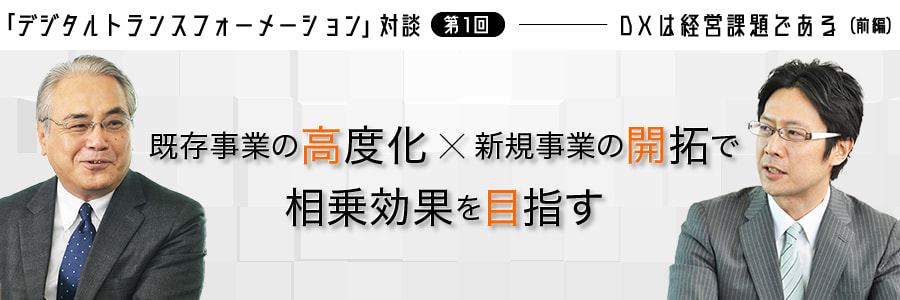
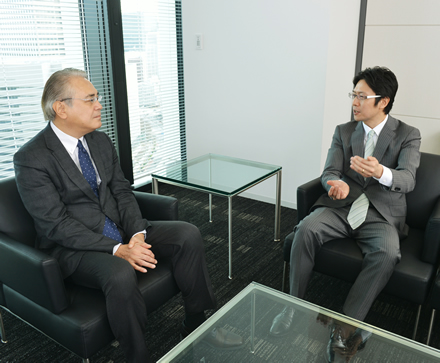
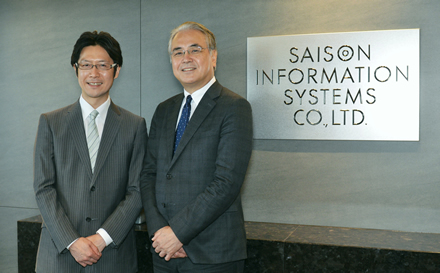
Digital transformation (DX) has been gaining attention in recent years. Against a backdrop of intensifying global competition, business acceleration, and the practical application of AI and IoT, an increasing number of companies are now seriously considering the issue. However, there are many cases where companies fail as a result of becoming fixated on short-term new technologies. Satoshi Uchiyama, Chairman and Executive Analyst at ITR, and Kazutoshi Ono, Technical Advisor at Saison Information Systems, discuss what DX should truly be like from a management perspective.
Four steps to advance digital transformation
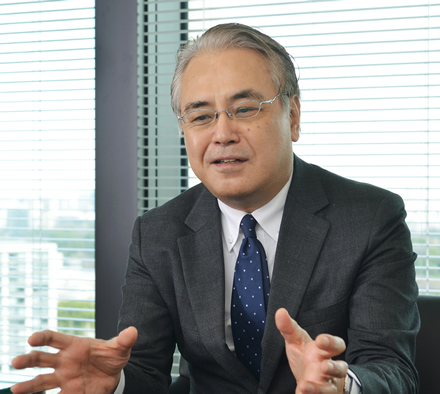
Uchiyama
Until now, awareness and efforts regarding DX have varied considerably between industries, but over the past year to year and a half, I feel that it has spread to managers in a wide range of industries. Not only are there industries that have been aware of change relatively early on, such as finance, which has seen the rise of Fintech, and the automotive industry, which is beginning to move toward a mobility society, but interest is also growing recently in B2B manufacturing and other industries. We are receiving more and more inquiries from customers regarding DX, and one of the most common is when they say, "I've created an organization to promote DX, but I don't know where to start."
There are four steps to advancing DX: "why, where, what, and how." While some companies are at the first stage, asking why it must be done (why), my impression is that many companies understand the "why" but don't know where they should aim (where). The next step is to figure out what specifically needs to be done (what), and finally, what specifically should be done with the current systems, institutions, and people (how)?
However, there are many companies that do not follow these steps in order. Even if they say, "I want to do a PoC right away! I want to use AI!", if they do not follow the steps, they will inevitably end up going back to the way things were, so I tell them to take it one step at a time.
Ono
I listened to you and thought that was absolutely true. Speaking from an engineer's perspective, there is a psychological term called "the hammer and the nails." What I mean is that when new technologies such as AI or blockchain emerge and you become somewhat accustomed to them, it's like you have a hammer in your hand, and everything looks like a nail and you want to hammer it in. Technology comes with the excitement of "Maybe we can do this and that," which is a good thing, but it can also lead to people saying, "Let's do that with AI," or "Let's do that with blockchain." This can lead to people forcing it to be used in places where it's not really necessary.
Uchiyama
Such PoCs seem to have a high probability of failure.
Ono
Yes. On the other hand, success can be achieved when these elements mesh well. For example, the AI speaker "Amazon Echo" is equipped with the voice recognition service "Amazon Alexa." Last year, a development contest for Alexa (the Amazon Alexa Skills Award 2018) was held, where Saison Information Systems entered the competition, winning both the first prize and a special prize among the 365 skills. The winning design supports visually impaired employees working in the company's refreshment room. In the refreshment room, employees receive massages and acupuncture treatments. Previously, staff rotated between tasks like calling the next reservation. With this system, simply saying "Alexa, call the next person" accesses the cloud-based reservation ledger and notifies the reservation holder via Slack or Skype. This system can now handle everything from rescheduling appointments to ordering supplies, providing an environment where employees with disabilities can work independently and proactively. We also plan to adjust the air conditioning in the refreshment room. While this is a small example, I believe it was a success story that successfully addressed why we were using this technology and what we were trying to achieve.
Uchiyama
The story of engineers wanting to use hammers is something that business managers can relate to. They hear that "AI is amazing" and try to incorporate it into their company's operations, but as a result, the workplace is manipulated. However, it seems that over the past year, there has been a growing understanding that this will not work.
DX can be classified into two types
Uchiyama
The term DX encompasses two qualitatively different types of business. One is the effective use of digital technology to enhance existing businesses. For example, this includes the use of IoT and AI at manufacturing sites and construction sites. The other is the creation of entirely new businesses. Both are referred to as "DX."
Both have a similar goal of transforming business, but the methods and approaches are quite different, so you need to decide which one to focus on before you start.It's common for the president to talk about new business while the division manager talks about improving existing businesses, so it's best to start by clarifying the direction.
Currently, organizations for DX are being set up and mid-term business plans are being formulated, but there is still a strong tendency to follow the traditional PDCA cycle. In the case of DX, it would be better to approach it with a so-called digital native culture like a venture, where people are willing to take on new challenges even if it means taking some risks, but I think many companies are too well-behaved and are not taking the plunge.
Ono
To begin with, venture companies don't often talk about DX, because they've been digital from the start. When a non-digital company becomes digital, it becomes "transformation." In that sense, the biggest challenge for so-called large companies is how to advance DX.
Earlier, you mentioned that there are two types of DX, but even if you start a new business, if it is a business that cannot utilize existing strengths, I honestly think that ventures are stronger in that area. I think it is meaningful for large companies to take on DX when they connect it with existing assets such as the trust they have built up, their customer base, and past data.
Uchiyama
The book "The Innovator's Dilemma" was published in 2000 and attracted a lot of attention, and in February of this year, a book called "Ambidextrous Management" was released. It's exactly as you just mentioned, and it discusses how large companies can leverage their strengths in traditional businesses when implementing digital transformation, and how to balance the "deepening" that makes them successful with the "exploration" that takes on new challenges. I felt that this book finally had an easy-to-understand message that could be sent directly to large Japanese companies.
Connecting two modes in a "bimodal" way
Ono
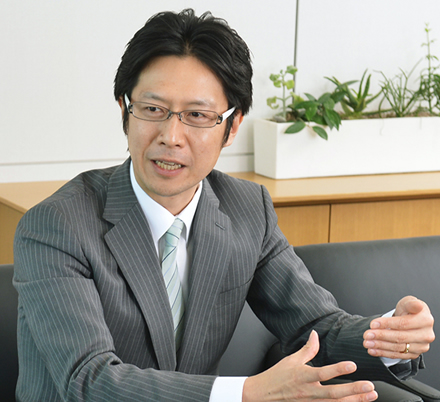
HULFT has been promoting the "bimodal" approach since last year, but I believe cultural integration cannot be achieved in six months or a year. Both "Mode 1," which prioritizes stability and is similar to SoR, and "Mode 2," which prioritizes speed and is similar to SoE, have their own merits. As I mentioned earlier, DX for large companies is meaningless without connecting existing assets and existing data. However, it is unrealistic and undesirable to force everyone to change their approach because "your way of doing things is Mode 1." The stability of Mode 1 is invaluable, and businesses where a single failure could result in a major accident must continue as Mode 1. In particular, data sets held by existing companies often contain personal information, and I would like to ask that these be properly protected as Mode 1. Of course, this data also needs to be connected to new businesses born from DX, but forcing an integration will lead to failure. Each exists independently, and while respecting each other, it is sufficient to connect where necessary. And we are promoting the message that HULFT is one realistic solution for bridging the two.
Uchiyama
When there are Mode 1 and Mode 2, we tend to judge them in terms of superiority or inferiority, or good or bad, but each has its merits, and new businesses undertaken through DX will probably eventually become Mode 1. Rather than continuing with trial and error forever, at a certain stage stability and scalability will become necessary. From now on, corporate management should be such that both modes can teach each other and share their areas of expertise, coexisting together.
Ono
HULFT was originally thought of as software for linking mainframes and UNIX, but I think that when it first came out it was more of an advanced Mode 2 type software.
Uchiyama
I remember that time well, but at the time, open systems were considered very unstable and important systems could not be run on them. In order to make greater use of these systems, there was a need to connect them to traditional, strict mainframes, and HULFT was born to meet this need.
Now, at HULFT, we are promoting the message "ReBORN: Creativity and Challenge," and I feel like the same phenomenon is occurring as it did back then. New opportunities are emerging when "traditional systems," which include Windows, UNIX, and Linux, are connected to edge computing, such as the cloud and IoT, as well as new technologies.
Ono
I believe that HULFT has always been a bridge connecting old and new technologies, including cultural gaps. In a few years, the cloud may also become Mode 1.
There is a lot of talk about DX and digital disruption, and in an age where we need to think about "what needs to be connected now," HULFT 's message of "ReBORN - Creativity and Challenge" may have come at an appropriate time.
List of "Digital Transformation" Dialogues
- "Digital Transformation" Dialogue Part 1 - DX is a Management Issue (Part 1)
- "Digital Transformation" Dialogue Part 1 - DX is a Management Issue (Part 2)