
You cannot survive in an IT environment that cannot adapt to change and speed.
What is "Smart IT" that meets the management goals we should be striving for today?


IT has become an indispensable tool for companies to continue and expand their business. However, when asked whether their internal IT environment is keeping up with the daily changes in globalization, technological advances, politics, economy, society, and so on, many companies would probably say, "Unfortunately, we can't keep up..."
Recently, we often hear comments like the following:
-

-
- Although ERP has been introduced, customization is costly and it is difficult to invest in it.
- We want to improve our company's system, which was developed five years ago, but the person in charge at the time has left the company and we don't know what to do.
- We want to use new services such as cloud services, but we don't have any engineers in-house, so we can't get started.
Even if you want to change your IT environment to keep up with changes in the world and business, you may find yourself in a situation where you are unable to do so due to constraints such as cost and skills. "Smart IT" is the solution to these problems. In this article, we will explain the basic concepts of smart IT and how to achieve it.
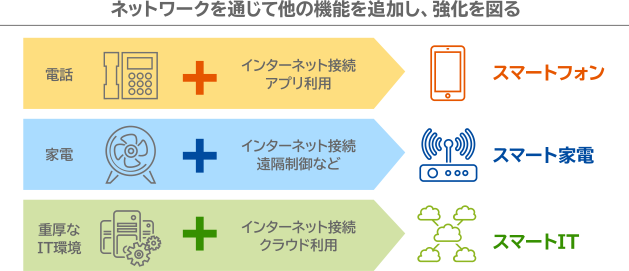
The definition of smart IT is "connecting to a network and adding and enhancing functions."
What does the "smart" in "smart IT" refer to? For example, the "smartphones" that we all use are a more convenient evolution of traditional mobile phones (feature phones) that can connect to the internet and use apps. Recently, terms like "smartwatches," "smart home appliances," and "smart cities" have also emerged, but what they all have in common is that they connect to a network, add other functions, and are continually enhanced.
Returning to the world of IT, in the past, the only way to build an in-house system was to use a packaged product or develop it from scratch. However, recently, many convenient cloud services have appeared, and the use of these services is on the rise. Office 365 and Amazon Web Services (AWS) are prime examples.
At our company, we combine these cloud services to define "smart IT" as "connecting a customer's entire IT environment to a network, adding other functions, and strengthening it," and we believe that the shift to smart IT will accelerate in the future.
The benefits of smart IT for management, the field, and IT departments
Smart IT has many benefits, but here we have summarized them from the perspectives of management, field departments, and information systems departments.
<Benefits for management> Flexible and rapid response to change
Even if you want to change your IT to keep up with changes in the world and business, systems developed in the traditional style take a certain amount of time and money, making it difficult to respond quickly.In fact, there are even cases where existing systems cannot be changed at all due to certain circumstances.
Smart IT can handle situations like these by adding new external functions rather than changing existing systems. Furthermore, by using cloud services as "external functions," not only can you reduce your initial investment, but it's also relatively easy to cancel your contract and switch to another service if your needs change. This allows you to create a system that can respond flexibly and quickly to changes.
Even when integrating the systems of multiple companies through M&A or other means, there are an increasing number of cases where each company's systems are utilized and linked together, rather than creating a single new system for the entire company. This can also be considered an example of smart IT.
<Benefits for field departments> Comprehensive functionality
When realizing smart IT, there are many cases where existing systems are connected to cloud services. Cloud services with a large number of users are specialized in their respective fields, many of them have a wide range of functions, and are constantly being enhanced (updated), so they become more and more convenient as you use them.
If your company already has a system that has been tailored to your business operations, a cloud service with a general configuration may be difficult to use. However, many cloud services are compatible with smartphones and tablets, making them easy to use even when you're out and about. Furthermore, because they can easily be linked with other cloud services, the ease of expanding functionality as needed is also a major benefit for field departments.
<Benefits for the information systems department> Reduction of operational burden
With cloud services used in smart IT, infrastructure and applications are operated by the service provider, which leads to a significant reduction in workload compared to when everything is operated by the in-house information systems department. System maintenance and operation tends to be highly dependent on the individual in charge, but there are cases where outsourcing operations has successfully eliminated this dependency.
The key to successful smart IT is "automated data integration"
Smart IT has many benefits, but one thing that must be considered in order to realize it is "data integration."
For example, if you use a cloud-based expense settlement service,
・Linking internal personnel master data to cloud services
・Integrate expense settlement data from the cloud service into the company's accounting system
This requires "data integration" such as the above. While it is possible to handle this manually by "outputting a CSV file and importing it into the linked system," doing so every time is a significant burden and there is also the risk of operational errors. This is best automated using the power of IT.
However, even if you talk about "automation," if you develop a data integration program for each individual, you will have to develop a dedicated program every time you use a new cloud service. Therefore, we recommend "DataSpider," a data integration platform provided by Saison Information Systems (now Saison Technology). It supports a wide range of systems and services, from applications like SAP to various databases and cloud services, and its unique feature is that it allows data integration without programming. data integration can be easily automated.
-
assignment
I want to (have to) change my IT to keep up with the changing times.
- The cost of change is huge...
- Even if we try to change it, the developer...
- A new technician...
-
move
- No changes to existing systems
- Enhanced functionality with cloud services
- Implementing data integration tool inside and outside the company
-
merit
- Flexible and rapid response to change
- Rich functionality
- Reduced operational burden
Saison Information Systems (now Saison Technology) offers "linkage services" that support smart IT. With products like HULFT and DataSpider that support data integration at their core, we help create new value by connecting internal systems and data with external services and data. If you'd like to take this opportunity to consider this service, please feel free to contact us.
Overview of Linkage Services
The person who wrote the article