
Seeing the "SAP 2027 Problem" as an opportunity to build a foundation for promoting DX

To keep pace with advances in IT technology and changes in the business environment, SAP is currently promoting migration to its next-generation ERP product, SAP S/4HANA (hereafter referred to as S/4HANA). In conjunction with this, the company has also announced that it will end support for SAP ERP in 2027. The underlying reasons for this are challenges such as the need to keep up with exponentially expanding data volumes and business speeds, as well as the burden placed on systems bloated by complex customizations tailored to each business. To address these issues, existing SAP ERP users must transition to S/4HANA and engage in business process reengineering (BPR). Now is the time to position ERP as the foundation (crucial element) for unlocking new possibilities through digital transformation and to undertake BPR while keeping in mind the latest features and services of S/4HANA.
Issue: SAP S/4HANA migration alone cannot solve the problem! Three factors hindering DX promotion
The Ministry of Economy, Trade and Industry's "DX Report," released in 2018 and which drew attention as the "2025 Cliff," lists three factors that hinder DX: "Systems are built by department, making it impossible to utilize data across the entire company," "On-site resistance to reviewing operations," and "Systems becoming complex and black-boxed." In the numerous SAP migration projects in which our company has been involved in data integration, we have actually seen the following issues arise.
Obstacle 1: Data cannot be utilized across the entire company
This situation can be broadly divided into two patterns. One is where all complex business processes are consolidated into an ERP system. While this is the original concept of ERP, every time the business changes, modifications are required to enable the business to do what it wants. The speed of change has been particularly rapid in recent years, making it increasingly difficult to keep up with the cost of ERP modifications. The other is where, rather than consolidating everything into an ERP system, a cloud system suited to the business is introduced and used in conjunction with other systems. In this case, maintaining the master data distributed across each cloud becomes complicated. In either case, modifications and maintenance cannot keep up due to labor and cost issues, and as a result, cross-sectional data utilization becomes impossible.
In many cases, data integration is achieved using EAI or similar technologies, but traditional EAI is an SoR system that prioritizes stability, and there are limits to how quickly it can be modified. In fact, in some cases, adding just one item required coordination with peripheral systems and other necessary development processes, and it took more than two weeks to release. To efficiently advance DX, it is necessary to make this integration part compatible with SoE.
Obstacle 2: Resistance from the field to reviewing operations
In the early stages of an SAP migration project, coordination inevitably arises regarding the impact on existing systems and how modifications should be made, primarily with the ERP. However, resolving problems with existing systems often stalls due to opposition from the field, who are reluctant to review their operations. Since the ERP requirements have already been solidified, we are sometimes approached with the question of whether data integration can somehow bridge the gap and resolve the issue. However, because we lack sufficient information and knowledge about the existing systems, individual adjustments to each system are time-consuming and labor-intensive, and overall optimization is difficult, potentially straying from the original BPR. In the worst case scenario, there is a risk that sufficient overall testing time will be unavailable, making it difficult to ensure quality, or that performance issues or other problems will surface late in the project, causing delays to the release schedule.
Obstacle 3: Systems become complex and black boxes
When various people individually customize a system, it ultimately becomes a black box, leading to various problems in subsequent development and operation. Intuitive and easy-to-understand GUI-based EAI tools help understand the system, but they are not sufficient to eliminate the black box. For example, when comparing the program flows that realize two interfaces using a GUI tool, what if one is arranged vertically and the other is arranged horizontally? Or what if the information attached to the same icon is in English by one developer and in Japanese by another? Depending on how the GUI "appears," something that is essentially the same can appear different, and in the sense that it cannot be properly understood, the black box has not been eliminated.
The above three obstacles are common issues not only in SAP migration but also in promoting DX. The key to resolving these issues is what, when, and how to proceed.
Proposal: An approach to simultaneously achieve SAP S/4HANA migration and digital transformation
Below, we will explain the specific measures (approach) we have derived from our experience supporting our customers in migrating to S/4HANA to achieve both S/4HANA migration and digital transformation simultaneously.
Proposal 1: Complement functions not available in ERP with cloud services and build a flexible SoE-oriented infrastructure
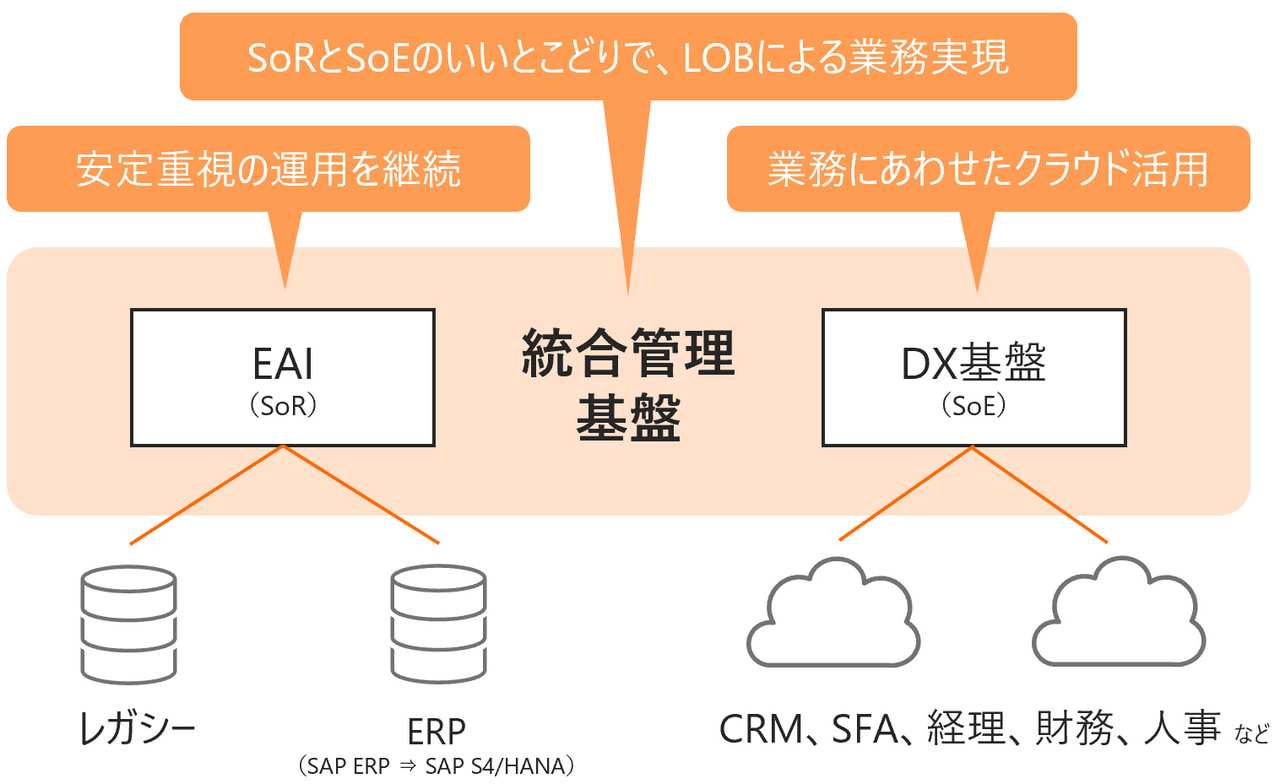
To achieve company-wide data utilization, it is effective to prepare a platform for promoting DX that can start small and flexibly accommodate changes, unlike a robust platform like traditional EAI. Then, use the existing EAI as an integration platform specialized for SoR, and the DX platform as an integration platform specialized for SoE. This allows mission-critical integration with mission-critical system, core system including ERP to continue with stable operation through EAI, while the DX platform enables connection and integration with various clouds tailored to business operations. This approach achieves the best of both SoR and SoE with an integrated management platform that combines EAI and DX platforms.
Realizing a digital transformation platform that responds flexibly to business changes through cloud computing
Suggestion 2: Solidify data integration concept before defining requirements
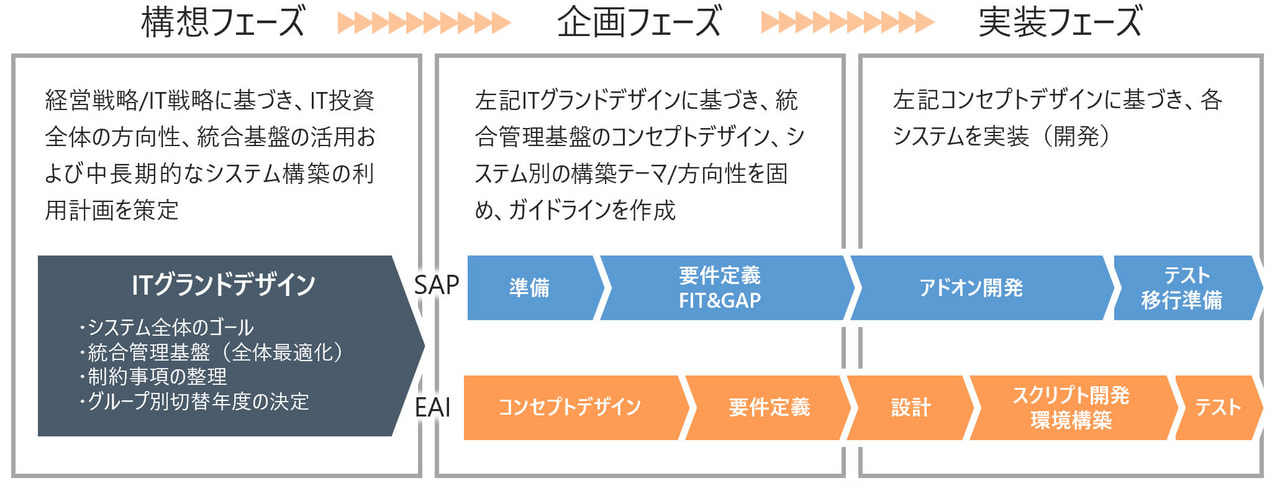
When it comes to resolving problems with existing systems, it's all about solidifying the foundation concept as early as possible. The diagram below illustrates how an actual SAP migration project works. After the concept phase, where consideration is based on the overall management and IT strategy, and the planning phase, where specific plans and requirements are visualized based on the grand design conceived, you arrive at the implementation phase (system development). The key here is to firmly solidify the concept for the foundation (EAI and DX foundation) that will coordinate between systems before defining the requirements. This will allow the subsequent implementation phase to proceed smoothly and prevent the project from being prolonged.
Focusing on the concept prevents projects from becoming protracted
Proposal 3: Shift from centralized management by the IT department to joint promotion with LOB
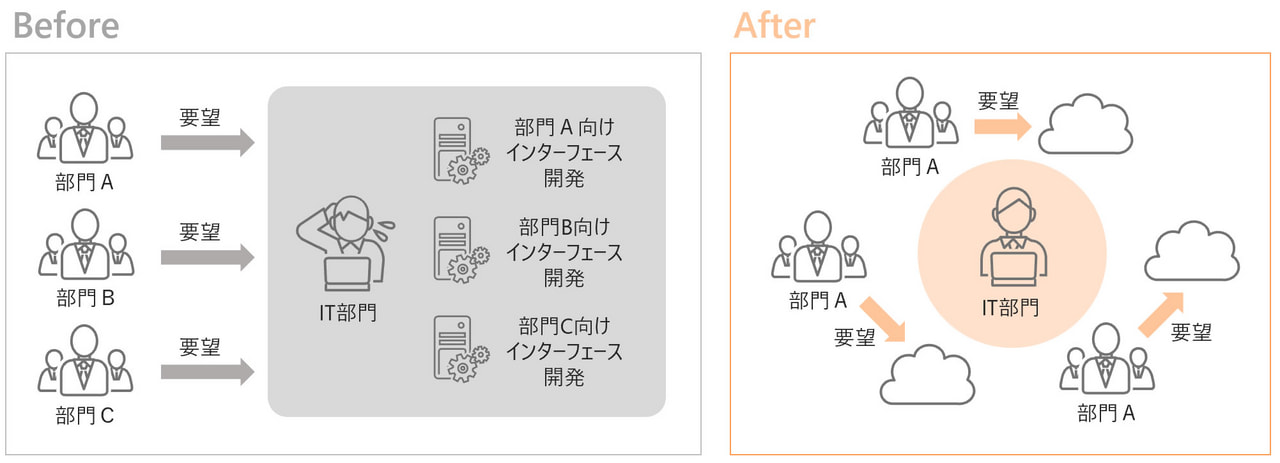
Traditionally, IT departments, which primarily manage SoR such as EAI, have realized safe and secure operations through a centralized system in which IT departments with the authority to make modifications receive requests from LOBs and develop them on a case-by-case basis. In contrast, a DX platform proactively introduces cloud services optimal for business operations, allowing collaborative development with the cloud and business logic to be transferred to the LOBs, and the IT department's primary role becomes preparing and managing the DX platform environment. Furthermore, in an integrated management platform where both systems coexist, it is also necessary to decide whether to fulfill the requests and demands from LOBs on the EAI side or the DX platform. For this reason, IT departments are required to maintain constant communication with LOBs and work together to operate the integrated management platform.
Quickly fulfilling LOB requests through cloud integration
Proposal 4: Standardize data integration through operational and development guidelines
Guidelines that summarize the rules for operating and developing the platform are effective in eliminating complexity and black-boxing. By referring to these, operations staff and LOBs can make appropriate decisions about data integration methods and protocols, rapidly expand, optimize costs, avoid dependency on individuals, and promote reuse. We have prepared standard guidelines based on our extensive experience supporting S/4HANA migrations. We will make proposals that best suit your needs, including consultation services.