

SBI Sumishin Net Bank, Ltd., which is expanding its business as a specialized Internet bank, is promoting the advancement of screening for its foreign currency remittance and receipt services. It is using iPaaS "HULFT Square", available as a cloud service, as data integration platform to realize an advanced screening flow combining multiple no-code tools and generated AI in a short period of time.
Customer Issues
- For foreign currency remittance and receipt services, where strengthening of anti-money laundering, anti-terrorist financing, and anti-proliferation financing measures (hereinafter referred to as "anti-money laundering measures") is required, we would like to establish an advanced screening process within a short period of time.
Benefits of implementation

952 hours per year
Reduce work

In just three months
Advanced screening process

In-house production Therefore,
Continuous improvement activities
It is possible to
To strengthen anti-money laundering measures, more sophisticated screening is required
Established in 2007 as an internet-only bank, SBI Sumishin Net Bank, Ltd. is a leading digital bank leveraging cutting-edge technology. The bank is steadily expanding its business, with total deposit balances exceeding 11 trillion yen in August 2025. It has partnered with partner companies to create a variety of financial services, including the BaaS (Banking as a Service) business, which provides full banking functions including deposits, loans, and payments. With its corporate slogan, "Creating a society where wealth circulates through technology and a spirit of fairness," the bank aims to become a tech company that goes beyond being a bank.
Within this company, the Business Department is responsible for customer contact points such as the Operations Center and Customer Center. The Business Management Group under the Business Department is responsible for resolving issues and managing outsourcing partners within the Business Department, and is currently working to reduce costs by strongly promoting in-house production and the digitalization of paper-based operations.
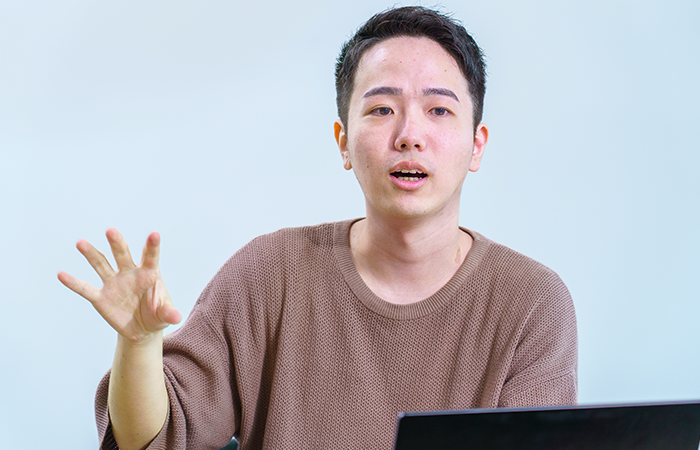
Business Management Group, Business Department
Mr. Takeya Matsumura
"The use of paper creates lead times in interactions with customers, and paper must be stored as evidence. In the event of a disaster, various issues arise, such as the inability to smoothly start business support from other locations if paper-based operations are used. For this reason, we are focusing on in-house development and moving forward with the digitalization of our entire business process," explains Takeya Matsumura of the Business Management Group, Business Department.
Under the Operations Department is the Foreign Exchange Remittance Administration Group, which is responsible for screening the foreign currency remittance and foreign currency receipt services that the company provides. The company provides services to both individuals and corporations, and has long been required to strengthen its system to combat money laundering. "Financial institutions both in Japan and overseas are promoting measures against money laundering, and there has been a demand for more sophisticated screening processes, including the confirmation of evidence at the time of transactions," says Matsumura.
HULFT Square is the optimal solution, enabling integration of various services in a short period of time
In order to improve the screening flow, it was necessary to expand the system, but since the system had been built with a small but elite team, including outsourced parties, it was anticipated that the workload would increase. "Previously, when it came to suspicious transactions, customers would send us documents such as transaction information by email or fax, and we would manually check each time. As the business expanded, if we continued to improve the system with the current environment, it was clear that we would run out of resources. Therefore, we considered creating an environment where advanced screening could be performed with a small number of people by skillfully combining multiple services," said Matsumura.
Furthermore, because financial industry regulations are frequently updated, there was a risk that a large-scale system would quickly become outdated. "We decided that it would be best to release it in a short period of time and then optimize it based on feedback from user departments, and we thought it would be appropriate to combine multiple no-code tools to create the optimal system," says Matsumura.
The functions required for the review included a form for customers to submit documents, AI technology to translate those documents and extract the necessary information, a workflow for conducting the review internally, and a collaboration platform to flexibly connect these various services. "Another department was using Azure OpenAI Service, so we thought we would make use of those resources. While we were using several other no-code tools, we turned our attention to HULFT Square, which can be used as a fully managed iPaaS, as a solution to connect them," says Matsumura.
HULFT Square can be used without the need for server construction and maintenance, so it allows the team to focus on improving operational efficiency. However, there was also concern that overseas iPaaS products have difficult-to-understand manuals, and even if Matsumura was able to set up the system, he would not be able to hand it over to other members. "After actually trying out several solutions, HULFT Square was the one that offered the best operability for designers, who could design and develop scripts using a GUI," he said, praising it for its ease of use.
Furthermore, Saison Technology had already been using DataSpider Servista as the foundation for multiple business operations, such as its customer center, and a sense of trust had been built up within the company, making it easy to gain their understanding. Not only did they offer a wide range of connectors to various solutions, but they also appreciated the high level of compatibility, which not only allowed them to simply connect via API to kintone, which the company was considering using in its workflow, but also allowed them to perform in-depth processing such as retrieving records and adding and updating rows in tables.
Reduced work hours by 952 hours per year and developed an advanced screening process in-house in just three months
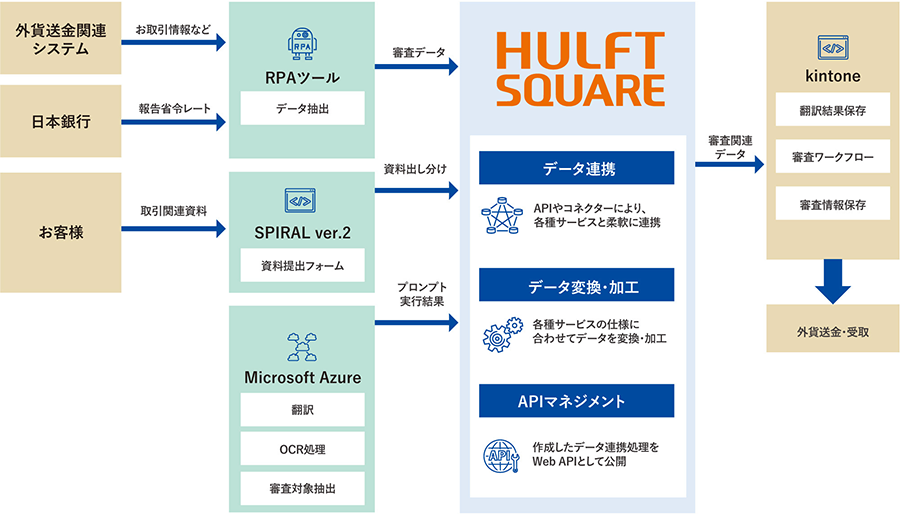
Currently, the same workflow is used for four main tasks: transaction verification for foreign currency remittance and foreign currency receipt services, ongoing customer management for foreign currency remittance services, and interviews for transaction monitoring. These screening workflows are implemented using HULFT Square as a data integration hub, combining the foreign currency remittance-related system for managing customer and transaction information, the no-code tools kintone and SPIRAL ver.2, Azure AI Translation for translation, Azure AI Document Intelligence for OCR processing of PDF documents, and Azure OpenAI Service for identifying screening targets. For solutions without APIs, RPA is used to extract data. For example, the foreign currency receipt service alone is used daily by approximately 12 people.
For example, if a case requiring investigation is discovered in the foreign currency remittance and receipt service, RPA extracts information from the foreign currency remittance-related system and uploads it to kintone. Customers submit documents using a form built on SPIRAL ver. 2. Because documents are submitted in various languages, supplementary screening is performed using AI translation, OCR processing, and information extraction. The final results are then returned to kintone, where a responsible person reviews them. If there are no problems, the foreign currency remittance or receipt is carried out. HULFT Square is used as data integration platform for this system. "For example, SPIRAL ver. 2 allows you to schedule execution by writing code in PHP, but programming is still required, and code written in a short period of time raises concerns about reliability. That's why HULFT Square, with its stable integration capabilities, is so useful," says Matsumura.
By implementing this advanced screening process and utilizing various solutions to improve operational efficiency, the company has achieved an average reduction of 79 hours per month, or 952 hours per year. "Until now, even when documents were sent by fax, we had to manually link them to the transaction, which took time. Now, we can properly retrieve documents linked to the receipt number, which has greatly contributed to improving operational efficiency," says Matsumura. Another major benefit is that the increase in workload due to the advanced screening process has been kept to a minimum, despite the increase in the number of accounts. "We have received many requests from our subcontractors, and by going in-house, we have significantly improved the speed of improvement. Requests that previously would have been too expensive to implement due to the high cost of modifications can now be resolved ourselves without incurring any costs, which is the best thing," says Matsumura.
The implementation took about three months from the start of the project to the transition to the new screening flow, and the script for HULFT Square was created in about three weeks, with ongoing updates and operational improvements. "In order to launch in such a short space of time, we received support from many people within the company regarding the UI and Azure OpenAI Service. We also received generous support from Saison Technology for HULFT Square, and they provided appropriate responses to every inquiry, which allowed us to build it while still learning," Matsumura recalls.
As we increase the number of development members,
High expectations for HULFT Square, including the acceleration of AI utilization
While they will continue to utilize various no-code tools, they will need to integrate them with peripheral services for tasks that cannot be completed using only those tools. For this reason, they continue to have high hopes for HULFT Square. "We haven't made any concrete progress yet, but as the use of AI accelerates, there should be more situations where we can make use of HULFT Square. The services we can choose from will vary depending on the requirements, but by utilizing HULFT Square, we would like to be able to flexibly integrate them," said Matsumura. Furthermore, for mission-critical areas that need to be controlled in-house, they will continue to use DataSpider Servista, which can be used on-premise.
Matsumura also said that he would like to work on creating a system that can make improvements to various business issues by training developers, such as by expanding the scope of use and increasing the number of members who can create scripts.
- Microsoft Azure, Azure AI Translation, Azure AI Document Intelligence, and Azure OpenAI Service are either registered trademarks or trademarks of Microsoft Corporation and/or its affiliates in the United States and/or other countries.
- kintone is a registered trademark of Cybozu, Inc.
- SPIRAL is a registered trademark of Spiral Corporation.
- Sumishin SBI Net Bank, Ltd. is the company name at the time of the interview. The company is scheduled to change its name to Docomo SMTB Net Bank, Inc. on August 3, 2026. The contents of this case study are subject to change without notice.
Recommended Content

Sumishin SBI Net Bank, Ltd.
- Head office location: 3-2-1 Roppongi, Minato-ku, Tokyo
- Established: June 1986 (Banking business license obtained: September 2007)
- Capital: 31 billion yen
- Business: Digital bank business, mortgage loan business, BaaS business
- The content of this case study is current as of the time of the interview. The content of this case study may change without notice.